Münzel Thomas, Sørensen Mette, Gori Tommaso, Schmidt Frank P, Rao Xiaoquan, Brook Frank R, Chen Lung Chi, Brook Robert D, Rajagopalan Sanjay
Center for Cardiology, Cardiology I, Angiology and Intensive Care Medicine, University Medical Center Mainz and Deutsches Zentrum für Herz und Kreislauf Forschung, Standort Rhein-Main, Germany.
Danish Cancer Society Research Center, Copenhagen, Denmark.
Eur Heart J. 2017 Feb 21;38(8):557-564. doi: 10.1093/eurheartj/ehw294.
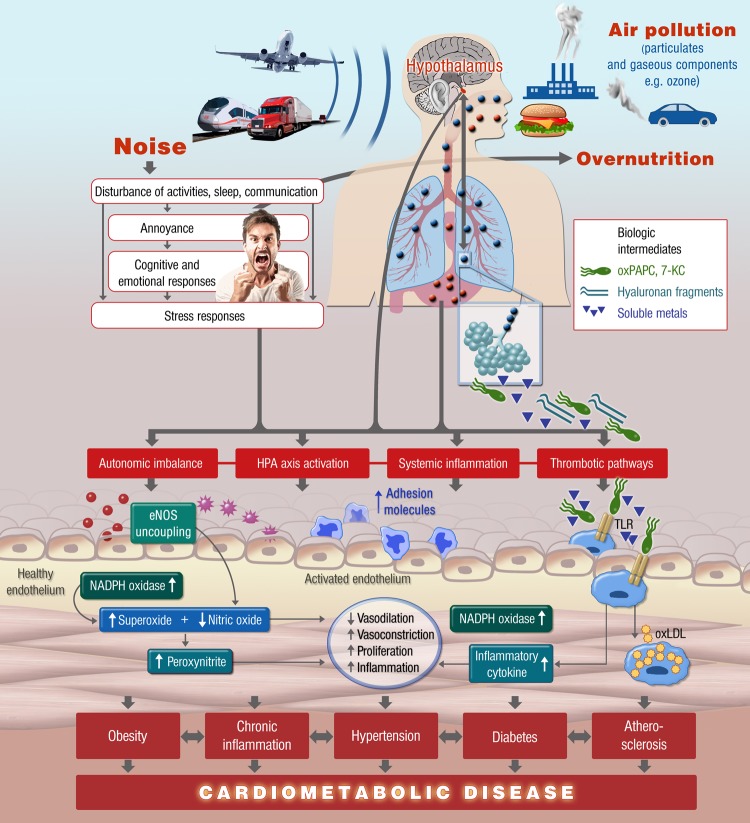
Environmental factors can act as facilitators of chronic non-communicable diseases. Ambient noise and air pollution collectively outrank all other environmental risk factors in importance, contributing to over 75% of the disease and disability burden associated with known environmental risk factors. In the first part of this review, we discussed the global burden and epidemiologic evidence supporting the importance of these novel risk factors as facilitators of cardiometabolic disease. In this part, we will discuss pathophysiological mechanisms responsible for noise and air pollution-mediated effects. Akin to traditional cardiovascular risk factors, a considerable body of evidence suggests that these environmental agents induce low-grade inflammation, oxidative stress, vascular dysfunction, and autonomic nervous system imbalance, thereby facilitating the development of diseases such as hypertension and diabetes. Through their impact on traditional risk factors and via additional novel mechanisms, environmental risk factors may have much larger impact on cardiovascular events than currently appreciated. In the second part of this review, we discuss deficiencies and gaps in knowledge and opportunities for new research.
环境因素可能成为慢性非传染性疾病的促发因素。环境噪声和空气污染共同在所有其他环境风险因素中占据最重要地位,导致与已知环境风险因素相关的疾病和残疾负担超过75%。在本综述的第一部分,我们讨论了全球负担以及支持这些新风险因素作为心血管代谢疾病促发因素重要性的流行病学证据。在这一部分,我们将讨论噪声和空气污染介导效应的病理生理机制。与传统心血管风险因素类似,大量证据表明,这些环境因素会引发低度炎症、氧化应激、血管功能障碍和自主神经系统失衡,从而促进高血压和糖尿病等疾病的发展。通过对传统风险因素的影响以及其他新机制,环境风险因素对心血管事件的影响可能比目前所认识到的要大得多。在本综述的第二部分,我们将讨论知识方面的不足和差距以及新研究的机会。