Child Psychiatry Service, Massachusetts General Hospital, 55 Fruit St, YAW 6A, Boston, MA 02114.
Pediatric Psychopharmacology Program, Division of Child Psychiatry, Massachusetts General Hospital, Boston.
J Clin Psychiatry. 2016 Jul;77(7):940-7. doi: 10.4088/JCP.14m09559.
The nonmedical use of stimulants (misuse) in the college setting remains of utmost public health and clinical concern. The objective of this study was to evaluate comprehensively the characteristics of college students who misused stimulants, attending to rates of attention-deficit/hyperactivity disorder (ADHD), other psychopathology, and substance use disorders.
The data presented are from a cross-sectional study of college students who misused prescription stimulant medications (not including cocaine or methamphetamine) and controls (college students without stimulant misuse). Between May 2010 and May 2013, college students were assessed blindly for psychopathology and substance use disorder by way of Structured Clinical Interview for DSM-IV-TR Axis I Disorders, Research Version, Patient Edition (SCID-I/P) and completion of self-report questionnaires.
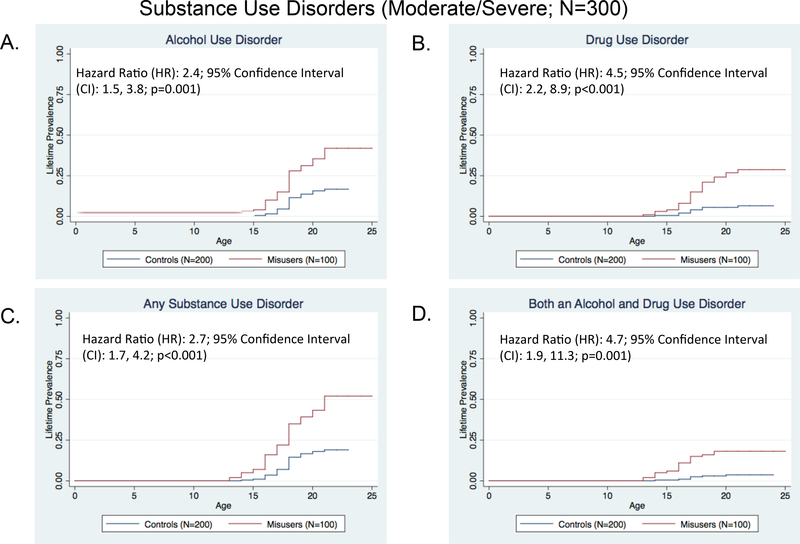
The analysis included 198 controls (mean ± SD age = 20.7 ± 2.6 years) and 100 stimulant misusers (20.7 ± 1.7 years). Misusers, when compared to controls, were more likely to endorse alcohol, drug, alcohol + drug, and any substance use disorder (all P values < .01). When a subset of stimulant misusers (n = 58) was examined, 67% had a full or subthreshold prescription stimulant use disorder. Misusers also had higher rates of conduct disorder (10% vs 3%; P = .02) and ADHD (including subthreshold cases; 27% vs 16%; P = .02) in addition to lower Global Assessment of Functioning score (P < .01). Higher rates of misuse of immediate-release—relative to extended-release—stimulants were reported.
Our data suggest that, compared to controls, college students who misuse stimulant medications are more likely to have ADHD, conduct disorder, stimulant and other substance use disorder, and overall dysfunction.
大学生中非医疗用途的兴奋剂(滥用)仍然是公共卫生和临床最关注的问题。本研究的目的是全面评估滥用兴奋剂的大学生的特征,关注注意力缺陷/多动障碍(ADHD)、其他精神病理学和物质使用障碍的发生率。
本研究的数据来自一项横断面研究,研究对象为滥用处方兴奋剂药物(不包括可卡因或冰毒)的大学生和对照组(无兴奋剂滥用的大学生)。在 2010 年 5 月至 2013 年 5 月期间,通过 DSM-IV-TR 轴 I 障碍研究版定式临床访谈,患者版(SCID-I/P)和自我报告问卷对大学生进行精神病理学和物质使用障碍的盲法评估。
分析包括 198 名对照者(平均±SD 年龄=20.7±2.6 岁)和 100 名兴奋剂滥用者(20.7±1.7 岁)。与对照组相比,滥用者更有可能出现酒精、药物、酒精+药物和任何物质使用障碍(所有 P 值均<0.01)。当检查一组兴奋剂滥用者(n=58)时,67%的人有完全或亚阈值处方兴奋剂使用障碍。滥用者还报告了更高的品行障碍率(10%比 3%;P=0.02)和 ADHD(包括亚阈值病例;27%比 16%;P=0.02),以及更低的总体功能评估分数(P<0.01)。报告的即时释放剂与延长释放剂相比,滥用率更高。
与对照组相比,滥用兴奋剂药物的大学生更有可能患有 ADHD、品行障碍、兴奋剂和其他物质使用障碍以及整体功能障碍。