Omenn Gilbert S, Lane Lydie, Lundberg Emma K, Beavis Ronald C, Overall Christopher M, Deutsch Eric W
Department of Computational Medicine and Bioinformatics, University of Michigan , 100 Washtenaw Avenue, Ann Arbor, Michigan 48109-2218, United States.
CALIPHO Group, SIB Swiss Institute of Bioinformatics and Department of Human Protein Science, University of Geneva , CMU, Michel-Servet 1, 1211 Geneva 4, Switzerland.
J Proteome Res. 2016 Nov 4;15(11):3951-3960. doi: 10.1021/acs.jproteome.6b00511. Epub 2016 Sep 20.
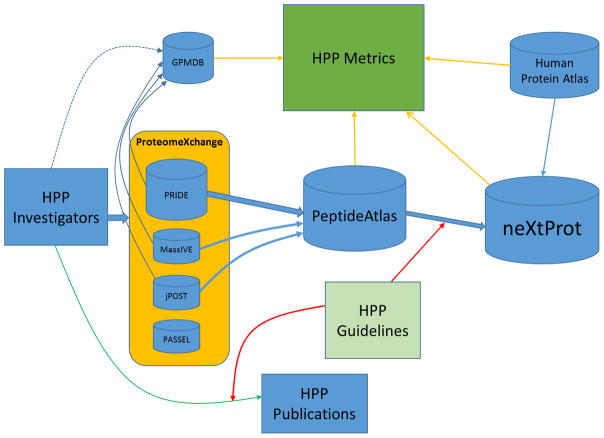
The HUPO Human Proteome Project (HPP) has two overall goals: (1) stepwise completion of the protein parts list-the draft human proteome including confidently identifying and characterizing at least one protein product from each protein-coding gene, with increasing emphasis on sequence variants, post-translational modifications (PTMs), and splice isoforms of those proteins; and (2) making proteomics an integrated counterpart to genomics throughout the biomedical and life sciences community. PeptideAtlas and GPMDB reanalyze all major human mass spectrometry data sets available through ProteomeXchange with standardized protocols and stringent quality filters; neXtProt curates and integrates mass spectrometry and other findings to present the most up to date authorative compendium of the human proteome. The HPP Guidelines for Mass Spectrometry Data Interpretation version 2.1 were applied to manuscripts submitted for this 2016 C-HPP-led special issue [ www.thehpp.org/guidelines ]. The Human Proteome presented as neXtProt version 2016-02 has 16,518 confident protein identifications (Protein Existence [PE] Level 1), up from 13,664 at 2012-12, 15,646 at 2013-09, and 16,491 at 2014-10. There are 485 proteins that would have been PE1 under the Guidelines v1.0 from 2012 but now have insufficient evidence due to the agreed-upon more stringent Guidelines v2.0 to reduce false positives. neXtProt and PeptideAtlas now both require two non-nested, uniquely mapping (proteotypic) peptides of at least 9 aa in length. There are 2,949 missing proteins (PE2+3+4) as the baseline for submissions for this fourth annual C-HPP special issue of Journal of Proteome Research. PeptideAtlas has 14,629 canonical (plus 1187 uncertain and 1755 redundant) entries. GPMDB has 16,190 EC4 entries, and the Human Protein Atlas has 10,475 entries with supportive evidence. neXtProt, PeptideAtlas, and GPMDB are rich resources of information about post-translational modifications (PTMs), single amino acid variants (SAAVSs), and splice isoforms. Meanwhile, the Biology- and Disease-driven (B/D)-HPP has created comprehensive SRM resources, generated popular protein lists to guide targeted proteomics assays for specific diseases, and launched an Early Career Researchers initiative.
人类蛋白质组组织(HUPO)的人类蛋白质组计划(HPP)有两个总体目标:(1)逐步完成蛋白质部件清单——人类蛋白质组草图,包括从每个蛋白质编码基因中可靠地鉴定和表征至少一种蛋白质产物,并越来越重视这些蛋白质的序列变异、翻译后修饰(PTM)和剪接异构体;(2)使蛋白质组学在整个生物医学和生命科学领域成为基因组学的综合对应物。PeptideAtlas和GPMDB使用标准化方案和严格的质量过滤器重新分析通过ProteomeXchange获得的所有主要人类质谱数据集;neXtProt整理并整合质谱数据和其他研究结果,以呈现最新的人类蛋白质组权威汇编。《HPP质谱数据解读指南》第2.1版应用于提交给2016年由C-HPP主导的这一特刊的稿件[www.thehpp.org/guidelines]。以neXtProt 2016 - 02版本呈现的人类蛋白质组有16518个可靠的蛋白质鉴定结果(蛋白质存在[PE]水平1),高于2012 - 12时的13664个、2013 - 09时的15646个以及2014 - 10时的16491个。有485种蛋白质在2012年的《指南》v1.0下本应是PE1,但由于商定的更严格的《指南》v2.0以减少假阳性,现在证据不足。neXtProt和PeptideAtlas现在都要求两个非嵌套、唯一映射(蛋白型)的至少9个氨基酸长度的肽段。作为提交给《蛋白质组研究杂志》第四届年度C-HPP特刊稿件的基线,有2949种缺失蛋白质(PE2 + 3 + 4)。PeptideAtlas有14629个标准(加上1187个不确定和1755个冗余)条目。GPMDB有16190个EC4条目,人类蛋白质图谱有10475个有支持证据的条目。neXtProt、PeptideAtlas和GPMDB是关于翻译后修饰(PTM)、单氨基酸变异(SAAVS)和剪接异构体的丰富信息资源。同时,生物学和疾病驱动(B/D)-HPP创建了全面的SRM资源,生成了流行的蛋白质列表以指导针对特定疾病的靶向蛋白质组学分析,并发起了一项早期职业研究人员倡议。