Soma Takehisa, Matsubayashi Makoto, Sasai Kazumi
Veterinary Diagnostic Laboratory, Marupi Lifetech Co., Ltd., 103 Fushiocho, Ikeda, Osaka 563-0011, Japan.
J Vet Med Sci. 2016 Dec 1;78(11):1731-1735. doi: 10.1292/jvms.16-0217. Epub 2016 Aug 2.
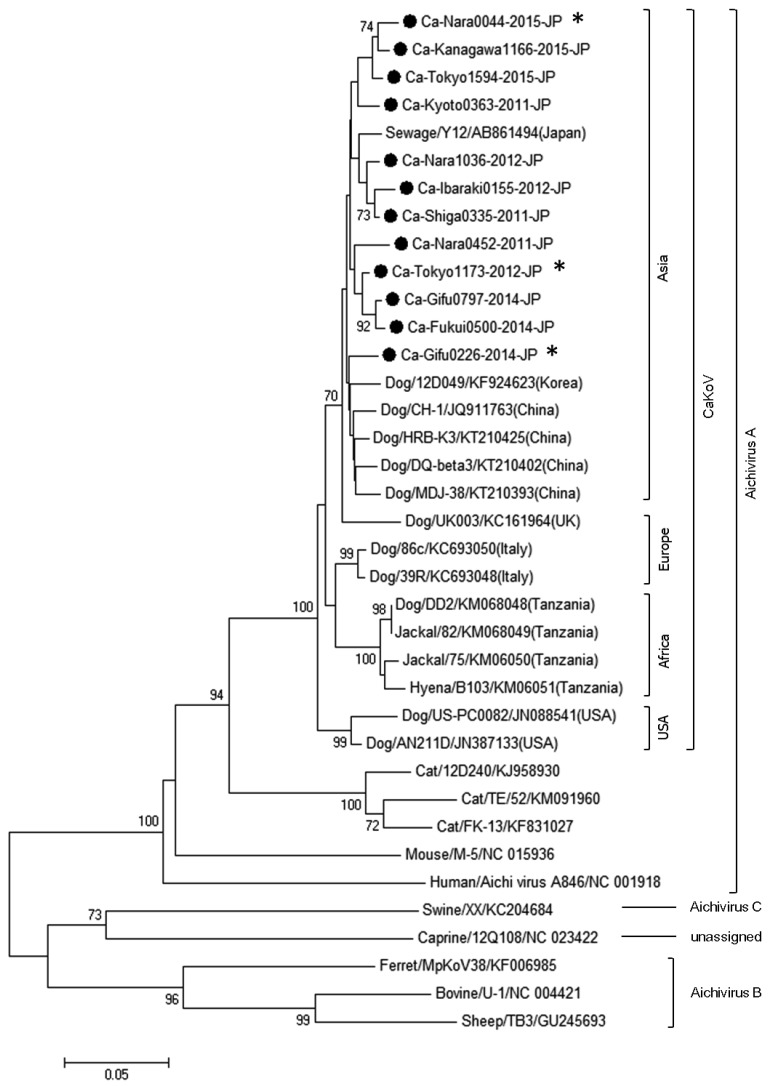
To investigate whether kokuvirus is present in Japanese dogs, we examined the fecal samples obtained from 94 diarrheal household dogs and 50 clinically healthy kenneled dogs by RT-PCR. The gene was detected in 37.2% and 48.0% in the former and the latter, respectively, suggesting that canine kobuvirus (CaKoV) is circulating among Japanese dogs. From the result of the latter, however, CaKoV may not be a primary pathogen. Furthermore, all gene-positive dogs were purebreds aged four months or younger. This finding suggests that CaKoV endemic is confined in multi-dog environments, and the dogs have a strong age-dependent resistance to CaKoV.
为调查日本犬是否存在杯状病毒,我们通过逆转录聚合酶链反应(RT-PCR)检测了从94只腹泻家养犬和50只临床健康的犬舍犬采集的粪便样本。该基因在前一组和后一组中的检出率分别为37.2%和48.0%,这表明犬杯状病毒(CaKoV)在日本犬中传播。然而,从后一组的结果来看,CaKoV可能不是主要病原体。此外,所有基因阳性犬均为4个月及以下的纯种犬。这一发现表明,CaKoV地方性流行局限于多犬环境中,并且犬对CaKoV具有很强的年龄依赖性抵抗力。