Woodrow Charles J, White Nicholas J
Mahidol-Oxford Tropical Medicine Research Unit, Faculty of Tropical Medicine, Mahidol University, 420/6, Rajvithi Road, Bangkok 10400, Thailand.
Mahidol-Oxford Tropical Medicine Research Unit, Faculty of Tropical Medicine, Mahidol University, 420/6, Rajvithi Road, Bangkok 10400, Thailand
FEMS Microbiol Rev. 2017 Jan;41(1):34-48. doi: 10.1093/femsre/fuw037. Epub 2016 Sep 8.
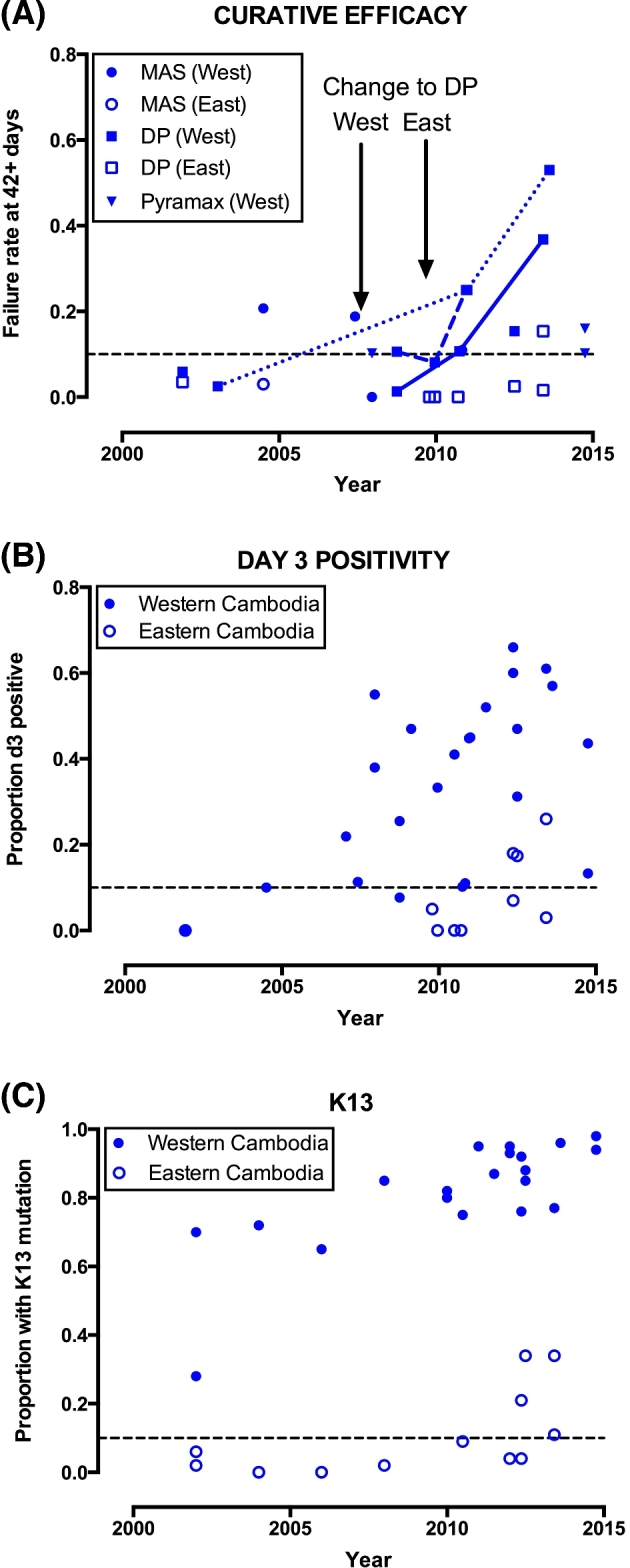
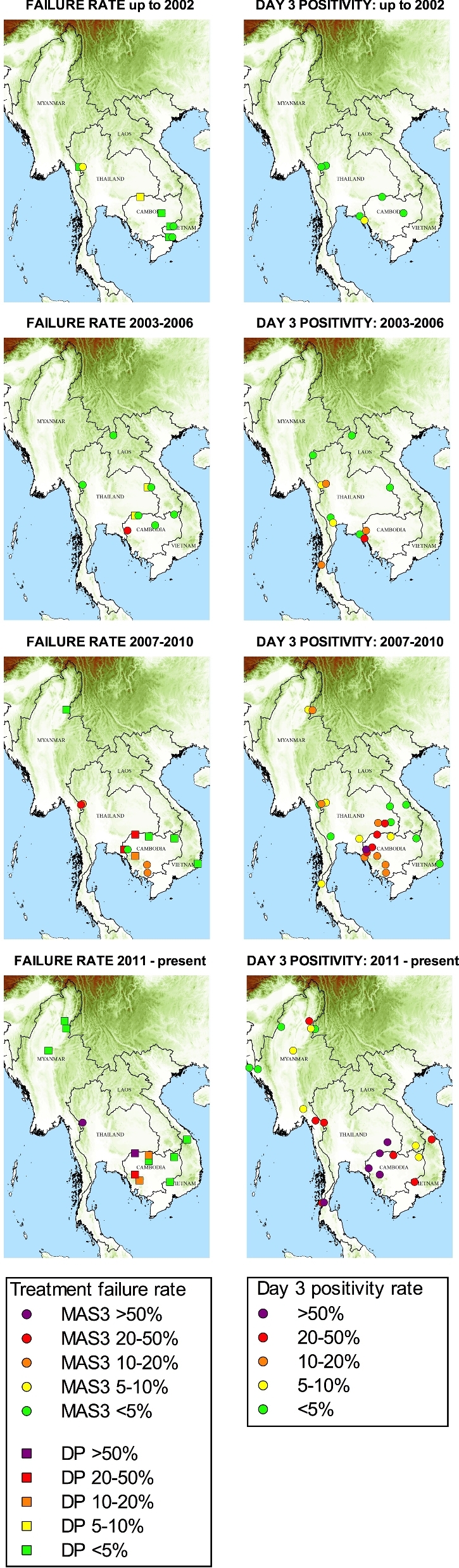
Artemisinins are the most rapidly acting of currently available antimalarial drugs. Artesunate has become the treatment of choice for severe malaria, and artemisinin-based combination therapies (ACTs) are the foundation of modern falciparum malaria treatment globally. Their safety and tolerability profile is excellent. Unfortunately, Plasmodium falciparum infections with mutations in the 'K13' gene, with reduced ring-stage susceptibility to artemisinins, and slow parasite clearance in patients treated with ACTs, are now widespread in Southeast Asia. We review clinical efficacy data from the region (2000-2015) that provides strong evidence that the loss of first-line ACTs in western Cambodia, first artesunate-mefloquine and then DHA-piperaquine, can be attributed primarily to K13 mutated parasites. The ring-stage activity of artemisinins is therefore critical for the sustained efficacy of ACTs; once it is lost, rapid selection of partner drug resistance and ACT failure are inevitable consequences. Consensus methods for monitoring artemisinin resistance are now available. Despite increased investment in regional control activities, ACTs are failing across an expanding area of the Greater Mekong subregion. Although multiple K13 mutations have arisen independently, successful multidrug-resistant parasite genotypes are taking over and threaten to spread to India and Africa. Stronger containment efforts and new approaches to sustaining long-term efficacy of antimalarial regimens are needed to prevent a global malaria emergency.
青蒿素类药物是目前可用的抗疟药物中起效最快的。青蒿琥酯已成为重症疟疾的首选治疗药物,以青蒿素为基础的联合疗法(ACTs)是全球现代恶性疟治疗的基础。它们的安全性和耐受性极佳。不幸的是,在东南亚,具有“K13”基因突变、对青蒿素的环状体期敏感性降低且接受ACTs治疗的患者体内寄生虫清除缓慢的恶性疟原虫感染现已广泛存在。我们回顾了该地区(2000 - 2015年)的临床疗效数据,这些数据有力地证明了柬埔寨西部一线ACTs(先是青蒿琥酯 - 甲氟喹,后是双氢青蒿素 - 哌喹)失效主要可归因于K13基因突变的寄生虫。因此,青蒿素的环状体期活性对于ACTs的持续疗效至关重要;一旦丧失,必然会迅速出现对联合用药的耐药性选择,ACTs治疗失败也将随之而来。目前已有监测青蒿素耐药性的共识方法。尽管对区域防控活动的投入增加,但在大湄公河次区域不断扩大的地区,ACTs治疗正在失效。尽管多个K13基因突变是独立出现的,但成功的多重耐药寄生虫基因型正在占据主导地位,并有可能蔓延至印度和非洲。需要采取更强有力的遏制措施以及维持抗疟治疗方案长期疗效的新方法,以防止全球疟疾紧急情况的发生。