Lisko Joseph G, Lee Grace E, Kimbrell J Brett, Rybak Michael E, Valentin-Blasini Liza, Watson Clifford H
Tobacco and Volatiles Branch, Division of Laboratory Sciences, National Center for Environmental Health, Centers for Disease Control and Prevention, Atlanta, GA.
Tobacco and Volatiles Branch at the Centers for Disease Control and Prevention, Battelle Memorial Institute, Columbus, OH.
Nicotine Tob Res. 2017 Apr 1;19(4):484-492. doi: 10.1093/ntr/ntw192.
Most electronic cigarettes (e-cigarettes) contain a solution of propylene glycol/glycerin and nicotine, as well as flavors. E-cigarettes and their associated e-liquids are available in numerous flavor varieties. A subset of the flavor varieties include coffee, tea, chocolate, and energy drink, which, in beverage form, are commonly recognized sources of caffeine. Recently, some manufacturers have begun marketing e-liquid products as energy enhancers that contain caffeine as an additive.
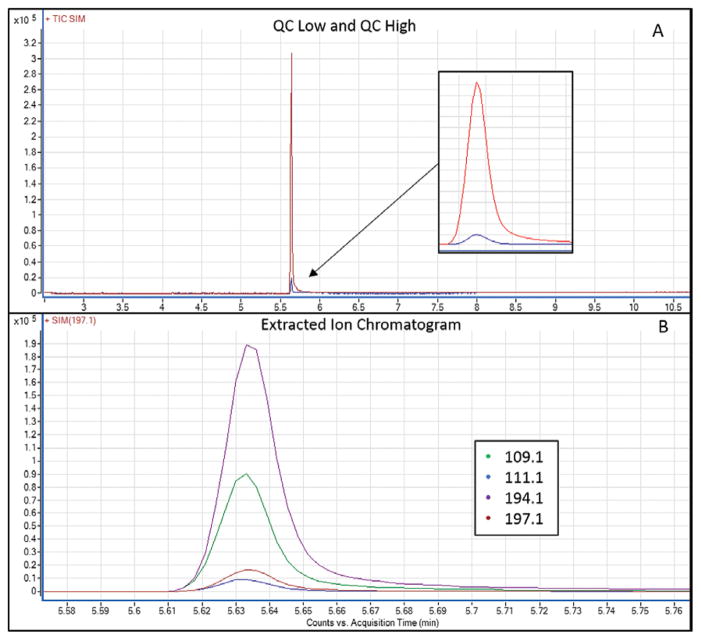
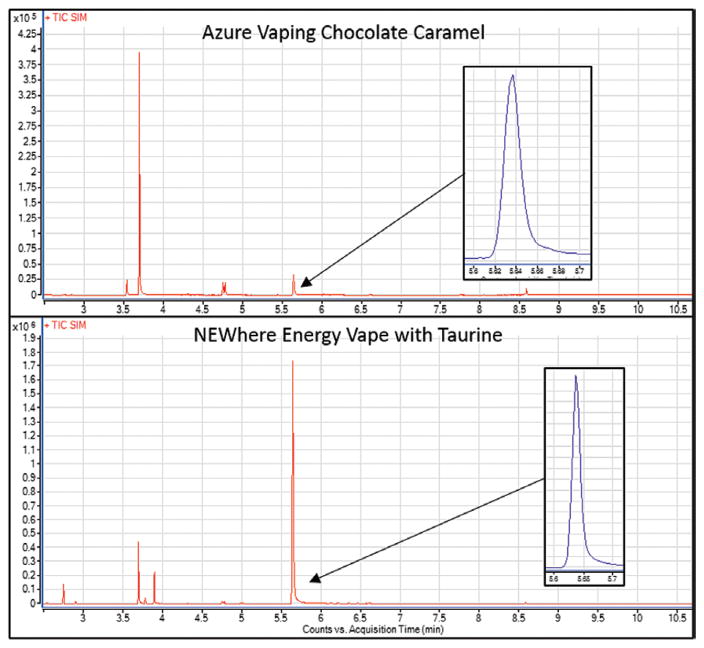
A Gas Chromatography-Mass Spectrometry (GC-MS) method for the quantitation of caffeine in e-liquids was developed, optimized and validated. The method was then applied to assess caffeine concentrations in 44 flavored e-liquids from cartridges, disposables, and refill solutions. Products chosen were flavors traditionally associated with caffeine (ie, coffee, tea, chocolate, and energy drink), marketed as energy boosters, or labeled as caffeine-containing by the manufacturer.
Caffeine was detected in 42% of coffee-flavored products, 66% of tea-flavored products, and 50% of chocolate-flavored e-liquids (limit of detection [LOD] - 0.04 µg/g). Detectable caffeine concentrations ranged from 3.3 µg/g to 703 µg/g. Energy drink-flavored products did not contain detectable concentrations of caffeine. Eleven of 12 products marketed as energy enhancers contained caffeine, though in widely varying concentrations (31.7 µg/g to 9290 µg/g).
E-liquid flavors commonly associated with caffeine content like coffee, tea, chocolate, and energy drink often contained caffeine, but at concentrations significantly lower than their dietary counterparts. Estimated daily exposures from all e-cigarette products containing caffeine were much less than ingestion of traditional caffeinated beverages like coffee.
This study presents an optimized and validated method for the measurement of caffeine in e-liquids. The method is applicable to all e-liquid matrices and could potentially be used to ensure regulatory compliance for those geographic regions that forbid caffeine in e-cigarette products. The application of the method shows that caffeine concentrations and estimated total caffeine exposure from e-cigarette products is significantly lower than oral intake from beverages. However, because very little is known about the effects of caffeine inhalation, e-cigarette users should proceed with caution when using caffeine containing e-cigarette products. Further research is necessary to determine associated effects from inhaling caffeine.
大多数电子烟含有丙二醇/甘油和尼古丁溶液以及调味剂。电子烟及其相关的电子烟液有多种口味。其中一部分口味包括咖啡、茶、巧克力和能量饮料,这些在饮料形式中是常见的咖啡因来源。最近,一些制造商开始将含有咖啡因作为添加剂的电子烟液产品作为能量增强剂进行营销。
开发、优化并验证了一种用于定量电子烟液中咖啡因的气相色谱 - 质谱(GC - MS)方法。然后将该方法应用于评估来自烟弹、一次性电子烟和补充液的44种调味电子烟液中的咖啡因浓度。所选产品为传统上与咖啡因相关的口味(即咖啡、茶、巧克力和能量饮料),被营销为能量增强剂或制造商标注含有咖啡因。
在42%的咖啡味产品、66%的茶味产品和50%的巧克力味电子烟液中检测到咖啡因(检测限[LOD] - 0.04μg/g)。可检测到的咖啡因浓度范围为3.3μg/g至703μg/g。能量饮料味产品未检测到可检测浓度的咖啡因。12种作为能量增强剂营销的产品中有11种含有咖啡因,但其浓度差异很大(31.7μg/g至9290μg/g)。
通常与咖啡因含量相关的电子烟液口味如咖啡、茶、巧克力和能量饮料通常含有咖啡因,但浓度明显低于其对应的食品。所有含咖啡因的电子烟产品的估计每日摄入量远低于饮用传统含咖啡因饮料如咖啡的摄入量。
本研究提出了一种用于测量电子烟液中咖啡因的优化且经过验证的方法。该方法适用于所有电子烟液基质,并可能用于确保那些禁止电子烟产品中含有咖啡因的地理区域的法规合规性。该方法的应用表明,电子烟产品中的咖啡因浓度和估计的总咖啡因摄入量明显低于饮料的口服摄入量。然而,由于对吸入咖啡因的影响知之甚少,电子烟使用者在使用含咖啡因的电子烟产品时应谨慎行事。有必要进行进一步研究以确定吸入咖啡因的相关影响。