Wen Frank, Bedford Trevor, Cobey Sarah
Department of Ecology and Evolution, University of Chicago, 1101 East 57th Street, Chicago, IL 60637, USA
Vaccine and Infectious Disease Division, Fred Hutchinson Cancer Research Center, Seattle, WA, USA.
Proc Biol Sci. 2016 Sep 14;283(1838). doi: 10.1098/rspb.2016.1312.
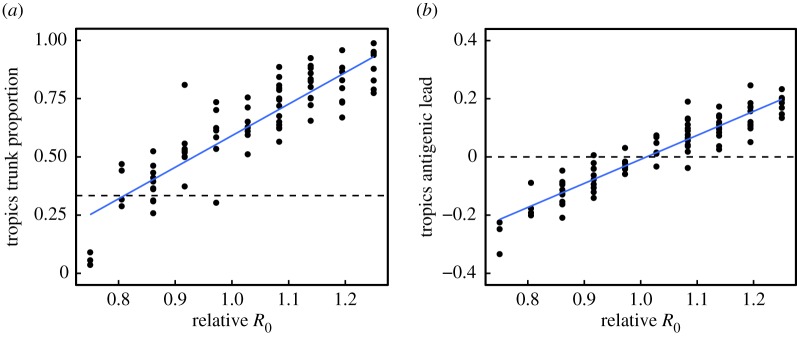
Most antigenically novel and evolutionarily successful strains of seasonal influenza A (H3N2) originate in East, South and Southeast Asia. To understand this pattern, we simulated the ecological and evolutionary dynamics of influenza in a host metapopulation representing the temperate north, tropics and temperate south. Although seasonality and air traffic are frequently used to explain global migratory patterns of influenza, we find that other factors may have a comparable or greater impact. Notably, a region's basic reproductive number (R0) strongly affects the antigenic evolution of its viral population and the probability that its strains will spread and fix globally: a 17-28% higher R0 in one region can explain the observed patterns. Seasonality, in contrast, increases the probability that a tropical (less seasonal) population will export evolutionarily successful strains but alone does not predict that these strains will be antigenically advanced. The relative sizes of different host populations, their birth and death rates, and the region in which H3N2 first appears affect influenza's phylogeography in different but relatively minor ways. These results suggest general principles that dictate the spatial dynamics of antigenically evolving pathogens and offer predictions for how changes in human ecology might affect influenza evolution.
大多数抗原性新颖且在进化上成功的季节性甲型流感(H3N2)毒株起源于东亚、南亚和东南亚。为了解这一模式,我们在一个代表北温带、热带和南温带的宿主集合种群中模拟了流感的生态和进化动态。尽管季节性和空中交通常被用来解释流感的全球迁徙模式,但我们发现其他因素可能具有相当或更大的影响。值得注意的是,一个地区的基本再生数(R0)强烈影响其病毒种群的抗原进化以及其毒株在全球传播和固定的概率:一个地区R0高出17%-28%就能解释观察到的模式。相比之下,季节性增加了热带(季节性较弱)种群输出进化上成功的毒株的概率,但仅凭季节性无法预测这些毒株在抗原方面会更先进。不同宿主种群的相对规模、它们的出生率和死亡率,以及H3N2首次出现的地区,以不同但相对较小的方式影响流感的系统地理学。这些结果表明了决定抗原性进化病原体空间动态的一般原则,并对人类生态变化如何影响流感进化提供了预测。