Luethi Nora, Cioccari Luca, Crisman Marco, Bellomo Rinaldo, Eastwood Glenn M, Mårtensson Johan
Department of Intensive Care, Austin Hospital, 145 Studley Rd, Heidelberg, 3084, VIC, Australia.
Department of Intensive Care Medicine, Lucerne Cantonal Hospital, Lucerne, Switzerland.
Crit Care. 2016 Sep 15;20:297. doi: 10.1186/s13054-016-1462-7.
It is uncertain whether liberal glucose control in critically ill diabetic patients leads to increased ketone production and ketoacidosis. Therefore, we aimed to assess the prevalence of ketosis, ketonuria and ketoacidosis in critically ill diabetic patients treated in accordance with a liberal glycemic control protocol.
We performed a prospective observational cohort study of 60 critically ill diabetic patients with blood and/or urine ketone bodies tested in ICU. All patients were treated according to a liberal glucose protocol targeting a blood glucose level (BGL) between 10 and 14 mmol/l in a single tertiary intensive care unit in Australia. We measured quantitative bedside blood 3-beta-hydroxybutyrate (β-OHB) and semi-quantitative urine ketones on ICU admission and daily during ICU stay, for a maximum of 10 consecutive days.
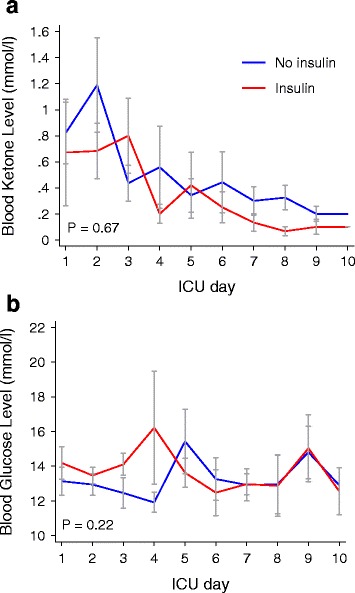
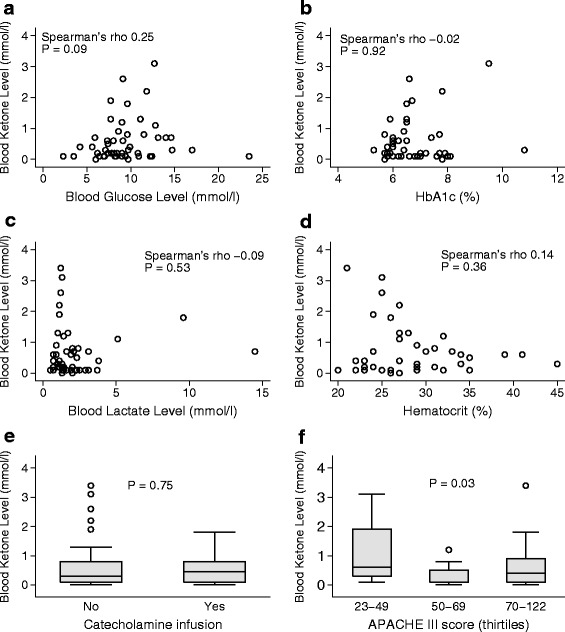
Median blood β-OHB level on admission was 0.3 (0.1, 0.8) mmol/l. Ketoacidosis was rare (3 %), but some level of ketosis (β-OHB ≥0.6 mmol/l) was found in 38 patients (63 %) early during their ICU stay. However, there was no significant difference in prevalence or severity of ketonemia and ketonuria among patients with BGL above (permissive hyperglycemia) or below 10 mmol/l. On multivariable linear regression analysis there was no association between blood ketone levels and BGL, HbA1c, lactate levels, hematocrit, catecholamine infusion or APACHE III score. In contrast, blood ketone levels tended to be higher after cardiopulmonary bypass surgery (P = 0.06).
Liberal glycemic control in critically ill diabetic patients does not appear to be associated with a high prevalence of ketoacidosis or ketonemia. Moreover, ketosis is typically present on admission and resolves rapidly. Finally, cardiopulmonary bypass surgery may be an important trigger of ketone body production.
Australian New Zealand Clinical Trials Registry ( ACTRN12615000216516 ; trial registration date 5 March 2015).
危重症糖尿病患者采用宽松血糖控制是否会导致酮体生成增加及酮症酸中毒尚不确定。因此,我们旨在评估按照宽松血糖控制方案治疗的危重症糖尿病患者中酮症、酮尿症及酮症酸中毒的发生率。
我们对60例在重症监护病房(ICU)检测血和/或尿酮体的危重症糖尿病患者进行了一项前瞻性观察队列研究。在澳大利亚一家三级重症监护病房,所有患者均按照宽松血糖方案进行治疗,目标血糖水平(BGL)为10至14 mmol/L。我们在患者入住ICU时及ICU住院期间每日测量床旁定量血3-β-羟基丁酸(β-OHB)和半定量尿酮体,最长连续测量10天。
入院时血β-OHB水平中位数为0.3(0.1,0.8)mmol/L。酮症酸中毒少见(3%),但38例患者(63%)在入住ICU早期出现了一定程度的酮症(β-OHB≥0.6 mmol/L)。然而,BGL高于(允许性高血糖)或低于10 mmol/L的患者中,酮血症和酮尿症的发生率及严重程度无显著差异。多变量线性回归分析显示,血酮水平与BGL、糖化血红蛋白(HbA1c)、乳酸水平、血细胞比容、儿茶酚胺输注或急性生理学与慢性健康状况评分系统III(APACHE III)评分之间无关联。相比之下,体外循环手术后血酮水平往往更高(P = 0.06)。
危重症糖尿病患者采用宽松血糖控制似乎与酮症酸中毒或酮血症的高发生率无关。此外,酮症通常在入院时就已存在且消退迅速。最后,体外循环手术可能是酮体生成的一个重要触发因素。
澳大利亚新西兰临床试验注册中心(ACTRN12615000216516;试验注册日期2015年3月5日)