Shaheen Abeer, Khaddam Jamal, Kesh Fadi
Department of dermatology, Tishreen University, Lattakia, Syria.
Department of Plastic and Reconstructive Surgery, Tishreen University, Lattakia, Syria.
BMC Dermatol. 2016 Sep 20;16(1):13. doi: 10.1186/s12895-016-0050-5.
Keloid is a benign fibrous growth, which presents in scar tissue of predisposed individuals. It is a result of irregular wound healing, but the exact mechanism is unknown. However, several factors may play a role in keloid formation. To date, there are no studies of keloids in Syria, and limited studies on Caucasians, so we have investigated the risk factors of keloids in Syrians (Caucasians), and this is the main objective of this study.
Diagnosis of keloids was clinically made after an interview and physical examination. We did a histopathological study in case the physical examination was unclear. The following information was taken for each patient; sex, Blood groups (ABO\Rh), cause of scarring, anatomical sites, age of onset, number of injured sites (single\multiple) and family history.
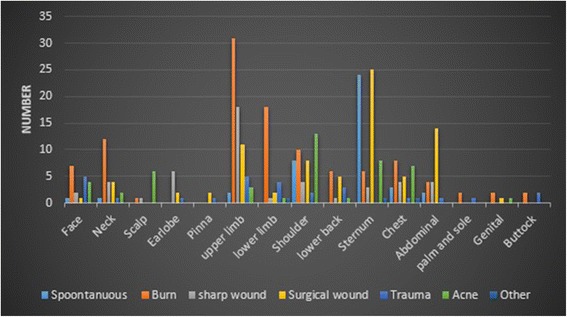
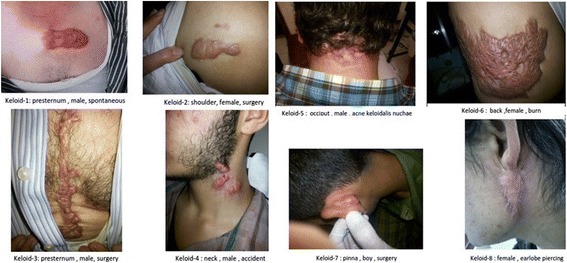
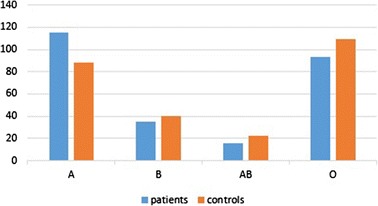
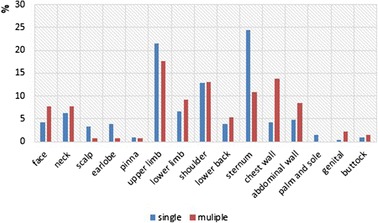
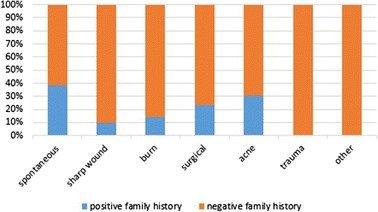
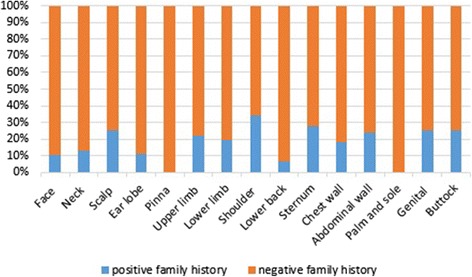
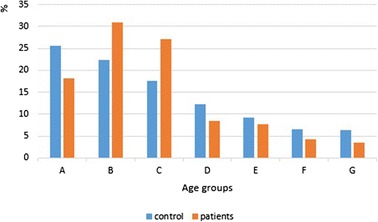
We have studied the clinical characteristics of 259 patients with keloids,130 (50.2 %) females and 129 (49.8 %) males. There were 209 (80.7 %) patients with keloids in a single anatomical site compared to 50 (19.3 %) patients with 130 keloids in multiple anatomical sites, 253 (97.68 %) patients with keloids caused by a single cause for each patient compared to 6 (2.32 %) patients with keloids caused by two different causes for each patient. Keloids could follow any form of skin injury, but burn was the most common (28.68 %). Also, keloids could develop at any anatomical sites, but upper limb (20 %) followed by sternum (19.17 %) was the most common. Over half of the patients developed keloids in the 11-30 age range. 19.3 % (50/259) of patients had family history, 76 % (38/50) of them had keloids located in the same anatomical sites of relative, also, 66 % (33\50) of them had keloids caused by the same cause. The following information was found to be statistically significant; people with blood group A (p = 0.01) compared with other blood groups, spontaneous keloids in patients with blood group A (p = 0.01), acne in males (p = 0.0008) compared to females, acne in someone who has a previous acne keloid (p = 0.0002), burn in someone who has a previous burn keloid (p = 0.029), family history, especially for spontaneous (p = 0.005), presternal (p = 0.039) and shoulder (p = 0.008) keloids, people in second and third decades (p = 0.02) (p = 0.01) respectively.
Age of onset, sex, cause of scarring, blood groups, anatomical site, presence of family history and the number of site (multiple\single) were significant in keloid formation in Syrians.
瘢痕疙瘩是一种良性纤维增生,出现在易感个体的瘢痕组织中。它是伤口愈合不规则的结果,但其确切机制尚不清楚。然而,几个因素可能在瘢痕疙瘩形成中起作用。迄今为止,叙利亚尚未有关于瘢痕疙瘩的研究,对白种人的研究也有限,因此我们调查了叙利亚人(白种人)瘢痕疙瘩的危险因素,这是本研究的主要目的。
通过访谈和体格检查对瘢痕疙瘩进行临床诊断。若体格检查结果不明确,则进行组织病理学研究。记录每位患者的以下信息:性别、血型(ABO\Rh)、瘢痕形成原因、解剖部位、发病年龄、受伤部位数量(单个\多个)以及家族史。
我们研究了259例瘢痕疙瘩患者的临床特征,其中女性130例(50.2%),男性129例(49.8%)。209例(80.7%)患者的瘢痕疙瘩位于单个解剖部位,50例(19.3%)患者的130个瘢痕疙瘩位于多个解剖部位;253例(97.68%)患者的瘢痕疙瘩由单一原因引起,6例(2.32%)患者的瘢痕疙瘩由两种不同原因引起。瘢痕疙瘩可继发于任何形式的皮肤损伤,但烧伤最为常见(28.68%)。此外,瘢痕疙瘩可发生于任何解剖部位,但上肢(20%)其次是胸骨(19.17%)最为常见。超过一半的患者在11至30岁年龄段出现瘢痕疙瘩。19.3%(50/259)的患者有家族史,其中76%(38/50)的患者瘢痕疙瘩位于亲属的相同解剖部位,66%(33/50)的患者瘢痕疙瘩由相同原因引起。发现以下信息具有统计学意义:A型血的人(p = 0.01)与其他血型相比,A型血患者的自发性瘢痕疙瘩(p = 0.01),男性痤疮患者(p = 0.0008)与女性相比,有痤疮瘢痕疙瘩病史者的痤疮(p = 0.0002),有烧伤瘢痕疙瘩病史者的烧伤(p = 0.),家族史,尤其是自发性瘢痕疙瘩(p = 0.005)、胸骨前瘢痕疙瘩(p = 0.039)和肩部瘢痕疙瘩(p = 0.008),分别在第二和第三个十年发病的人(p = 0.02)(p = 0.01)。
发病年龄、性别、瘢痕形成原因、血型、解剖部位、家族史的存在以及部位数量(多个\单个)在叙利亚人瘢痕疙瘩形成中具有重要意义。