Fardsanei F, Nikkhahi F, Bakhshi B, Salehi T Z, Tamai I A, Soltan Dallal M M
Division of Microbiology, Department of Pathobiology, School of Public Health, Tehran University of Medical Science, Tehran, Iran.
Department of Bacteriology, Faculty of Medical Sciences, Tarbiat Modares University, Tehran, Iran; Food Microbiology Research Centre, Tehran University of Medical Sciences, Tehran, Iran.
New Microbes New Infect. 2016 Aug 4;14:24-30. doi: 10.1016/j.nmni.2016.07.016. eCollection 2016 Nov.
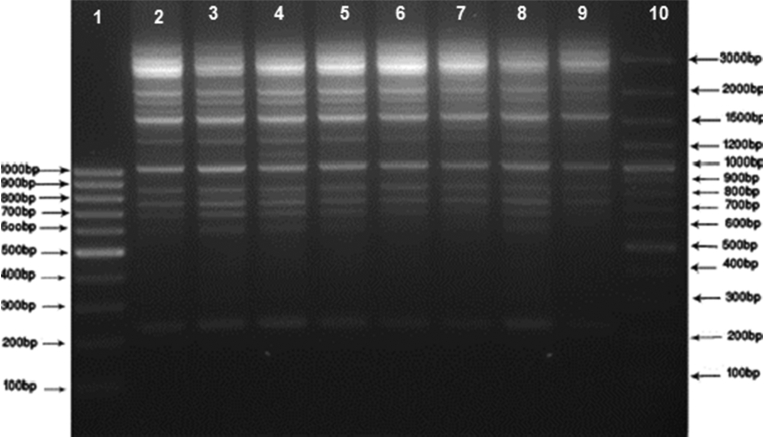
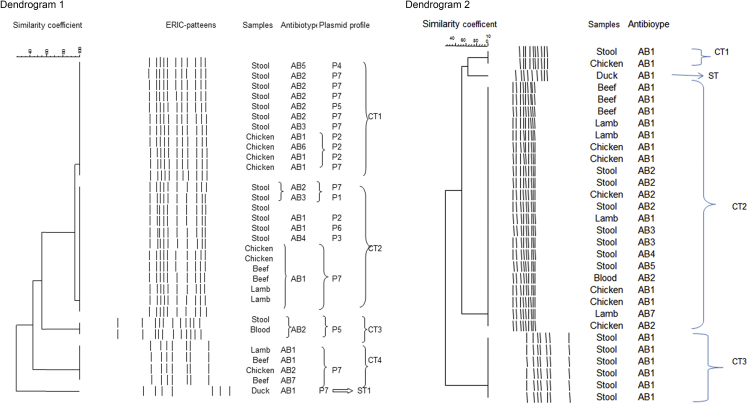
In recent years, Salmonella enterica serovar Enteritidis has been a primary cause of human salmonellosis in many countries. The major objective of this study was to investigate genetic diversity among Salmonella Enteritidis strains from different origins (food and human) by Enterobacterial Repetitive Intergenic Consensus (ERIC) -PCR, as well as to assess their plasmid profiling and antimicrobial resistance. A total of 30 Salmonella Enteritidis isolates, 15 from food samples (chicken, lamb, beef and duck meats) and 15 from clinical samples were collected in Tehran. Identification of isolates as Salmonella was confirmed by using conventional standard biochemical and serological tests. Multiplex-PCR was used for serotyping of isolates to identify Salmonella Enteritidis. Antimicrobial susceptibility testing to 16 agents founds drug resistance patterns among Salmonella Enteritidis isolates. No resistance was observed to cephalexin, ceftriaxone, ceftazidime and cefotaxime, ciprofloxacin, imipenem or meropenem, chloramphenicol and gentamicin. The highest resistance (96.7%) was observed to nitrofurantoin. Seven plasmid profiles (P1-P7) were detected, and a 68-kb plasmid was found in all isolates. Two different primers; ERIC and (GTG)5 were used for genotyping, which each produced four profiles. The majority of clinical and food isolates fell into two separate common types (CTs) with a similar percentage of 95% by ERIC-PCR. Using primer (GTG)5, 29 isolates incorporated in three CTs with 70% of isolates showing a single banding pattern. Limited genetic diversity among human and food isolates of Salmonella Enteritidis may indicate that contaminated foods were possibly the source of human salmonellosis. These results confirmed that ERIC-PCR genotyping has limited discriminatory power for Salmonella Enteritidis of different origin.
近年来,肠炎沙门氏菌肠炎血清型已成为许多国家人类沙门氏菌病的主要病因。本研究的主要目的是通过肠杆菌重复基因间共识(ERIC)-PCR研究不同来源(食品和人类)的肠炎沙门氏菌菌株之间的遗传多样性,并评估其质粒图谱和抗菌药物耐药性。在德黑兰共收集了30株肠炎沙门氏菌分离株,其中15株来自食品样本(鸡肉、羊肉、牛肉和鸭肉),15株来自临床样本。通过常规标准生化和血清学试验确认分离株为沙门氏菌。采用多重PCR对分离株进行血清分型以鉴定肠炎沙门氏菌。对16种药物进行抗菌药敏试验,发现了肠炎沙门氏菌分离株的耐药模式。未观察到对头孢氨苄、头孢曲松、头孢他啶、头孢噻肟、环丙沙星、亚胺培南或美罗培南、氯霉素和庆大霉素的耐药性。对呋喃妥因的耐药率最高(96.7%)。检测到七种质粒图谱(P1-P7),所有分离株中均发现一个68 kb的质粒。使用两种不同的引物ERIC和(GTG)5进行基因分型,每种引物均产生四种图谱。通过ERIC-PCR,大多数临床和食品分离株分为两种不同的常见类型(CTs),比例相似,均为95%。使用引物(GTG)5,29株分离株归入三个CTs,70%的分离株显示单一的条带模式。肠炎沙门氏菌人类和食品分离株之间有限的遗传多样性可能表明受污染的食物可能是人类沙门氏菌病的来源。这些结果证实,ERIC-PCR基因分型对不同来源的肠炎沙门氏菌的鉴别能力有限。