Iwata Sachiko, Katayama Reiji, Kinoshita Masahiro, Saikusa Mamoru, Araki Yuko, Takashima Sachio, Abe Toshi, Iwata Osuke
Department of Paediatrics and Child Health, Kurume University School of Medicine, Fukuoka, Japan.
Centre for Developmental and Cognitive Neuroscience, Kurume University School of Medicine, Fukuoka, Japan.
Sci Rep. 2016 Sep 23;6:33995. doi: 10.1038/srep33995.
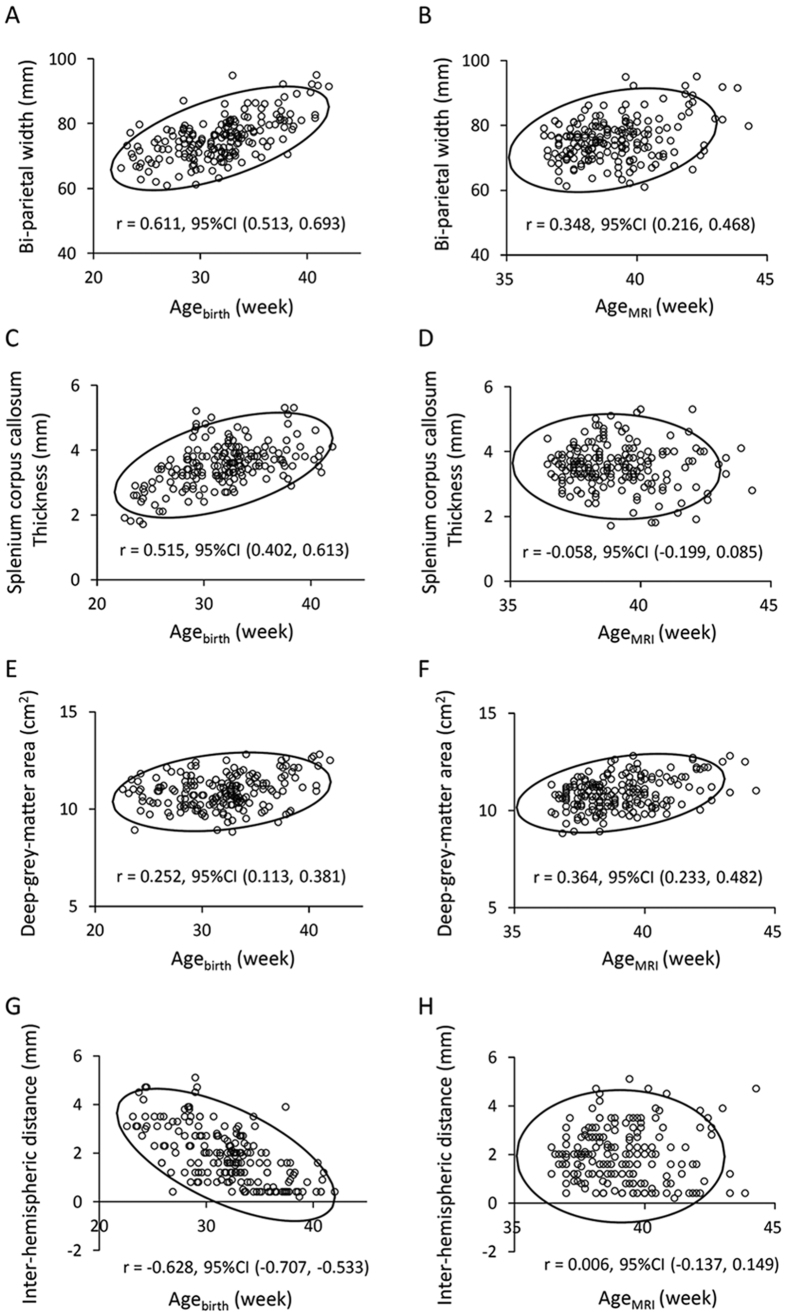
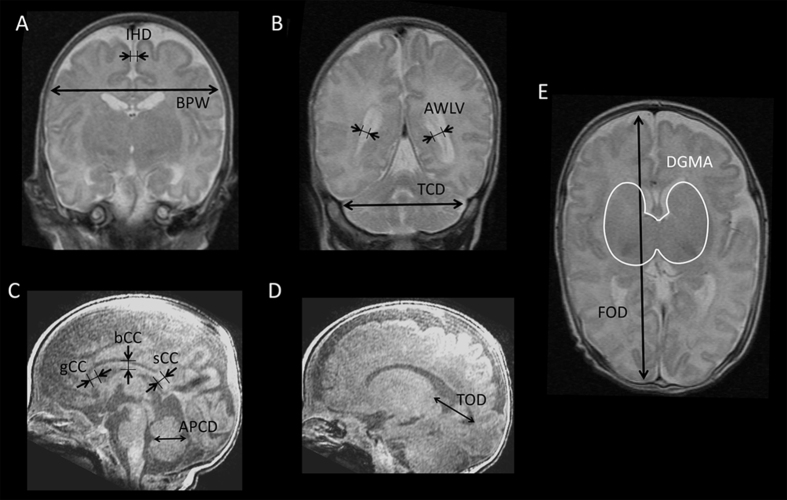
Regional brain sizes of very-preterm infants at term-equivalent age differ from those of term-born peers, which have been linked with later cognitive impairments. However, dependence of regional brain volume loss on gestational age has not been studied in detail. To investigate the spatial pattern of brain growth in neonates without destructive brain lesions, head MRI of 189 neonates with a wide range of gestational age (24-42 weeks gestation) was assessed using simple metrics measurements. Dependence of MRI findings on gestational age at birth (Age) and the corrected age at MRI scan (Age) were assessed. The head circumference was positively correlated with Age, but not Age. The bi-parietal width, deep grey matter area and the trans-cerebellar diameter were positively correlated with both Age and Age. The callosal thickness (positive), atrial width of lateral ventricle (negative) and the inter-hemispheric distance (negative) were exclusively correlated with Age. The callosal thickness and cerebral/cerebellar transverse diameters showed predominant dependence on Age over Age, suggesting that brain growth after preterm-birth was considerably restricted or even became negligible compared with that in utero. Such growth restriction after preterm birth may extensively affect relatively more matured infants, considering the linear relationships observed between brain sizes and Age.
足月相当年龄的极早产儿的脑区大小与足月儿同龄人的脑区大小不同,这与后期认知障碍有关。然而,脑区体积损失对胎龄的依赖性尚未得到详细研究。为了研究无破坏性脑损伤的新生儿脑生长的空间模式,我们使用简单的指标测量方法对189名胎龄范围广泛(妊娠24 - 42周)的新生儿进行了头部MRI评估。评估了MRI结果对出生时胎龄(年龄)和MRI扫描时校正年龄(年龄)的依赖性。头围与年龄呈正相关,但与年龄无关。双顶径、深部灰质面积和小脑横径与年龄和年龄均呈正相关。胼胝体厚度(正相关)、侧脑室心房宽度(负相关)和半球间距离(负相关)仅与年龄相关。胼胝体厚度和脑/小脑横径对年龄的依赖性比年龄更为显著,这表明与子宫内相比,早产后脑生长受到相当大的限制,甚至可以忽略不计。考虑到脑大小与年龄之间观察到的线性关系,早产后的这种生长受限可能会对相对成熟的婴儿产生广泛影响。