Gupta Varun K, Pech Ulrike, Bhukel Anuradha, Fulterer Andreas, Ender Anatoli, Mauermann Stephan F, Andlauer Till F M, Antwi-Adjei Emmanuel, Beuschel Christine, Thriene Kerstin, Maglione Marta, Quentin Christine, Bushow René, Schwärzel Martin, Mielke Thorsten, Madeo Frank, Dengjel Joern, Fiala André, Sigrist Stephan J
Institute for Biology/Genetics, Freie Universität Berlin, Berlin, Germany.
NeuroCure, Charité, Berlin, Germany.
PLoS Biol. 2016 Sep 29;14(9):e1002563. doi: 10.1371/journal.pbio.1002563. eCollection 2016 Sep.
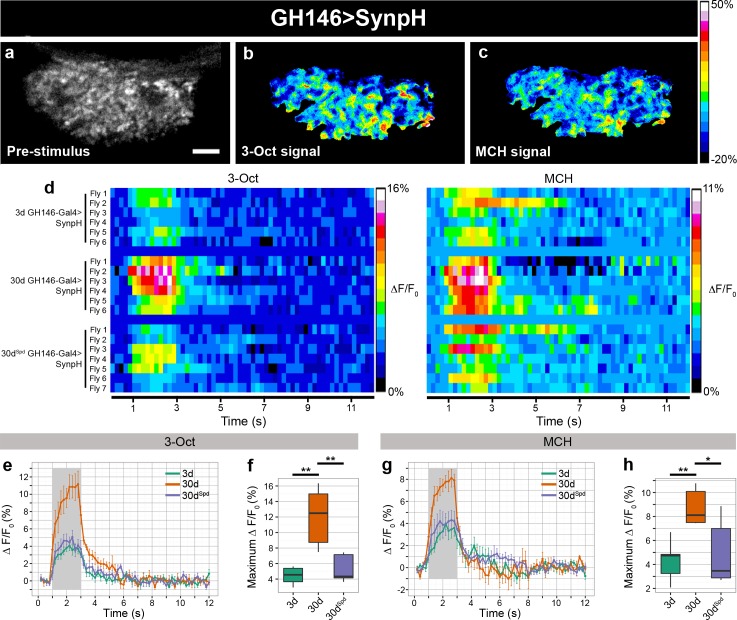
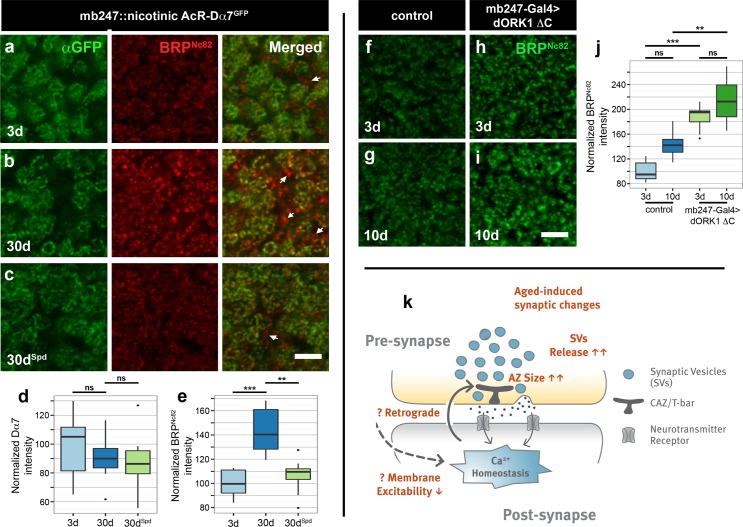
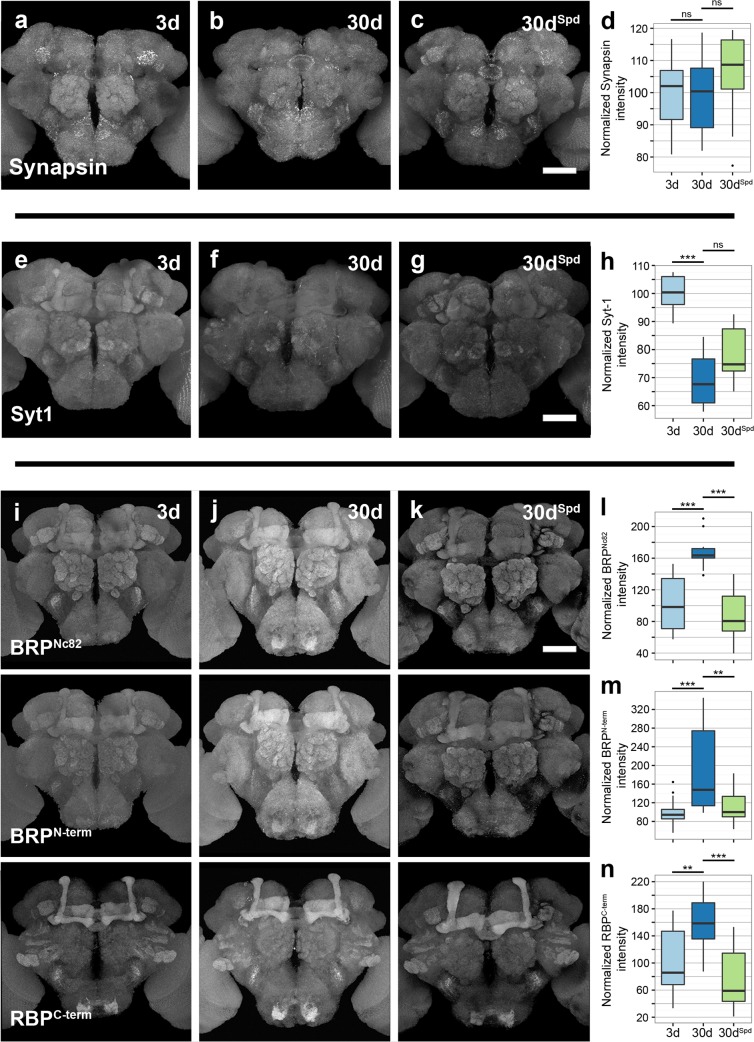
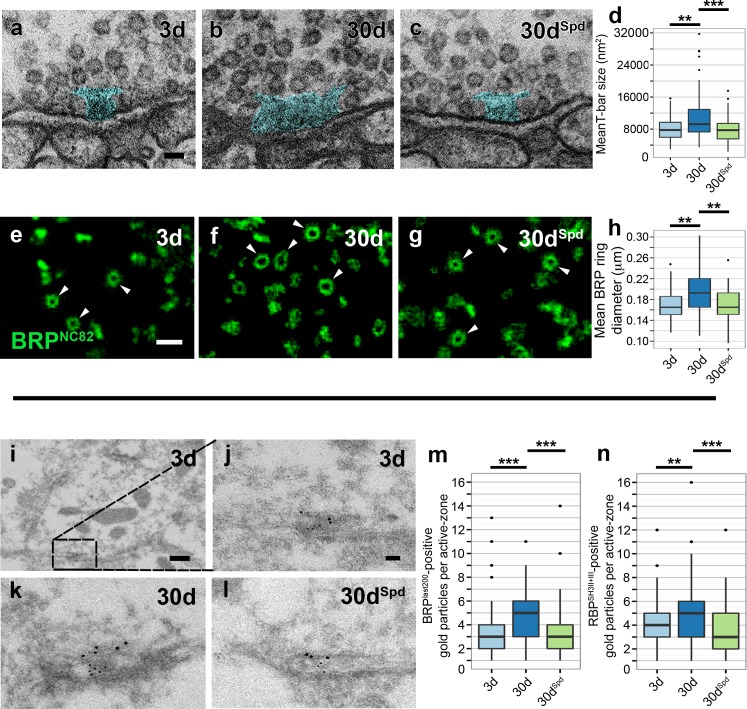
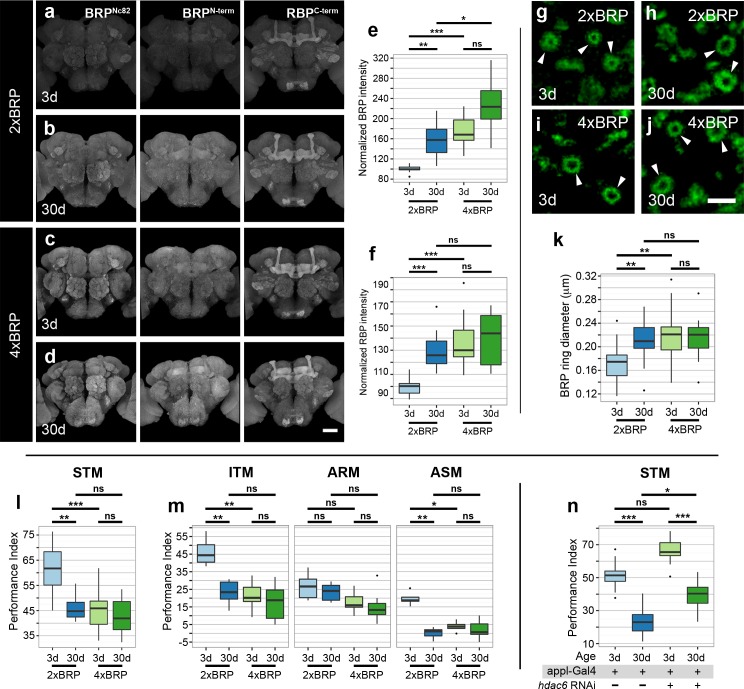
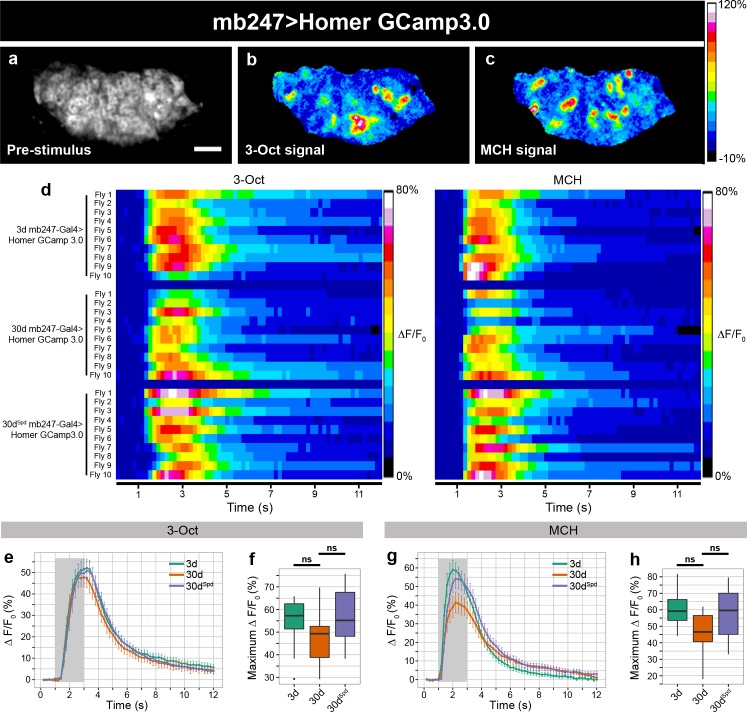
Memories are assumed to be formed by sets of synapses changing their structural or functional performance. The efficacy of forming new memories declines with advancing age, but the synaptic changes underlying age-induced memory impairment remain poorly understood. Recently, we found spermidine feeding to specifically suppress age-dependent impairments in forming olfactory memories, providing a mean to search for synaptic changes involved in age-dependent memory impairment. Here, we show that a specific synaptic compartment, the presynaptic active zone (AZ), increases the size of its ultrastructural elaboration and releases significantly more synaptic vesicles with advancing age. These age-induced AZ changes, however, were fully suppressed by spermidine feeding. A genetically enforced enlargement of AZ scaffolds (four gene-copies of BRP) impaired memory formation in young animals. Thus, in the Drosophila nervous system, aging AZs seem to steer towards the upper limit of their operational range, limiting synaptic plasticity and contributing to impairment of memory formation. Spermidine feeding suppresses age-dependent memory impairment by counteracting these age-dependent changes directly at the synapse.
记忆被认为是由一组突触改变其结构或功能表现而形成的。形成新记忆的能力会随着年龄的增长而下降,但年龄诱导的记忆障碍背后的突触变化仍知之甚少。最近,我们发现喂食亚精胺能特异性抑制形成嗅觉记忆时年龄依赖性的损伤,这为寻找与年龄依赖性记忆障碍相关的突触变化提供了一种手段。在这里,我们表明,一个特定的突触区室,即突触前活性区(AZ),随着年龄的增长,其超微结构的精细程度会增加,并且会释放出明显更多的突触小泡。然而,这些年龄诱导的AZ变化被喂食亚精胺完全抑制了。在幼龄动物中,通过基因手段强制扩大AZ支架(BRP的四个基因拷贝)会损害记忆形成。因此,在果蝇神经系统中,老化的AZ似乎趋向于其操作范围的上限,限制了突触可塑性,并导致记忆形成受损。喂食亚精胺通过直接在突触处抵消这些年龄依赖性变化来抑制年龄依赖性记忆障碍。