Department of Chemistry, University of Illinois at Urbana-Champaign, Urbana, Illinois 61801, USA.
Faraday Discuss. 2016 Dec 22;195:171-189. doi: 10.1039/c6fd00122j.
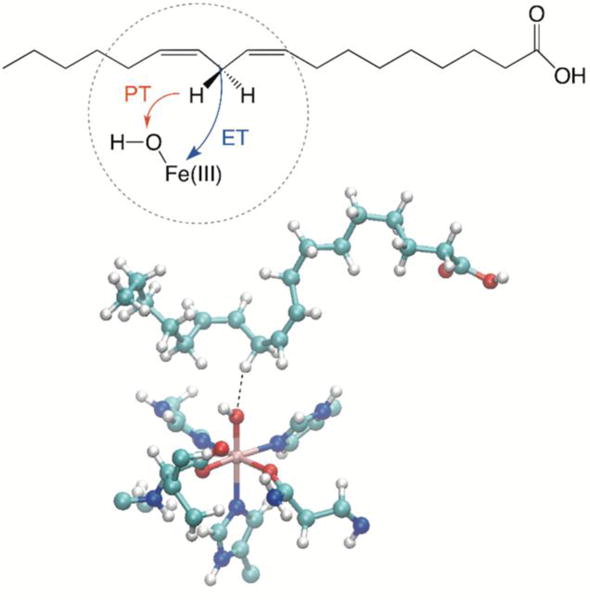
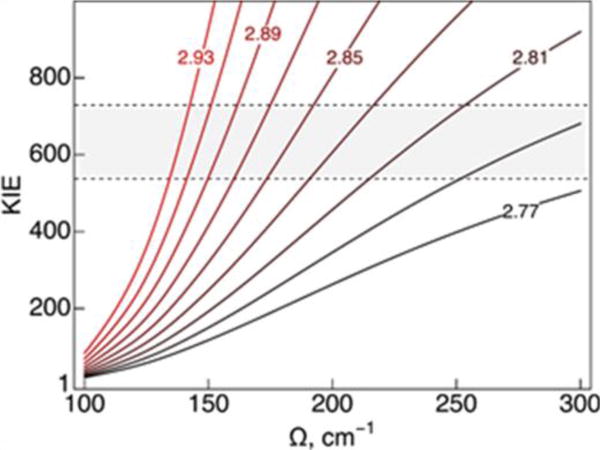
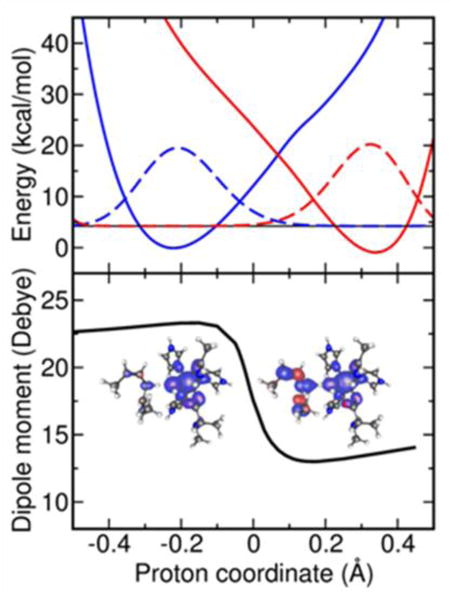
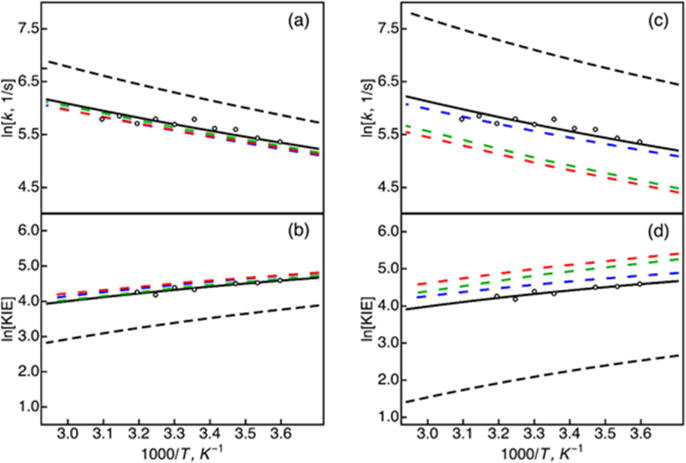
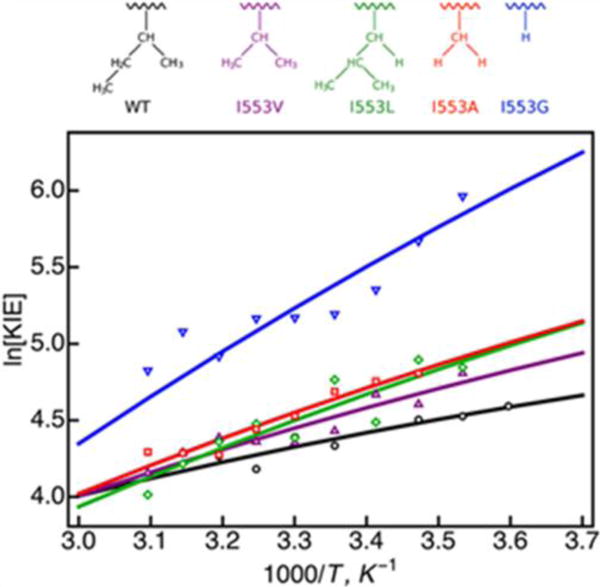
A general theory has been developed for proton-coupled electron transfer (PCET), which is vital to a wide range of chemical and biological processes. This theory describes PCET reactions in terms of nonadiabatic transitions between reactant and product electron-proton vibronic states and includes the effects of thermal fluctuations of the solvent or protein environment, as well as the proton donor-acceptor motion. Within the framework of this general PCET theory, a series of analytical rate constant expressions has been derived for PCET reactions in well-defined regimes. Herein, the application of this theory to PCET in the enzyme soybean lipoxygenase illustrates the regimes of validity for the various rate constant expressions and elucidates the fundamental physical principles dictating PCET reactions. Such theoretical studies provide significant physical insights that guide the interpretation of experimental data and lead to experimentally testable predictions. A combination of theoretical treatments with atomic-level simulations is essential to understanding PCET.
已经发展出一种质子耦合电子转移(PCET)的通用理论,它对广泛的化学和生物过程至关重要。该理论根据反应物和产物电子-质子振动态之间的非绝热跃迁来描述 PCET 反应,并包括溶剂或蛋白质环境的热波动以及质子供体-受体运动的影响。在这个通用的 PCET 理论框架内,已经为明确的反应条件下的 PCET 反应推导出了一系列解析速率常数表达式。本文将该理论应用于酶大豆脂氧合酶中的 PCET,说明了各种速率常数表达式的有效范围,并阐明了决定 PCET 反应的基本物理原理。这些理论研究提供了重要的物理见解,指导了对实验数据的解释,并导致了可通过实验检验的预测。理论处理与原子级模拟的结合对于理解 PCET 是必不可少的。