Bourne Rupert R A, Taylor Hugh R, Flaxman Seth R, Keeffe Jill, Leasher Janet, Naidoo Kovin, Pesudovs Konrad, White Richard A, Wong Tien Y, Resnikoff Serge, Jonas Jost B
Vision & Eye Research Unit, Postgraduate Medical Institute, Anglia Ruskin University, Cambridge, United Kingdom.
Melbourne School of Population Health, University of Melbourne, Australia.
PLoS One. 2016 Oct 20;11(10):e0162229. doi: 10.1371/journal.pone.0162229. eCollection 2016.
To assess the number of individuals visually impaired or blind due to glaucoma and to examine regional differences and temporal changes in this parameter for the period from 1990 to 2012.
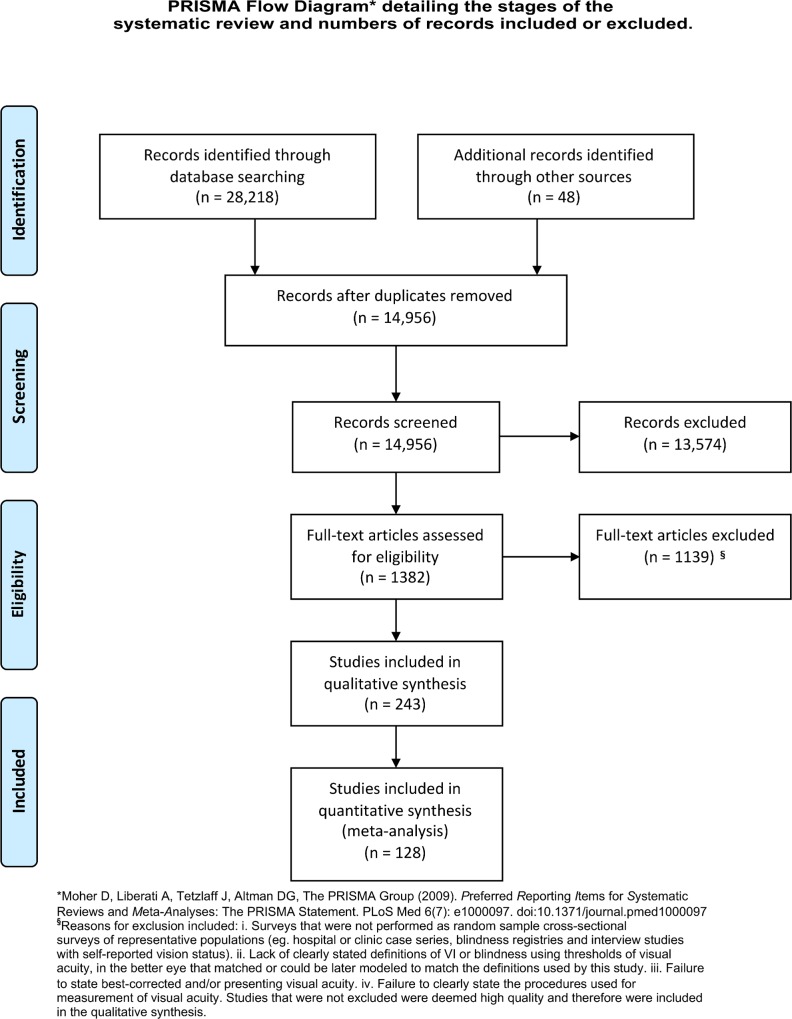
As part of the Global Burden of Diseases (GBD) Study 2010, we performed a systematic literature review for the period from 1980 to 2012. We primarily identified 14,908 relevant manuscripts, out of which 243 high-quality, population-based studies remained after review by an expert panel that involved application of selection criteria that dwelt on population representativeness and clarity of visual acuity methods used. Sixty-six specified the proportion attributable to glaucoma. The software tool DisMod-MR (Disease Modeling-Metaregression) of the GBD was used to calculate fraction of vision impairment due to glaucoma.
In 2010, 2.1 million (95% Uncertainty Interval (UI):1.9,2.6) people were blind, and 4.2 (95% UI:3.7,5.8) million were visually impaired due to glaucoma. Glaucoma caused worldwide 6.6% (95% UI:5.9,7.9) of all blindness in 2010 and 2.2% (95% UI:2.0,2.8) of all moderate and severe visual impairment (MSVI). These figures were lower in regions with younger populations (<5% in South Asia) than in high-income regions with relatively old populations (>10%). From 1990 to 2010, the number of blind or visually impaired due to glaucoma increased by 0.8 million (95%UI:0.7, 1.1) or 62% and by 2.3 million (95%UI:2.1,3.5) or 83%, respectively. Percentage of global blindness caused by glaucoma increased between 1990 and 2010 from 4.4% (4.0,5.1) to 6.6%. Age-standardized prevalence of glaucoma related blindness and MSVI did not differ markedly between world regions nor between women.
By 2010, one out of 15 blind people was blind due to glaucoma, and one of 45 visually impaired people was visually impaired, highlighting the increasing global burden of glaucoma.
评估因青光眼导致视力受损或失明的人数,并研究1990年至2012年期间该参数的地区差异和时间变化。
作为2010年全球疾病负担(GBD)研究的一部分,我们对1980年至2012年期间的文献进行了系统回顾。我们初步识别出14908篇相关手稿,经过一个专家小组审查后,根据人口代表性和所使用视力测定方法的清晰度等选择标准,最终保留了243项高质量的基于人群的研究。其中66项明确了青光眼所致比例。利用GBD的软件工具DisMod-MR(疾病建模-元回归)计算青光眼所致视力损害的比例。
2010年,210万人(95%不确定区间(UI):190万,260万)因青光眼失明,420万人(95%UI:370万,580万)因青光眼视力受损。2010年,青光眼导致全球所有失明病例的6.6%(95%UI:5.9%,7.9%)以及所有中度和重度视力损害(MSVI)病例的2.2%(95%UI:2.0%,2.8%)。在人口较年轻的地区(南亚<5%),这些数字低于人口相对老龄化的高收入地区(>10%)。1990年至2010年,因青光眼失明或视力受损的人数分别增加了80万(95%UI:70万,110万)或62%,以及230万(95%UI:210万,350万)或83%。1990年至2010年,青光眼导致的全球失明比例从4.4%(4.0%,5.1%)增至6.6%。世界各地区以及女性之间,青光眼相关失明和MSVI的年龄标准化患病率无明显差异。
到2010年,每15名盲人中有1人因青光眼失明,每45名视力受损者中有1人因青光眼视力受损,凸显青光眼的全球负担日益加重。