Wu Yuan-Hua, Yen Chia-Jui, Hsiao Jenn-Ren, Ou Chun-Yen, Huang Jehn-Shyun, Wong Tung-Yiu, Tsai Sen-Tien, Huang Cheng-Chih, Lee Wei-Ting, Chen Ken-Chung, Fang Sheen-Yie, Wu Jiunn-Liang, Hsueh Wei-Ting, Lin Forn-Chia, Yang Ming-Wei, Chang Jang-Yang, Liao Hsiao-Chen, Wu Shang-Yin, Lin Chen-Lin, Wang Yi-Hui, Weng Ya-Ling, Yang Han-Chien, Chen Yu-Shan, Chang Jeffrey S
Department of Radiation Oncology, National Cheng Kung University Hospital, College of Medicine, National Cheng Kung University, Tainan, Taiwan.
Division of Hematology/Oncology, Department of Internal Medicine, National Cheng Kung University Hospital, College of Medicine, National Cheng Kung University, Tainan, Taiwan.
PLoS One. 2016 Oct 25;11(10):e0164937. doi: 10.1371/journal.pone.0164937. eCollection 2016.
Although betel quid (BQ) is an established risk factor of head and neck cancer (HNC), insufficiencies exist in the literature regarding the dose-response, BQ types, HNC sites, and BQ cessation. The current study was conducted to fill these insufficiencies.
A hospital-based case-control study was conducted to evaluate the association between BQ and HNC. In-person interview was conducted to collect data on BQ chewing. The current analysis included 487 men newly diagnosed with HNC and 617 male controls who were frequency-matched to the cases by age. The association between BQ and HNC was assessed using multivariable unconditional logistic regression.
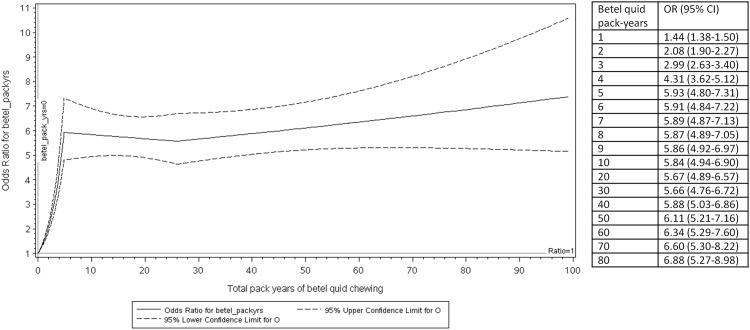
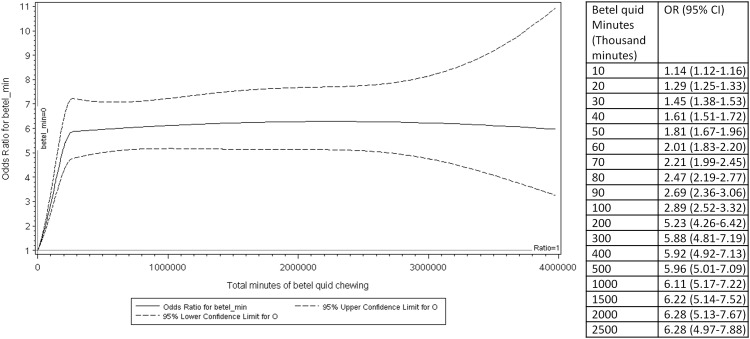
Ever BQ chewing was associated with an increased HNC risk regardless of the BQ types. A non-linear positive association between BQ and HNC was observed, with a steep rise in HNC risk for the first 5 pack-years or 200,000 minutes of BQ consumption. Every year of BQ cessation was associated with a 2.9% reduction in HNC risk; however, the risk did not reduce to the level of non-BQ chewers even after 20 years of BQ cessation. Eliminating BQ chewing may prevent 51.6% of HNCs, 62.6% of oral cancers, and 41.3% of pharyngeal cancers in Taiwan.
Our results supported the positive association between BQ and HNC. BQ cessation is effective in reducing HNC risk and should be encouraged. Because BQ cessation may not reduce the HNC risk to the level of non-BQ chewers, it is important to prevent the initiation of BQ chewing.
尽管槟榔嚼块(BQ)是头颈癌(HNC)的一个既定风险因素,但关于剂量反应、BQ类型、HNC部位和BQ戒断,文献中存在不足。本研究旨在填补这些不足。
开展一项基于医院的病例对照研究,以评估BQ与HNC之间的关联。通过面对面访谈收集BQ咀嚼的数据。当前分析纳入了487名新诊断为HNC的男性和617名男性对照,后者按年龄与病例进行频数匹配。使用多变量无条件逻辑回归评估BQ与HNC之间的关联。
无论BQ类型如何,曾经咀嚼BQ均与HNC风险增加相关。观察到BQ与HNC之间存在非线性正相关,在最初5包年或200,000分钟的BQ消费中,HNC风险急剧上升。BQ戒断的每一年与HNC风险降低2.9%相关;然而,即使在BQ戒断20年后,风险也未降至非BQ咀嚼者的水平。在台湾,戒除BQ咀嚼可预防51.6%的HNC、62.6%的口腔癌和41.3%的咽癌。
我们的结果支持BQ与HNC之间的正相关。BQ戒断可有效降低HNC风险,应予以鼓励。由于BQ戒断可能无法将HNC风险降至非BQ咀嚼者的水平,预防BQ咀嚼的起始很重要。