Department of Computational Science and Engineering, Georgia Institute of Technology, Atlanta, Georgia, USA.
Tri-Institutional Center for Translational Research in Neuroimaging and Data Science (TReNDS), Georgia State University, Georgia Institute of Technology, Emory University, Atlanta, Georgia, USA.
Hum Brain Mapp. 2023 Feb 1;44(2):509-522. doi: 10.1002/hbm.26077. Epub 2022 Sep 15.
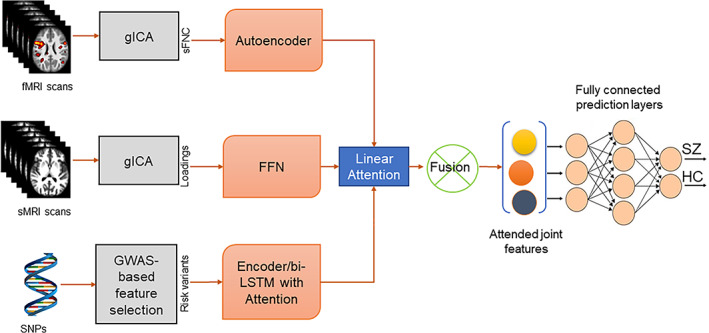
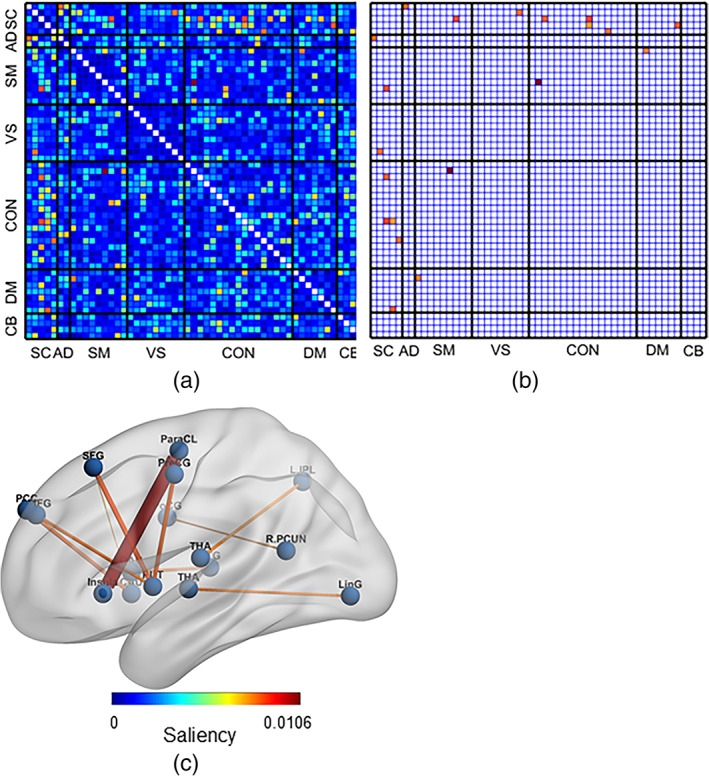
Characterizing neuropsychiatric disorders is challenging due to heterogeneity in the population. We propose combining structural and functional neuroimaging and genomic data in a multimodal classification framework to leverage their complementary information. Our objectives are two-fold (i) to improve the classification of disorders and (ii) to introspect the concepts learned to explore underlying neural and biological mechanisms linked to mental disorders. Previous multimodal studies have focused on naïve neural networks, mostly perceptron, to learn modality-wise features and often assume equal contribution from each modality. Our focus is on the development of neural networks for feature learning and implementing an adaptive control unit for the fusion phase. Our mid fusion with attention model includes a multilayer feed-forward network, an autoencoder, a bi-directional long short-term memory unit with attention as the features extractor, and a linear attention module for controlling modality-specific influence. The proposed model acquired 92% (p < .0001) accuracy in schizophrenia prediction, outperforming several other state-of-the-art models applied to unimodal or multimodal data. Post hoc feature analyses uncovered critical neural features and genes/biological pathways associated with schizophrenia. The proposed model effectively combines multimodal neuroimaging and genomics data for predicting mental disorders. Interpreting salient features identified by the model may advance our understanding of their underlying etiological mechanisms.
由于人群的异质性,对神经精神疾病进行特征描述具有挑战性。我们建议在多模态分类框架中结合结构和功能神经影像学以及基因组数据,以利用它们的互补信息。我们的目标有两个(i)提高疾病的分类准确性,(ii)深入研究所学习的概念,以探索与精神障碍相关的潜在神经和生物学机制。以前的多模态研究主要集中在基于感知器的原始神经网络上,以学习模态特定的特征,并且通常假设每个模态的贡献相等。我们关注的是用于特征学习的神经网络的开发和融合阶段的自适应控制单元的实现。我们的中间融合注意力模型包括多层前馈网络、自动编码器、带注意力的双向长短时记忆单元作为特征提取器,以及用于控制模态特定影响的线性注意力模块。所提出的模型在精神分裂症预测方面取得了 92%(p<.0001)的准确率,优于应用于单模态或多模态数据的其他几种最先进的模型。事后特征分析揭示了与精神分裂症相关的关键神经特征和基因/生物学途径。该模型有效地结合了多模态神经影像学和基因组学数据来预测精神障碍。解释模型确定的显著特征可能有助于我们理解其潜在的发病机制。