Jewett Amy, Beck Laurie F, Taylor Christopher, Baldwin Grant
Centers for Disease Control and Prevention, Division of Unintentional Injury Prevention, Atlanta, GA, United States.
Centers for Disease Control and Prevention, Division of Unintentional Injury Prevention, Atlanta, GA, United States.
J Safety Res. 2016 Dec;59:1-7. doi: 10.1016/j.jsr.2016.09.001. Epub 2016 Oct 4.
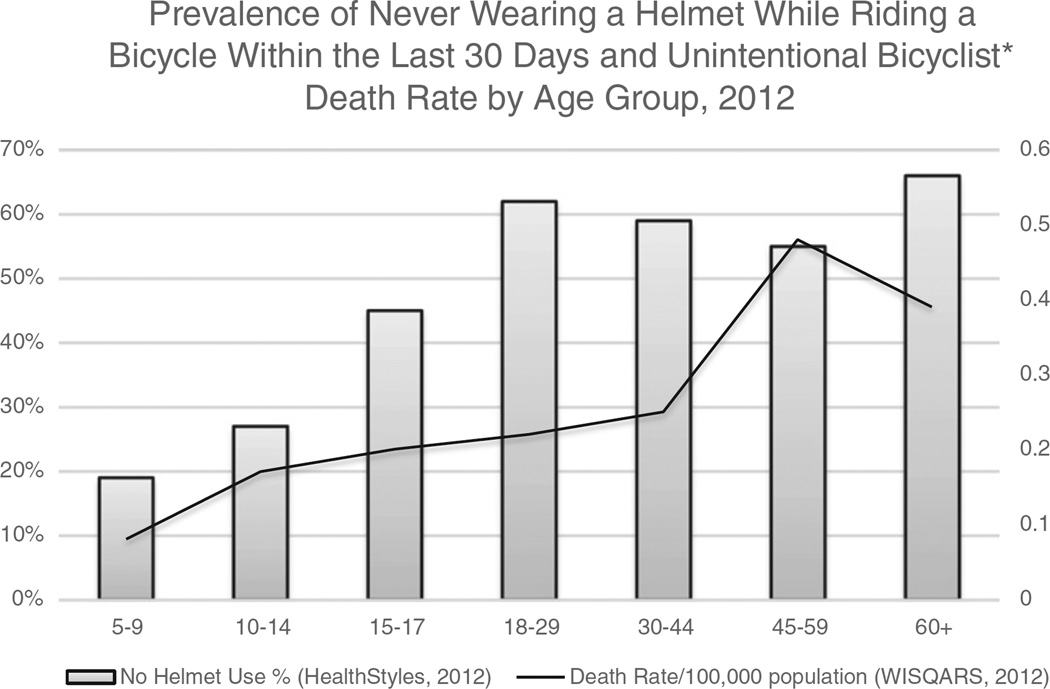
In 2013, injuries to bicyclists accounted for 925 fatalities and 493,884 nonfatal, emergency department-treated injuries in the United States. Bicyclist deaths increased by 19% from 2010 to 2013. The greatest risk of death and disability to bicyclists is head injuries. The objective of this study was to provide estimates of prevalence and associated factors of bicycle riding and helmet use among children and adults in the United States.
CDC analyzed self-reported data from the 2012 Summer ConsumerStyles survey. Adult respondents (18+years) were asked about bicycle riding and helmet use in the last 30days for themselves and their children (5 to 17years). For bicycle riders, CDC estimated the prevalence of helmet use and conducted multivariable regression analyses to identify factors associated with helmet use.
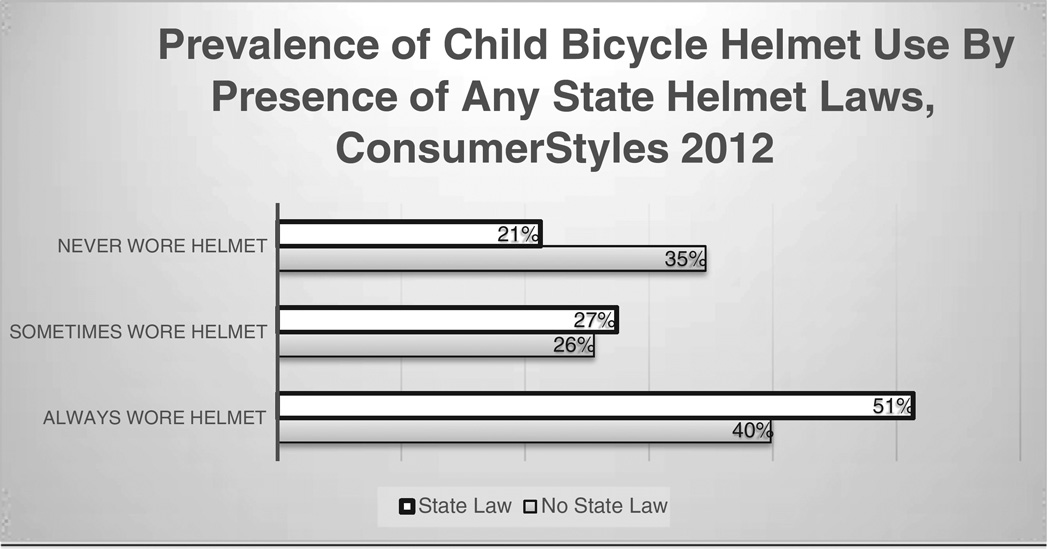
Among adults, 21% rode bicycles within the past 30days and 29% always wore helmets. Respondents reported that, of the 61% of children who rode bicycles within the past 30days, 42% always wore helmets. Children were more likely to always wear helmets (90%) when their adult respondents always wore helmets than when their adult respondents did not always wear helmets (38%). Children who lived in states with a child bicycle helmet law were more likely to always wear helmets (47%) than those in states without a law (39%).
Despite the fact that bicycle helmets are highly effective at reducing the risk for head injuries, including severe brain injuries and death, less than half of children and adults always wore bicycle helmets while riding.
States and communities should consider interventions that improve the safety of riding such as policies to promote helmet use, modeling of helmet wearing by adults, and focusing on high risk groups, including Hispanic cyclists, occasional riders, adults, and children ages 10 to 14.
2013年,在美国,骑自行车者受伤导致925人死亡,493,884人受非致命伤并前往急诊科治疗。从2010年到2013年,骑自行车者死亡人数增加了19%。骑自行车者面临的最大死亡和残疾风险是头部受伤。本研究的目的是估计美国儿童和成人骑自行车及使用头盔的患病率及相关因素。
美国疾病控制与预防中心(CDC)分析了2012年夏季消费者风格调查的自我报告数据。成年受访者(18岁及以上)被问及他们自己以及其子女(5至17岁)在过去30天内骑自行车及使用头盔的情况。对于骑自行车者,CDC估计了头盔使用的患病率,并进行多变量回归分析以确定与头盔使用相关的因素。
在成年人中,21%在过去30天内骑过自行车,29%总是佩戴头盔。受访者报告称,在过去30天内骑自行车的儿童中,61%的儿童,42%总是佩戴头盔。当成年受访者总是佩戴头盔时,其子女更有可能总是佩戴头盔(90%),而当成年受访者并非总是佩戴头盔时,其子女总是佩戴头盔的比例为38%。生活在有儿童自行车头盔法律的州的儿童比没有该法律的州的儿童更有可能总是佩戴头盔(47%对39%)。
尽管自行车头盔在降低头部受伤风险(包括严重脑损伤和死亡)方面非常有效,但不到一半的儿童和成人在骑车时总是佩戴自行车头盔。
各州和社区应考虑采取干预措施来提高骑行安全性,例如促进头盔使用的政策、成年人示范佩戴头盔,以及关注高风险群体(包括西班牙裔骑自行车者、偶尔骑车者、成年人以及10至14岁的儿童)。