Chang Ye, Guo Xiaofan, Guo Liang, Li Zhao, Li Yuan, Sun Yingxian
Department of Cardiology, The First Hospital of China Medical University, Shenyang, People's Republic of China.
Medicine (Baltimore). 2016 Nov;95(44):e5301. doi: 10.1097/MD.0000000000005301.
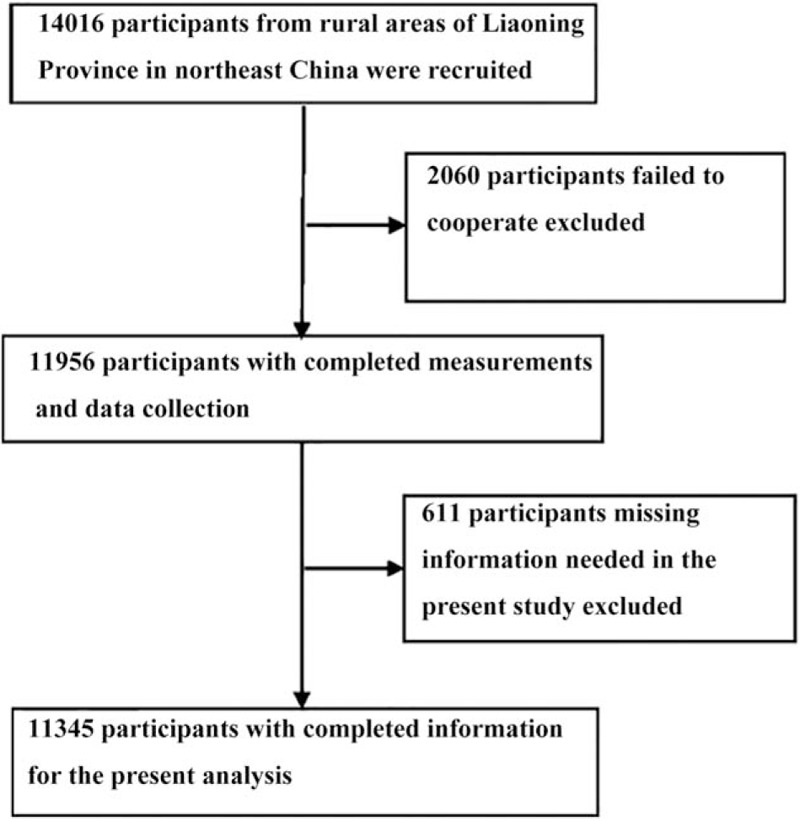
Recently, 2 new anthropometric indices, the A Body Shape Index (ABSI) and Body Roundness Index (BRI), have been developed. Our study was to compare the associations between different anthropometric indices, including ABSI, BRI, body mass index (BMI), waist circumference (WC) and waist-to-hip ratio (WHR), and hypertension in a rural population of northeast China.This cross-sectional study was conducted in the rural areas of northeast China from January 2012 to August 2013 using a multistage, stratified random cluster-sampling scheme. All eligible permanent residents aged ≥35 years (a total of 14,016 individuals) in each village were invited to participate in the study. A final sample size of 11,345 (5253 males and 6092 females) were included in this study.All the 5 anthropometric measures were positively correlated with hypertension. The prevalence of hypertension increased across quartiles for ABSI, BMI, BRI, WC, and WHR. Multivariable logistic regression analysis of the presence of hypertension for the highest quartile versus the lowest quartile of each anthropometric measure, showed that BRI had the largest values of ORs (OR: 3.49, 95% CI: 2.86-4.21 in men; OR: 3.06, 95% CI: 2.56-3.67 in women) and ABSI had the smallest ORs (OR: 1.30, 95% CI: 1.06-1.58 in men; OR: 1.19, 95% CI: 1.04-1.34 in women). BRI had the highest AROCs for hypertension (AROC: 0.65, 95% CI: 0.64-0.67 for men and AROC: 0.68, 95% CI: 0.67-0.70 for women), while ABSI had the lowest AROCs for hypertension (AROC: 0.60, 95% CI: 0.58-0.61 for men and AROC: 0.59, 95% CI: 0.58-0.61 for women).Our results showed that ABSI, BMI, BRI, WC, and WHR were all associated with hypertension. ABSI showed the weakest association with hypertension, while BRI showed potential for use as an alternative obesity measure in assessment of hypertension.
最近,新开发了两种人体测量指数,即A体型指数(ABSI)和身体圆度指数(BRI)。我们的研究旨在比较包括ABSI、BRI、体重指数(BMI)、腰围(WC)和腰臀比(WHR)在内的不同人体测量指数与中国东北农村人群高血压之间的关联。
这项横断面研究于2012年1月至2013年8月在中国东北地区农村进行,采用多阶段分层随机整群抽样方案。邀请每个村庄所有年龄≥35岁的符合条件的常住居民(共14016人)参与研究。本研究最终纳入样本量为11345人(男性5253人,女性6092人)。
所有这5种人体测量指标均与高血压呈正相关。ABSI、BMI、BRI、WC和WHR的高血压患病率随四分位数增加而升高。对每种人体测量指标的最高四分位数与最低四分位数的高血压患病情况进行多变量逻辑回归分析,结果显示BRI的比值比(OR)值最大(男性:OR = 3.49,95%置信区间:2.86 - 4.21;女性:OR = 3.06,95%置信区间:2.56 - 3.67),ABSI的OR值最小(男性:OR = 1.30,95%置信区间:1.06 - 1.58;女性:OR = 1.19,95%置信区间:1.04 -