Romera Eva M, Gómez-Ortiz Olga, Ortega-Ruiz Rosario
Department of Psychology, University of Córdoba Córdoba, Spain.
Department of Psychology, University of CórdobaCórdoba, Spain; Department of Psychology, Social Work and Counselling, University of GreenwichLondon, UK.
Front Psychol. 2016 Nov 10;7:1749. doi: 10.3389/fpsyg.2016.01749. eCollection 2016.
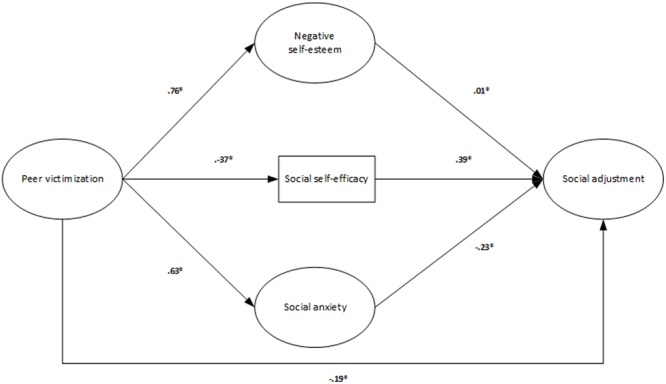
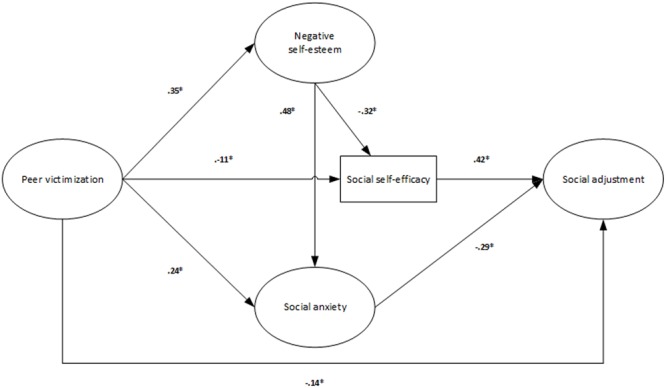
There is extensive scientific evidence of the serious psychological and social effects that peer victimization may have on students, among them internalizing problems such as anxiety or negative self-esteem, difficulties related to low self-efficacy and lower levels of social adjustment. Although a direct relationship has been observed between victimization and these effects, it has not yet been analyzed whether there is a relationship of interdependence between all these measures of psychosocial adjustment. The aim of this study was to examine the relationship between victimization and difficulties related to social adjustment among high school students. To do so, various explanatory models were tested to determine whether psychological adjustment (negative self-esteem, social anxiety and social self-efficacy) could play a mediating role in this relationship, as suggested by other studies on academic adjustment. The sample comprised 2060 Spanish high school students (47.9% girls; mean age = 14.34). The instruments used were the scale of victimization from , the negative scale from and a general item about social self-efficacy, all of them self-reports. Structural equation modeling was used to analyze the data. The results confirmed the partial mediating role of negative self-esteem, social anxiety and social self-efficacy between peer victimization and social adjustment and highlight the importance of empowering victimized students to improve their self-esteem and self-efficacy and prevent social anxiety. Such problems lead to the avoidance of social interactions and social reinforcement, thus making it difficult for these students to achieve adequate social adjustment.
有大量科学证据表明同伴侵害可能会对学生产生严重的心理和社会影响,其中包括内化问题,如焦虑或消极的自尊,与低自我效能感相关的困难以及较低水平的社会适应能力。尽管已经观察到侵害与这些影响之间存在直接关系,但尚未分析这些心理社会适应的所有指标之间是否存在相互依存关系。本研究的目的是检验高中生中侵害行为与社会适应困难之间的关系。为此,测试了各种解释模型,以确定心理适应(消极自尊、社交焦虑和社会自我效能感)是否能像其他关于学业适应的研究所表明的那样,在这种关系中发挥中介作用。样本包括2060名西班牙高中生(女生占47.9%;平均年龄 = 14.34岁)。所使用的工具包括同伴侵害量表、消极自尊量表和一个关于社会自我效能感的一般项目,均为自我报告形式。采用结构方程模型对数据进行分析。结果证实了消极自尊、社交焦虑和社会自我效能感在同伴侵害与社会适应之间的部分中介作用,并强调了增强受侵害学生的自尊和自我效能感以及预防社交焦虑的重要性。这些问题会导致回避社会互动和社会强化,从而使这些学生难以实现充分的社会适应。