Eng Felipe, Haroth Sven, Feussner Kirstin, Meldau Dorothea, Rekhter Dmitrij, Ischebeck Till, Brodhun Florian, Feussner Ivo
Cuban Research Institute on Sugar Cane Byproducts, Vía Blanca & Carretera Central 804, San Miguel del Padrón, Havana, Cuba.
Georg-August-University Göttingen, Albrecht-von-Haller-Institute for Plant Sciences, Department of Plant Biochemistry, Göttingen, Germany.
PLoS One. 2016 Dec 1;11(12):e0167627. doi: 10.1371/journal.pone.0167627. eCollection 2016.
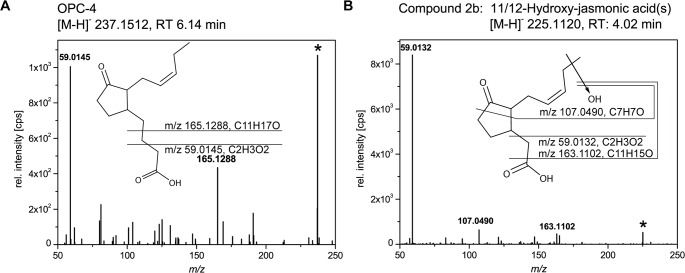
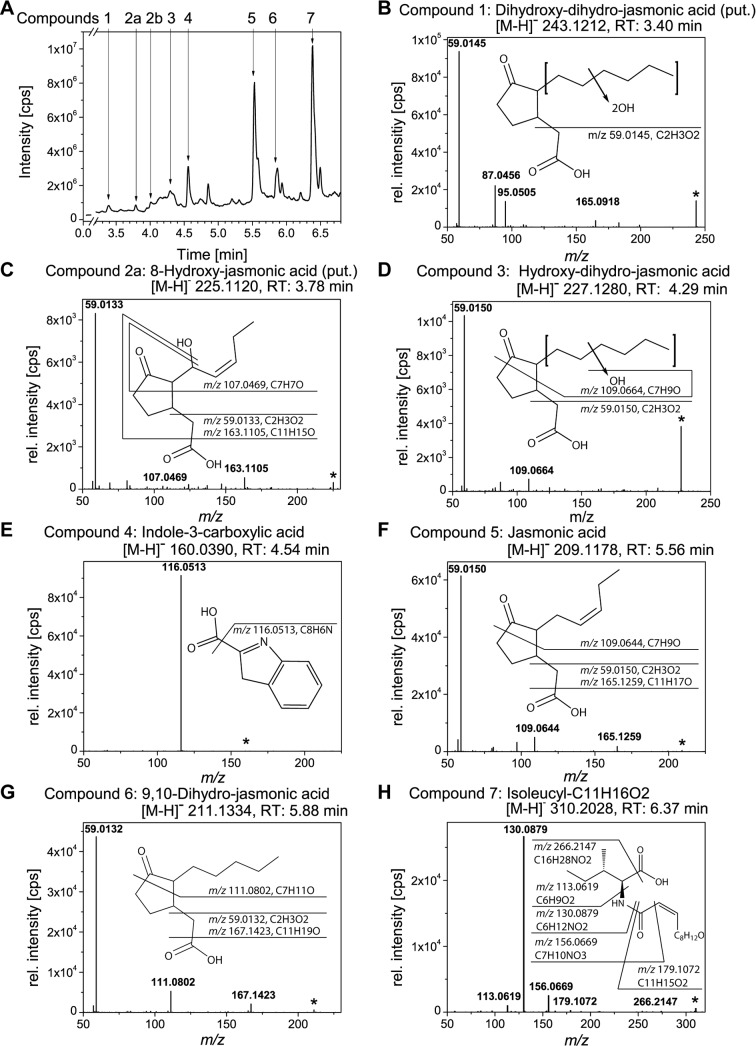
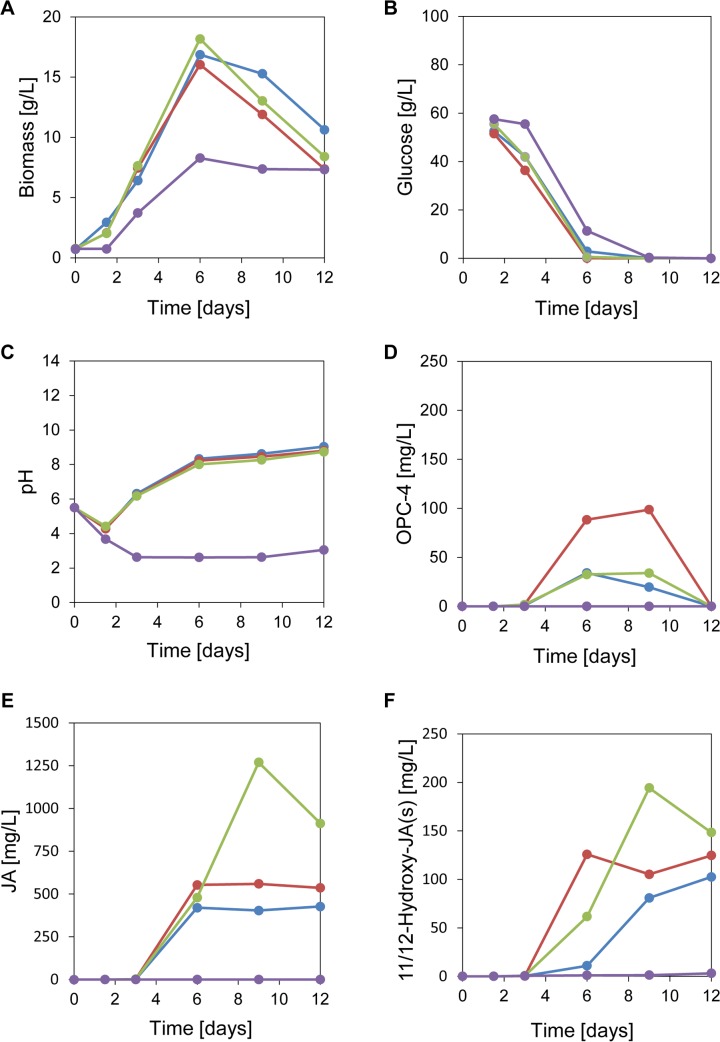
Jasmonic acid is a plant hormone that can be produced by the fungus Lasiodiplodia theobromae via submerged fermentation. From a biotechnological perspective jasmonic acid is a valuable feedstock as its derivatives serve as important ingredients in different cosmetic products and in the future it may be used for pharmaceutical applications. The objective of this work was to improve the production of jasmonic acid by L. theobromae strain 2334. We observed that jasmonic acid formation is dependent on the culture volume. Moreover, cultures grown in medium containing potassium nitrate as nitrogen source produced higher amounts of jasmonic acid than analogous cultures supplemented with ammonium nitrate. When cultivated under optimal conditions for jasmonic acid production, L. theobromae secreted several secondary metabolites known from plants into the medium. Among those we found 3-oxo-2-(pent-2-enyl)-cyclopentane-1-butanoic acid (OPC-4) and hydroxy-jasmonic acid derivatives, respectively, suggesting that fungal jasmonate metabolism may involve similar reaction steps as that of plants. To characterize fungal growth and jasmonic acid-formation, we established a mathematical model describing both processes. This model may form the basis of industrial upscaling attempts. Importantly, it showed that jasmonic acid-formation is not associated to fungal growth. Therefore, this finding suggests that jasmonic acid, despite its enormous amount being produced upon fungal development, serves merely as secondary metabolite.
茉莉酸是一种植物激素,可由可可毛色二孢菌通过深层发酵产生。从生物技术的角度来看,茉莉酸是一种有价值的原料,因为其衍生物是不同化妆品中的重要成分,并且未来可能用于制药应用。这项工作的目的是提高可可毛色二孢菌2334菌株茉莉酸的产量。我们观察到茉莉酸的形成取决于培养体积。此外,在以硝酸钾作为氮源的培养基中生长的培养物比补充硝酸铵的类似培养物产生更高量的茉莉酸。当在茉莉酸生产的最佳条件下培养时,可可毛色二孢菌将几种植物中已知的次生代谢产物分泌到培养基中。在这些产物中,我们分别发现了3-氧代-2-(戊-2-烯基)-环戊烷-1-丁酸(OPC-4)和羟基茉莉酸衍生物,这表明真菌茉莉酸代谢可能涉及与植物类似的反应步骤。为了表征真菌生长和茉莉酸形成,我们建立了一个描述这两个过程的数学模型。该模型可能构成工业放大尝试的基础。重要的是,它表明茉莉酸的形成与真菌生长无关。因此,这一发现表明,尽管在真菌发育过程中产生了大量的茉莉酸,但它仅仅作为次生代谢产物。