Sharp Tyler M, Ryff Kyle R, Alvarado Luisa, Shieh Wun-Ju, Zaki Sherif R, Margolis Harold S, Rivera-Garcia Brenda
Dengue Branch, Centers for Disease Control and Prevention (CDC).
Puerto Rico Department of Health, San Juan.
J Infect Dis. 2016 Dec 15;214(suppl 5):S475-S481. doi: 10.1093/infdis/jiw245.
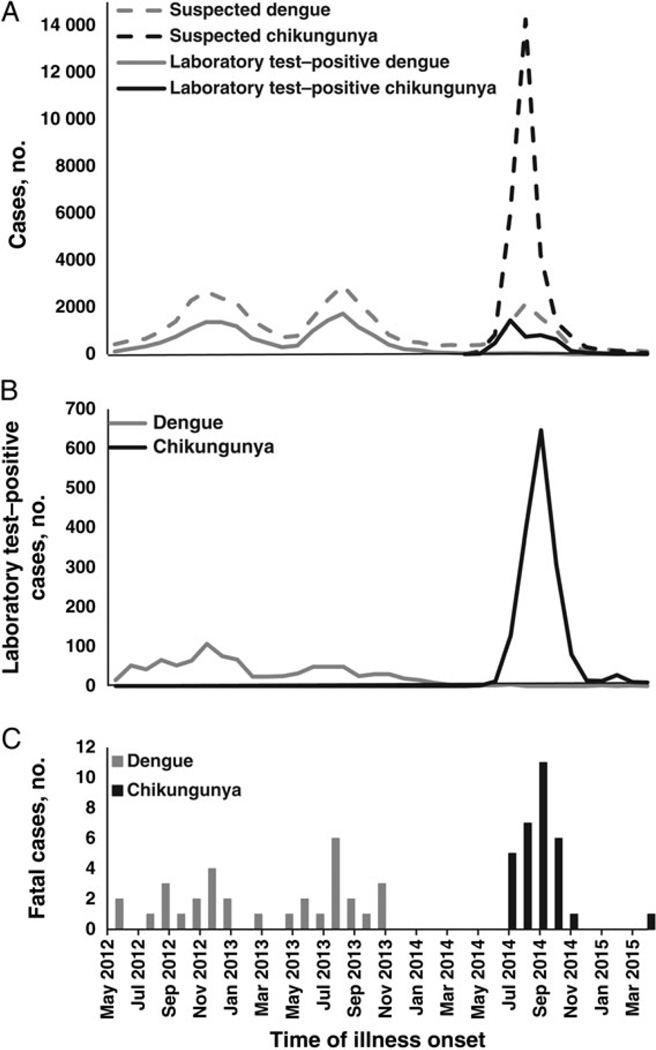
After chikungunya virus (CHIKV) transmission was detected in Puerto Rico in May 2014, multiple surveillance systems were used to describe epidemiologic trends and CHIKV-associated disease. Of 28 327 cases reported via passive surveillance, 6472 were tested for evidence of CHIKV infection, and results for 4399 (68%) were positive. Of 250 participants in household cluster investigations, 70 (28%) had evidence of recent CHIKV infection. Enhanced surveillance for chikungunya at 2 hospitals identified 1566 patients who tested positive for CHIKV, of whom 10.9% were hospitalized. Enhanced surveillance for fatal cases enabled identification of 31 cases in which CHIKV was detected in blood or tissue specimens. All surveillance systems detected a peak incidence of chikungunya in September 2014 and continued circulation in 2015. Concomitant surveillance for dengue demonstrated low incidence, which had decreased before CHIKV was introduced. Multifaceted chikungunya surveillance in Puerto Rico resolved gaps in traditional passive surveillance and enabled a holistic description of the spectrum of disease associated with CHIKV infection.
2014年5月在波多黎各检测到基孔肯雅病毒(CHIKV)传播后,采用了多种监测系统来描述流行病学趋势及与CHIKV相关的疾病。在通过被动监测报告的28327例病例中,6472例接受了CHIKV感染证据检测,4399例(68%)结果呈阳性。在250名家庭聚集性调查参与者中,70名(28%)有近期CHIKV感染证据。两家医院加强了对基孔肯雅热的监测,共发现1566例CHIKV检测呈阳性的患者,其中10.9%住院治疗。加强对死亡病例的监测后,在31例血液或组织标本中检测到CHIKV。所有监测系统均显示,2014年9月基孔肯雅热发病率达到峰值,并在2015年持续传播。同时进行的登革热监测显示发病率较低,在引入CHIKV之前就已下降。波多黎各对基孔肯雅热的多方面监测弥补了传统被动监测的不足,能够全面描述与CHIKV感染相关的疾病谱。