Simmons Graham, Brès Vanessa, Lu Kai, Liss Nathan M, Brambilla Donald J, Ryff Kyle R, Bruhn Roberta, Velez Edwin, Ocampo Derrek, Linnen Jeffrey M, Latoni Gerardo, Petersen Lyle R, Williamson Phillip C, Busch Michael P
Emerg Infect Dis. 2016 Jul;22(7):1221-8. doi: 10.3201/eid2207.160116. Epub 2016 Jul 15.
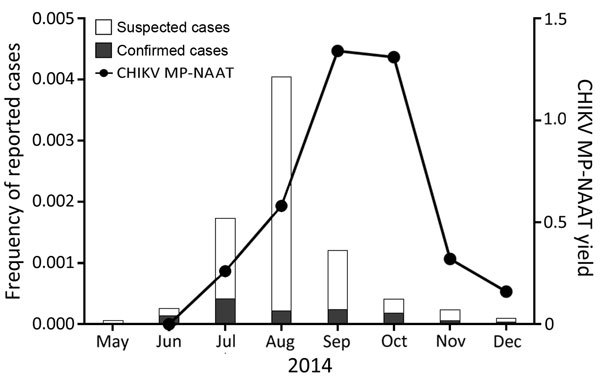
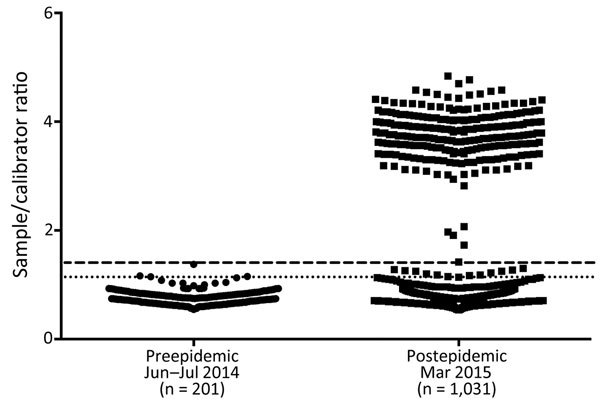
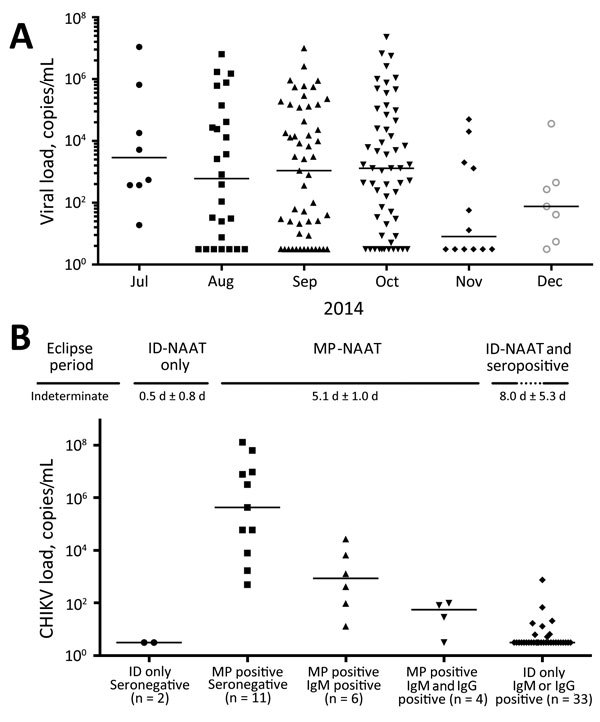
Chikungunya virus (CHIKV) caused large epidemics throughout the Caribbean in 2014. We conducted nucleic acid amplification testing (NAAT) for CHIKV RNA (n = 29,695) and serologic testing for IgG against CHIKV (n = 1,232) in archived blood donor samples collected during and after an epidemic in Puerto Rico in 2014. NAAT yields peaked in October with 2.1% of donations positive for CHIKV RNA. A total of 14% of NAAT-reactive donations posed a high risk for virus transmission by transfusion because of high virus RNA copy numbers (10 (4) -10 (9) RNA copies/mL) and a lack of specific IgM and IgG responses. Testing of minipools of 16 donations would not have detected 62.5% of RNA-positive donations detectable by individual donor testing, including individual donations without IgM and IgG. Serosurveys before and after the epidemic demonstrated that nearly 25% of blood donors in Puerto Rico acquired CHIKV infections and seroconverted during the epidemic.
基孔肯雅病毒(CHIKV)在2014年引发了加勒比地区的大规模疫情。我们对2014年波多黎各疫情期间及之后采集的存档献血者样本进行了CHIKV RNA的核酸扩增检测(NAAT)(n = 29,695)以及针对CHIKV的IgG血清学检测(n = 1,232)。NAAT阳性率在10月达到峰值,2.1%的献血样本CHIKV RNA呈阳性。由于病毒RNA拷贝数高(10⁴ - 10⁹ RNA拷贝/毫升)且缺乏特异性IgM和IgG反应,总共14%的NAAT反应性献血样本存在输血传播病毒的高风险。对16份献血样本进行混合检测无法检测出个体献血者检测可发现的62.5%的RNA阳性样本,包括没有IgM和IgG的个体样本。疫情前后的血清学调查表明,波多黎各近25%的献血者在疫情期间感染了CHIKV并发生了血清转化。