Kalter-Leibovici Ofra, Chetrit Angela, Avni Shlomit, Averbuch Emma, Novikov Ilya, Daoud Nihaya
Unit of Cardiovascular Epidemiology, The Gertner Institute for Epidemiology & Health Policy Research, Tel-Hashomer, Israel ; Sackler Faculty of Medicine, Tel-Aviv University, Tel-Aviv, Israel.
Unit of Cardiovascular Epidemiology, The Gertner Institute for Epidemiology & Health Policy Research, Tel-Hashomer, Israel.
Isr J Health Policy Res. 2016 Dec 1;5:36. doi: 10.1186/s13584-016-0095-2. eCollection 2016.
Cigarette smoking is a major cause of health disparities. We aimed to determine social characteristics associated with smoking status and age at smoking initiation in the ethnically-diverse population of Israel.
This is a cross-sectional survey, based on data collected during 2010 by the Israel Bureau of Statistics, in a representative nationwide sample of 7,524 adults (≥20 years). Information collected by personal interviews included a broad set of demographic and socio-economic characteristics and detailed information on smoking habits. Associations between social characteristics and smoking habits were tested in multivariable regression models.
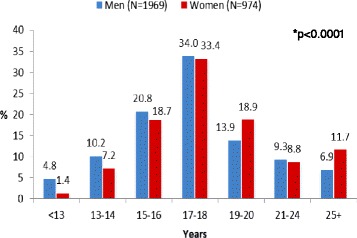
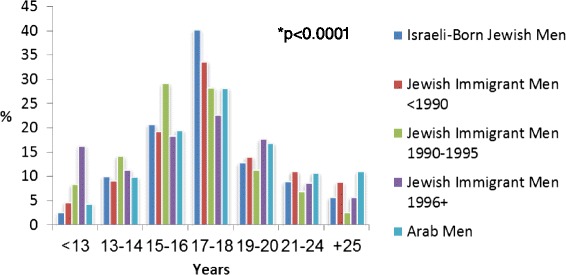
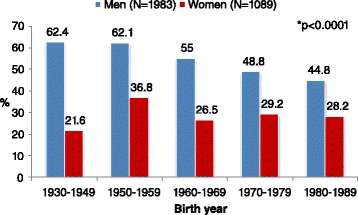
Current smoking was more frequent among men than among women (30.9 % vs. 16.8 %; < 0.0001). In multivariable regression analysis, the association of some social characteristics with smoking status differed by gender. Lower socioeconomic status (reflected by higher rate of unemployment, lower income, possession of fewer material assets, difficulty to meet living expenses) and lower educational level were significantly associated with current smoking among men but not among women. Family status other than being married was associated with higher likelihood of being a current smoker, while being traditional or observant was associated with a lower likelihood of ever smoking among both gender groups. Arab minority men and male immigrants from the former Soviet Union countries were more frequently current smokers than Israeli-born Jewish men [adjusted odds ratio (95 % confidence interval): 1.53 (1.22, 1.93) and 1.37 (1.01-1.87), respectively]. Compared to Israeli-born men, the age at smoking initiation was younger among male immigrants, and older among Arab minority men [adjusted hazard ratio (95 % confidence interval): 1.360 (1.165-1.586), and 0.849 (0.749-0.962), respectively]. While the prevalence of current smoking was lower in younger birth cohorts, the age at smoking initiation among ever-smokers declined as well.
Among several subgroups within the Israeli population the smoking uptake is high, e.g. Arab men, men who are less affluent, who have lower educational level, and male immigrants. These subgroups should be prioritized for intervention to reduce the burden of smoking. To be effective, gender, cultural background and socioeconomic characteristics should be considered in the design and implementation of culturally-congruent tobacco control and smoking prevention and cessation interventions.
吸烟是导致健康差异的主要原因。我们旨在确定以色列多民族人口中与吸烟状况及开始吸烟年龄相关的社会特征。
这是一项横断面调查,基于以色列统计局2010年收集的数据,样本为具有全国代表性的7524名成年人(≥20岁)。通过个人访谈收集的信息包括一系列广泛的人口统计学和社会经济特征以及关于吸烟习惯的详细信息。在多变量回归模型中测试社会特征与吸烟习惯之间的关联。
当前吸烟在男性中比在女性中更常见(30.9%对16.8%;<0.0001)。在多变量回归分析中,一些社会特征与吸烟状况的关联因性别而异。较低的社会经济地位(以较高的失业率、较低的收入、拥有较少的物质资产、难以维持生活费用来反映)和较低的教育水平与男性当前吸烟显著相关,但与女性无关。非已婚的家庭状况与当前吸烟的可能性较高相关,而传统或虔诚在两个性别群体中都与曾经吸烟的可能性较低相关。阿拉伯少数民族男性和来自前苏联国家的男性移民比以色列出生的犹太男性更常为当前吸烟者[调整后的优势比(95%置信区间):分别为1.53(1.22,1.93)和1.37(1.01 - 1.87)]。与以色列出生的男性相比,男性移民开始吸烟的年龄更年轻,而阿拉伯少数民族男性则更年长[调整后的风险比(95%置信区间):分别为1.360(1.165 - 1.586)和0.849(0.749 - 0.962)]。虽然在较年轻的出生队列中当前吸烟的患病率较低,但曾经吸烟者开始吸烟的年龄也有所下降。
在以色列人口的几个亚组中,吸烟率较高,例如阿拉伯男性、较不富裕的男性、教育水平较低的男性以及男性移民。这些亚组应被优先干预以减轻吸烟负担。为了有效,在设计和实施符合文化的烟草控制及吸烟预防与戒烟干预措施时,应考虑性别、文化背景和社会经济特征。