
痴呆症患者脑电图特征的正则化线性判别分析
Regularized Linear Discriminant Analysis of EEG Features in Dementia Patients.
作者信息
Neto Emanuel, Biessmann Felix, Aurlien Harald, Nordby Helge, Eichele Tom
机构信息
Section for Clinical Neurophysiology, Haukeland University HospitalBergen, Norway; Institute of Biological and Medical Psychology, University of BergenBergen, Norway.
Amazon Development Center Germany Berlin, Germany.
出版信息
Front Aging Neurosci. 2016 Nov 30;8:273. doi: 10.3389/fnagi.2016.00273. eCollection 2016.
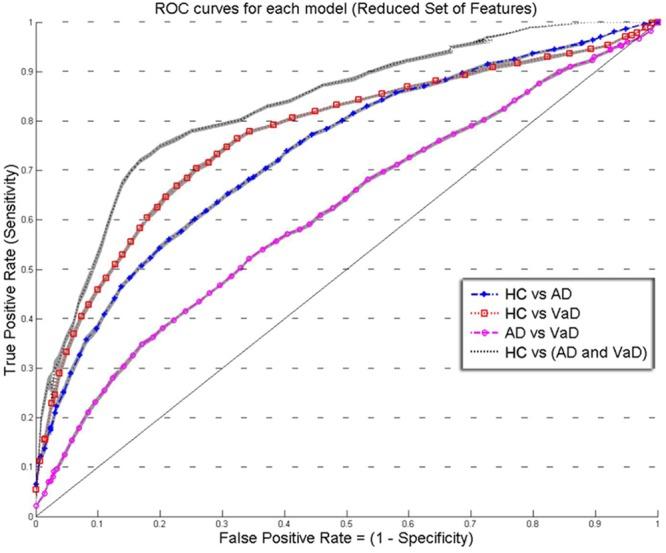
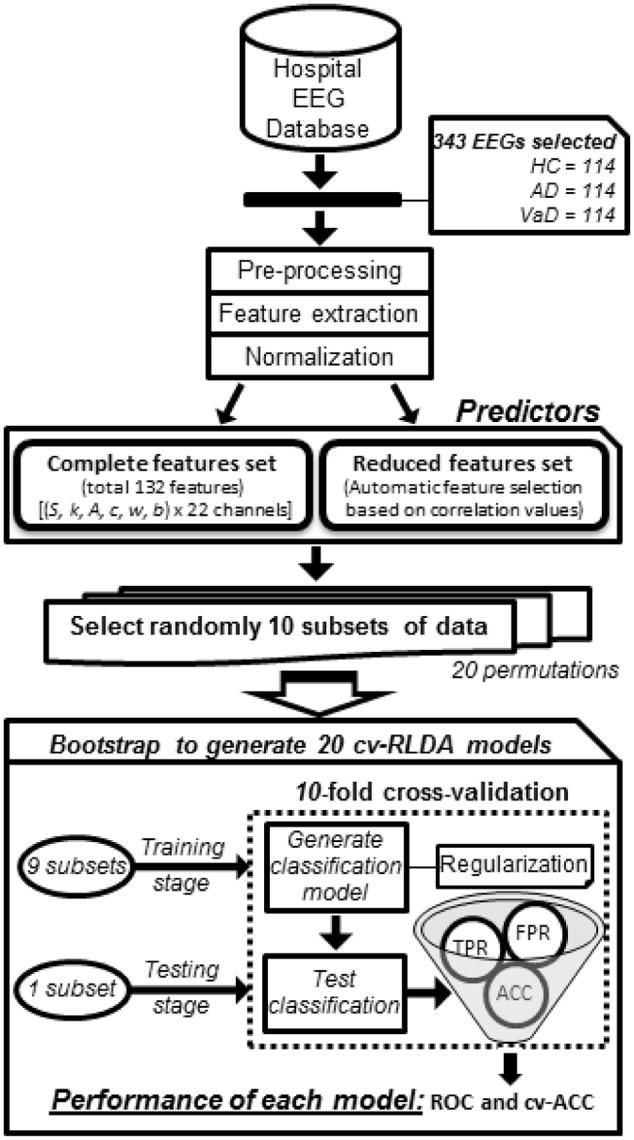
The present study explores if EEG spectral parameters can discriminate between healthy elderly controls (HC), Alzheimer's disease (AD) and vascular dementia (VaD) using. We considered EEG data recorded during normal clinical routine with 114 healthy controls (HC), 114 AD, and 114 VaD patients. The spectral features extracted from the EEG were the absolute delta power, decay from lower to higher frequencies, amplitude, center and dispersion of the alpha power and baseline power of the entire frequency spectrum. For discrimination, we submitted these EEG features to regularized linear discriminant analysis algorithm with a 10-fold cross-validation. To check the consistency of the results obtained by our classifiers, we applied bootstrap statistics. Four binary classifiers were used to discriminate HC from AD, HC from VaD, AD from VaD, and HC from dementia patients (AD or VaD). For each model, we measured the discrimination performance using the area under curve (AUC) and the accuracy of the cross-validation (cv-ACC). We applied this procedure using two different sets of predictors. The first set considered all the features extracted from the 22 channels. For the second set of features, we automatically rejected features poorly correlated with their labels. Fairly good results were obtained when discriminating HC from dementia patients with AD or VaD (AUC = 0.84). We also obtained AUC = 0.74 for discrimination of AD from HC, AUC = 0.77 for discrimination of VaD from HC, and finally AUC = 0.61 for discrimination of AD from VaD. Our models were able to separate HC from dementia patients, and also and to discriminate AD from VaD above chance. Our results suggest that these features may be relevant for the clinical assessment of patients with dementia.
本研究探讨脑电图频谱参数能否用于区分健康老年对照组(HC)、阿尔茨海默病(AD)和血管性痴呆(VaD)。我们考虑了在正常临床常规检查期间记录的脑电图数据,其中包括114名健康对照者(HC)、114名AD患者和114名VaD患者。从脑电图中提取的频谱特征包括绝对δ功率、从低频到高频的衰减、α功率的幅度、中心频率和离散度以及整个频谱的基线功率。为了进行区分,我们将这些脑电图特征提交给具有10倍交叉验证的正则化线性判别分析算法。为了检验我们的分类器所获得结果的一致性,我们应用了自助法统计。使用四个二元分类器来区分HC与AD、HC与VaD、AD与VaD以及HC与痴呆患者(AD或VaD)。对于每个模型,我们使用曲线下面积(AUC)和交叉验证的准确率(cv-ACC)来测量区分性能。我们使用两组不同的预测变量应用了此程序。第一组考虑从22个通道提取的所有特征。对于第二组特征,我们自动剔除了与标签相关性较差的特征。在区分HC与患有AD或VaD的痴呆患者时获得了相当好的结果(AUC = 0.84)。我们还获得了区分AD与HC的AUC = 0.74、区分VaD与HC的AUC = 0.77,最后区分AD与VaD的AUC = 0.61。我们的模型能够将HC与痴呆患者区分开来,并且也能够在高于机遇水平的情况下区分AD与VaD。我们的结果表明,这些特征可能与痴呆患者的临床评估相关。

 Zotero 插件