Ameratunga Rohan, Bartlett Adam, McCall John, Steele Richard, Woon See-Tarn, Katelaris Constance H
Department of Clinical Immunology, Auckland Hospital, Auckland, New Zealand; Department of Virology and Immunology, Auckland Hospital, Auckland, New Zealand.
Liver Transplantation Service, Auckland Hospital , Auckland , New Zealand.
Front Immunol. 2016 Nov 30;7:547. doi: 10.3389/fimmu.2016.00547. eCollection 2016.
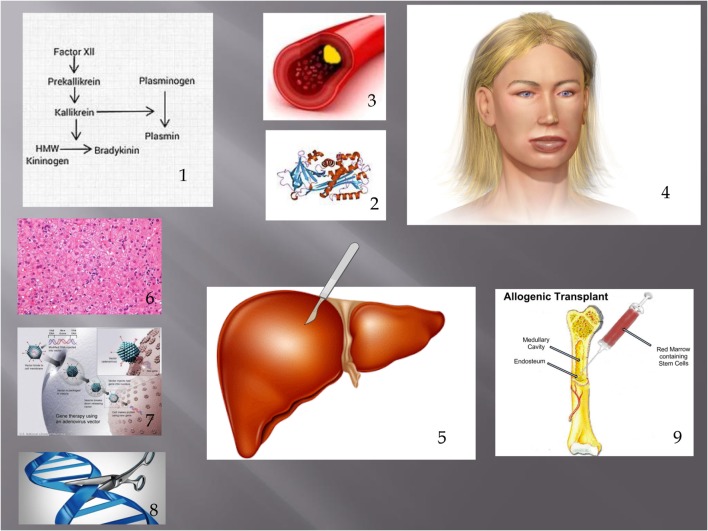
Hereditary angioedema (HAE) is a rare autosomal dominant disorder caused by mutations of the SERPING1 or the Factor 12 genes. It is potentially fatal, particularly if not identified at an early stage. Apart from androgens, which are contraindicated in children and in pregnant women, a range of effective, albeit very expensive treatments have recently become available for HAE patients. The cost of these new treatments is beyond the reach of most developing countries. At this time, there is no cure for the disorder. In spite of mutations of the SERPING1 gene, autoimmunity and infections are not prominent features of the condition. Here, we present the argument that HAE should be viewed primarily as a metabolic liver disorder. This conceptual paradigm shift will stimulate basic research and may facilitate new therapeutic approaches to HAE outlined in this paper. We suggest several novel potential treatment options for HAE from the perspectives of clinical immunology, molecular biology, and liver transplantation. Many of these offer the prospect of curing the disorder. The effectiveness of these options is rapidly improving in many cases, and their risks are decreasing. Given the very high costs of treating HAE, some of these curative options may become feasible in the next decade.
遗传性血管性水肿(HAE)是一种由SERPING1基因或凝血因子12基因突变引起的罕见常染色体显性疾病。它可能是致命的,尤其是在早期未被识别的情况下。除了儿童和孕妇禁用的雄激素外,最近一系列有效的治疗方法已可供HAE患者使用,尽管这些治疗方法非常昂贵。这些新治疗方法的费用超出了大多数发展中国家的承受能力。目前,这种疾病无法治愈。尽管存在SERPING1基因突变,但自身免疫和感染并非该疾病的突出特征。在此,我们提出HAE应主要被视为一种代谢性肝脏疾病的观点。这种概念范式的转变将刺激基础研究,并可能促进本文概述的针对HAE的新治疗方法。我们从临床免疫学、分子生物学和肝移植的角度提出了几种针对HAE的新型潜在治疗选择。其中许多提供了治愈该疾病的前景。在许多情况下,这些选择的有效性正在迅速提高,风险也在降低。鉴于治疗HAE的成本非常高,其中一些治愈性选择在未来十年可能会变得可行。