Department of Health Service and Population Research, Institute of Psychiatry, Psychology & Neuroscience, King's College London, London.
Department of Primary Care and Public Health Sciences, King's College London, London.
Diabet Med. 2017 Jul;34(7):916-924. doi: 10.1111/dme.13298. Epub 2017 Jan 30.
To investigate whether the association of severe mental illness with Type 2 diabetes varies by ethnicity and age.
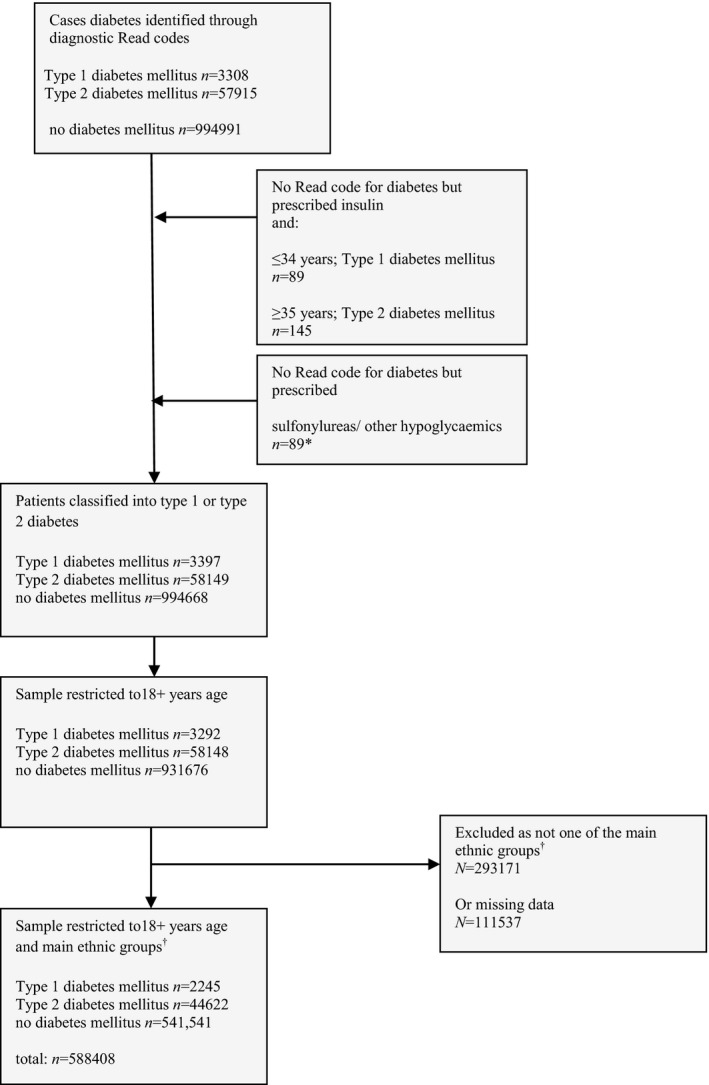
We conducted a cross-sectional analysis of data from an ethnically diverse sample of 588 408 individuals aged ≥18 years, registered to 98% of general practices (primary care) in London, UK. The outcome of interest was prevalent Type 2 diabetes.
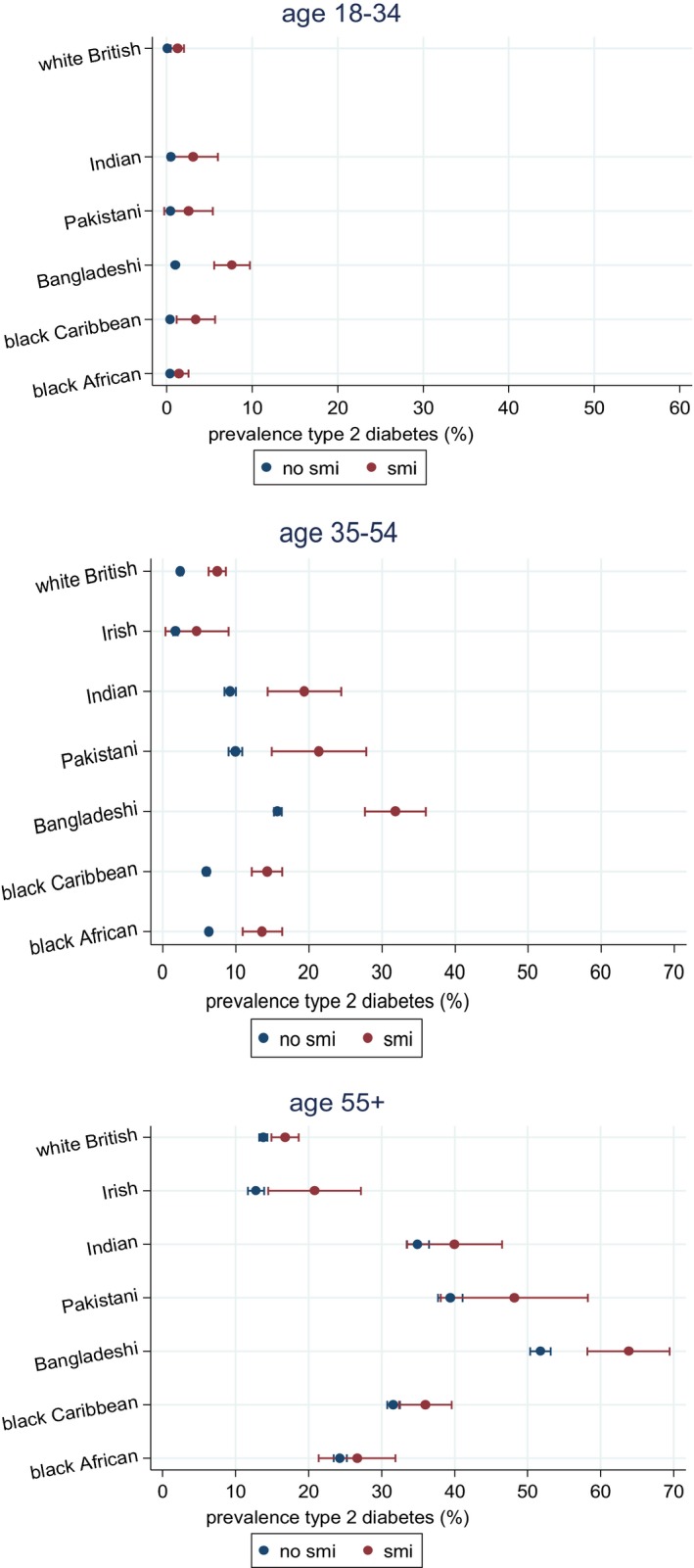
Relative to people without severe mental illness, the relative risk of Type 2 diabetes in people with severe mental illness was greatest in the youngest age groups. In the white British group the relative risks were 9.99 (95% CI 5.34, 18.69) in those aged 18-34 years, 2.89 (95% CI 2.43, 3.45) in those aged 35-54 years and 1.16 (95% CI 1.04, 1.30) in those aged ≥55 years, with similar trends across all ethnic minority groups. Additional adjustment for anti-psychotic prescriptions only marginally attenuated the associations. Assessment of estimated prevalence of Type 2 diabetes in severe mental illness by ethnicity (absolute measures of effect) indicated that the association between severe mental illness and Type 2 diabetes was more marked in ethnic minorities than in the white British group with severe mental illness, especially for Indian, Pakistani and Bangladeshi individuals with severe mental illness.
The relative risk of Type 2 diabetes is elevated in younger populations. Most associations persisted despite adjustment for anti-psychotic prescriptions. Ethnic minority groups had a higher prevalence of Type 2 diabetes in the presence of severe mental illness. Future research and policy, particularly with respect to screening and clinical care for Type 2 diabetes in populations with severe mental illness, should take these findings into account.
调查严重精神疾病与 2 型糖尿病的相关性是否因种族和年龄而异。
我们对来自英国伦敦 98%的普通诊所(初级保健)注册的 588408 名年龄≥18 岁的种族多样化样本进行了横断面分析。研究的结局指标是 2 型糖尿病的患病率。
与无严重精神疾病的个体相比,严重精神疾病患者发生 2 型糖尿病的相对风险在年龄最小的组最高。在白种英国人组中,18-34 岁人群的相对风险为 9.99(95%CI 5.34,18.69),35-54 岁人群为 2.89(95%CI 2.43,3.45),≥55 岁人群为 1.16(95%CI 1.04,1.30),所有少数族裔人群均呈现出类似的趋势。仅对抗精神病药物处方进行额外调整略微减弱了这些关联。根据种族评估严重精神疾病患者 2 型糖尿病的估计患病率(效应的绝对衡量)表明,与白种英国人组相比,严重精神疾病与 2 型糖尿病之间的关联在少数族裔中更为明显,尤其是患有严重精神疾病的印度、巴基斯坦和孟加拉国个体。
2 型糖尿病的相对风险在年轻人群中升高。尽管调整了抗精神病药物处方,但大多数关联仍然存在。在严重精神疾病的情况下,少数族裔人群的 2 型糖尿病患病率更高。未来的研究和政策,特别是在严重精神疾病人群中 2 型糖尿病的筛查和临床护理方面,应考虑到这些发现。