Janzén David L I, Bergenholm Linnéa, Jirstrand Mats, Parkinson Joanna, Yates James, Evans Neil D, Chappell Michael J
Biomedical and Biological Systems Laboratory, School of Engineering, University of WarwickCoventry, UK; Drug Metabolism and Pharmacokinetics, Cardiovascular and Metabolic Diseases, iMED, AstraZenecaGothenburg, Sweden; Fraunhofer-Chalmers Centre, Chalmers Science ParkGothenburg, Sweden.
Biomedical and Biological Systems Laboratory, School of Engineering, University of WarwickCoventry, UK; Drug Metabolism and Pharmacokinetics, Cardiovascular and Metabolic Diseases, iMED, AstraZenecaGothenburg, Sweden.
Front Physiol. 2016 Dec 5;7:590. doi: 10.3389/fphys.2016.00590. eCollection 2016.
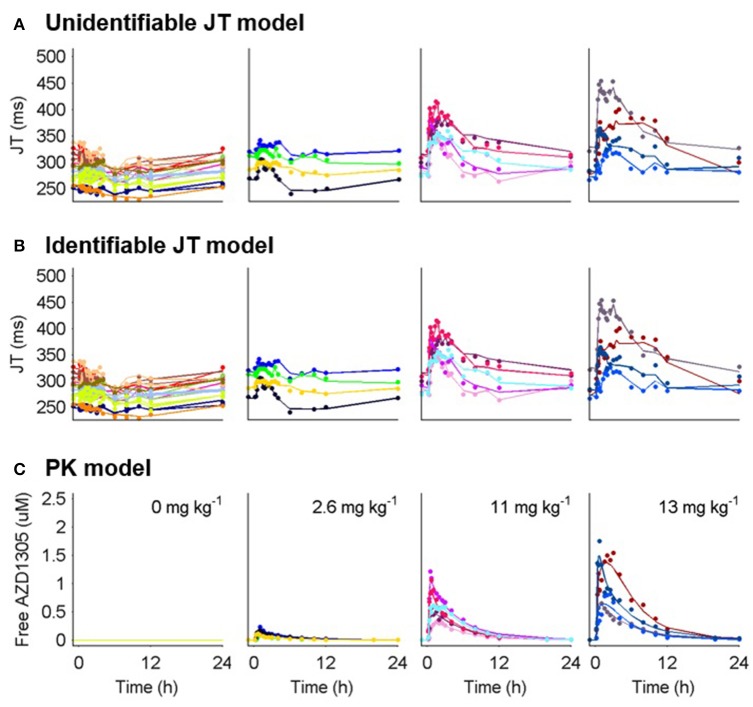
Issues of parameter identifiability of routinely used pharmacodynamics models are considered in this paper. The structural identifiability of 16 commonly applied pharmacodynamic model structures was analyzed analytically, using the input-output approach. Both fixed-effects versions (non-population, no between-subject variability) and mixed-effects versions (population, including between-subject variability) of each model structure were analyzed. All models were found to be structurally globally identifiable under conditions of fixing either one of two particular parameters. Furthermore, an example was constructed to illustrate the importance of sufficient data quality and show that structural identifiability is a prerequisite, but not a guarantee, for successful parameter estimation and practical parameter identifiability. This analysis was performed by generating artificial data of varying quality to a structurally identifiable model with known true parameter values, followed by re-estimation of the parameter values. In addition, to show the benefit of including structural identifiability as part of model development, a case study was performed applying an unidentifiable model to real experimental data. This case study shows how performing such an analysis prior to parameter estimation can improve the parameter estimation process and model performance. Finally, an unidentifiable model was fitted to simulated data using multiple initial parameter values, resulting in highly different estimated uncertainties. This example shows that although the standard errors of the parameter estimates often indicate a structural identifiability issue, reasonably "good" standard errors may sometimes mask unidentifiability issues.
本文探讨了常用药效学模型的参数可识别性问题。采用输入-输出方法,对16种常用药效学模型结构的结构可识别性进行了分析。分析了每种模型结构的固定效应版本(非群体,无个体间变异性)和混合效应版本(群体,包括个体间变异性)。结果发现,在固定两个特定参数中的任何一个的条件下,所有模型在结构上都是全局可识别的。此外,构建了一个示例来说明足够数据质量的重要性,并表明结构可识别性是成功进行参数估计和实际参数可识别性的前提条件,但不是保证。该分析通过向具有已知真实参数值的结构可识别模型生成不同质量的人工数据,然后重新估计参数值来进行。此外,为了展示将结构可识别性纳入模型开发的好处,进行了一个案例研究,将一个不可识别的模型应用于实际实验数据。该案例研究展示了在参数估计之前进行此类分析如何能够改进参数估计过程和模型性能。最后,使用多个初始参数值将一个不可识别的模型拟合到模拟数据上,导致估计的不确定性差异很大。这个例子表明,尽管参数估计的标准误差通常表明存在结构可识别性问题,但合理的“良好”标准误差有时可能掩盖不可识别性问题。