Cobiac Linda J, Scarborough Peter, Kaur Asha, Rayner Mike
Centre for Health Policy, School of Population and Global Health, The University of Melbourne, Melbourne, Australia.
British Heart Foundation Centre on Population Approaches for Non-Communicable Disease Prevention, Nuffield Department of Population Health, University of Oxford, Oxford, United Kingdom.
PLoS One. 2016 Dec 20;11(12):e0167859. doi: 10.1371/journal.pone.0167859. eCollection 2016.
To model population health impacts of dietary changes associated with the redevelopment of the UK food-based dietary guidelines (the 'Eatwell Guide').
Using multi-state lifetable methods, we modelled the impact of dietary changes on cardiovascular disease, diabetes and cancers over the lifetime of the current UK population. From this model, we determined change in life expectancy and disability-adjusted life years (DALYs) that could be averted.
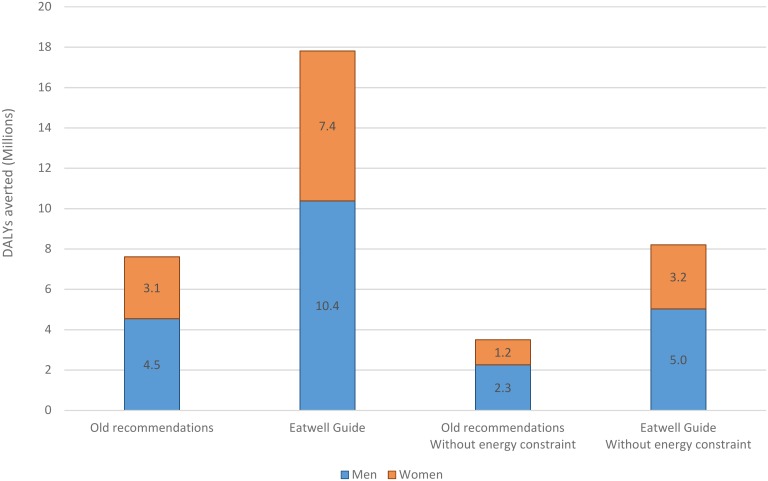
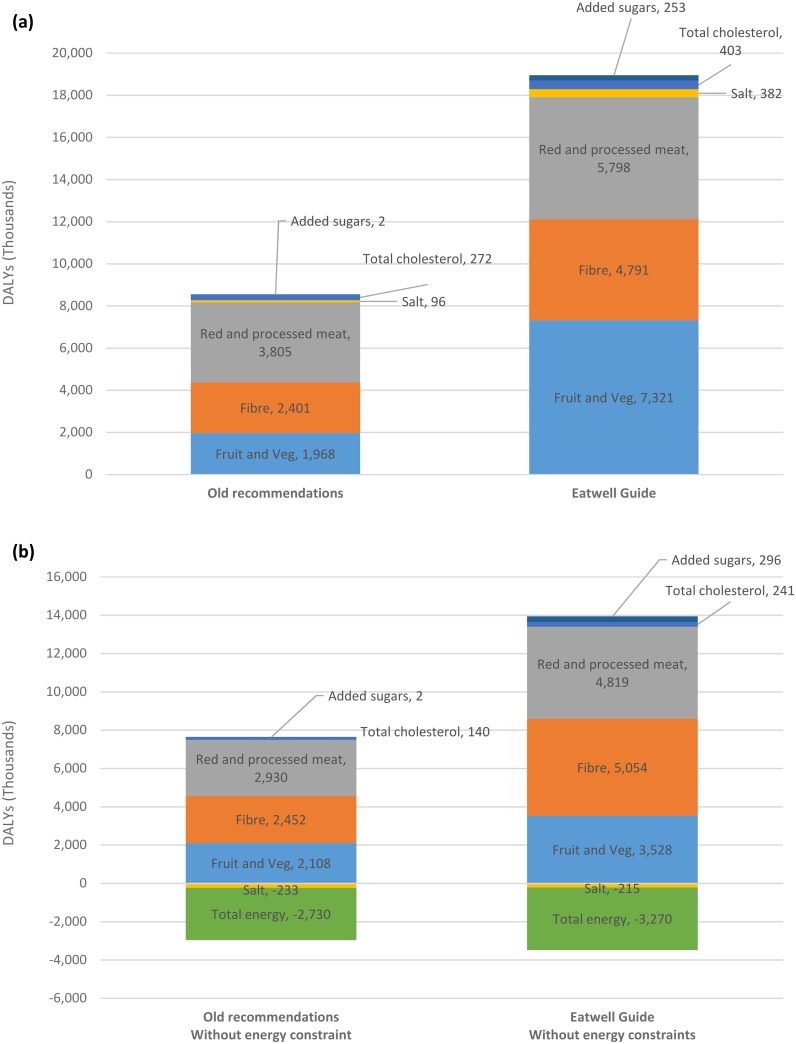
Changing the average diet to that recommended in the new Eatwell Guide, without increasing total energy intake, could increase average life expectancy by 5.4 months (95% uncertainty interval: 4.7 to 6.2) for men and 4.0 months (3.4 to 4.6) for women; and avert 17.9 million (17.6 to 18.2) DALYs over the lifetime of the current population. A large proportion of the health benefits are from prevention of type 2 diabetes, with 440,000 (400,000 to 480,000) new cases prevented in men and 340,000 (310,000 to 370,000) new cases prevented in women, over the next ten years. Prevention of cardiovascular diseases and colorectal cancer is also large. However, if the diet recommended in the new Eatwell Guide is achieved with an accompanying increase in energy intake (and thus an increase in body mass index), around half the potential improvements in population health will not be realised.
The dietary changes required to meet recommendations in the Eatwell Guide, which include eating more fruits and vegetables and less red and processed meats and dairy products, are large. However, the potential population health benefits are substantial.
对与英国基于食物的膳食指南(“饮食指南”)重新制定相关的饮食变化对人群健康的影响进行建模。
我们使用多状态生命表方法,对当前英国人群一生中饮食变化对心血管疾病、糖尿病和癌症的影响进行建模。通过该模型,我们确定了预期寿命的变化以及可以避免的伤残调整生命年(DALYs)。
在不增加总能量摄入的情况下,将平均饮食改为新饮食指南中推荐的饮食,男性的平均预期寿命可增加5.4个月(95%不确定区间:4.7至6.2),女性可增加4.0个月(3.4至4.6);在当前人群的一生中可避免1790万(1760至1820)个伤残调整生命年。大部分健康益处来自2型糖尿病的预防,在未来十年中,男性可预防44万(40万至48万)例新发病例,女性可预防34万(31万至37万)例新发病例。心血管疾病和结直肠癌的预防效果也很显著。然而,如果在遵循新饮食指南推荐饮食的同时能量摄入增加(从而体重指数增加),那么人群健康方面大约一半的潜在改善将无法实现。
要达到饮食指南中的建议所需的饮食变化幅度很大,包括多吃水果和蔬菜,少吃红肉、加工肉类和乳制品。然而,对人群健康的潜在益处是巨大的。