Jiang Haiying, Li Juan, Li Linmiao, Zhang Xiujuan, Yuan Lihong, Chen Jinping
Guangdong Key Laboratory of Animal Conservation and Resource Utilization, Guangdong Public Laboratory of Wild Animal Conservation and Utilization, Guangdong Institute of Applied Biological Resources, Guangzhou, China.
Immunogenetics. 2017 Apr;69(4):271-285. doi: 10.1007/s00251-016-0966-2. Epub 2016 Dec 24.
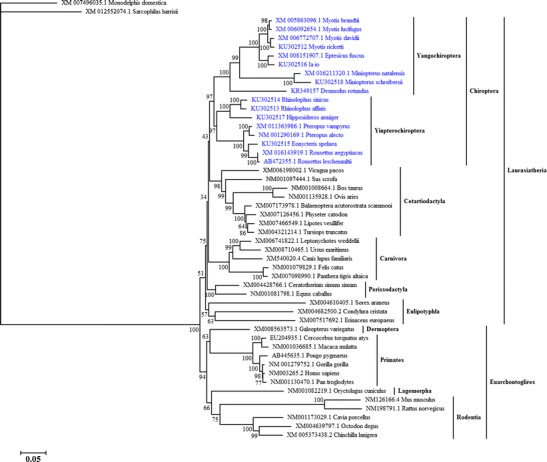
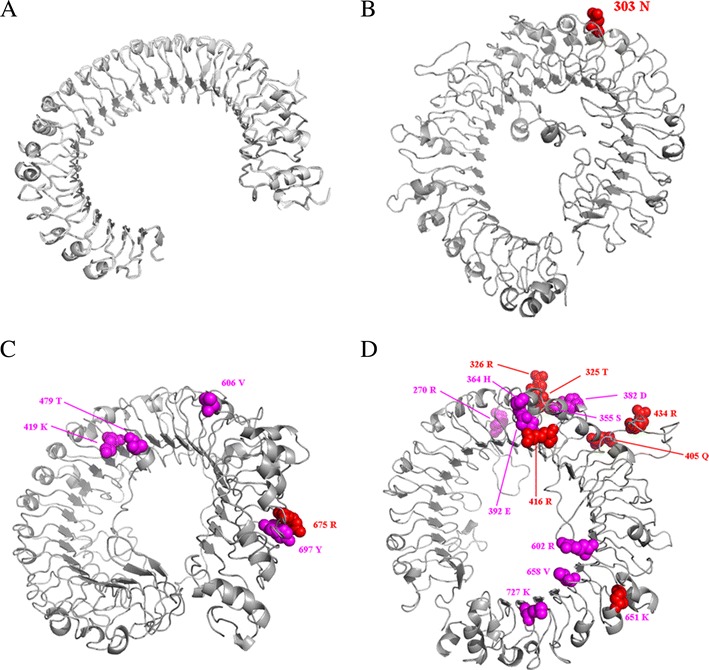
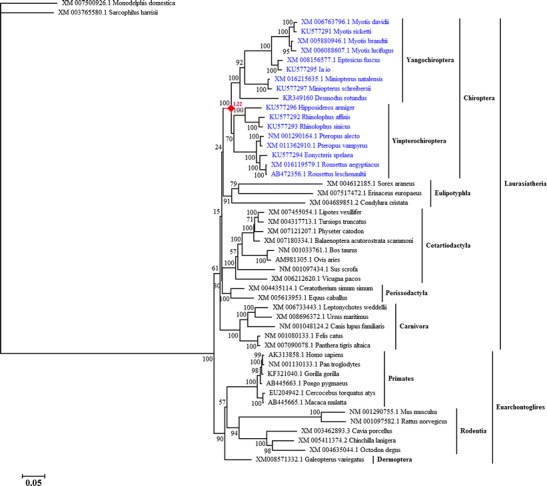
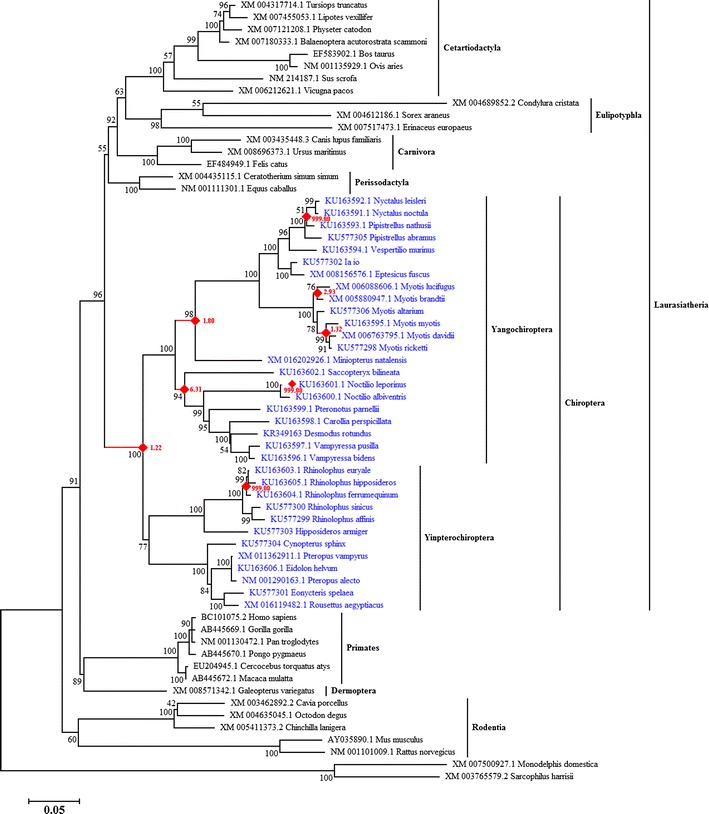
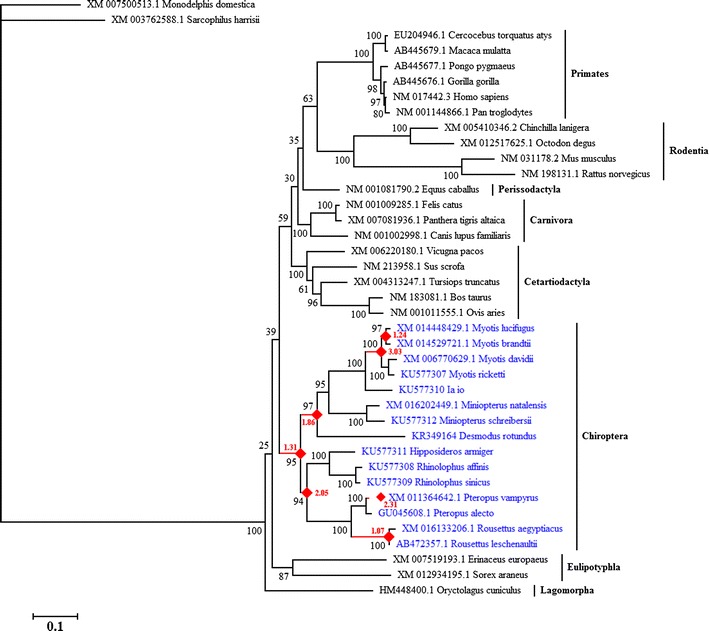
Previous studies have shown that bats are reservoirs of a large number of viruses, many of which cause illness and mortality in humans and other animals. However, these bat-associated pathogens cause little, if any, clinicopathology in bats. This long-term adaptation should be reflected somewhat in the immune system. Toll-like receptors (TLRs) are the first line of immune defense against pathogens in vertebrates. Therefore, this study focuses on the selection of TLRs involved in virus recognition. The coding sequences of TLR3, TLR7, TLR8, and TLR9 were sequenced in ten bats. The selection pressure acting on each gene was also detected using branch- and site-specific methods. The results showed that the ancestor of bats and certain other bat sublineages evolved under positive selection for TLR7, TLR8, and TLR9. The highest proportion of positive selection occurred in TLR9, followed by TLR8 and TLR7. All of the positively selected sites were located in the leucine-rich repeat (LRR) domain, which implied their important roles in pathogen recognition. However, TLR3 evolved under negative selection. Our results are not in line with previous studies which identified more positively selected sites in TLR8 in mammalian species. In this study, the most positively selected sites were found in TLR9. This study encompassed more species that were considered natural reservoirs of viruses. The positive selection for TLR7, TLR8, and TLR9 might contribute to the adaptation of pathogen-host interaction in bats, especially in bat TLR9.
先前的研究表明,蝙蝠是大量病毒的宿主,其中许多病毒会导致人类和其他动物患病和死亡。然而,这些与蝙蝠相关的病原体在蝙蝠身上几乎不会引起临床病理学变化(如果有也是极少的)。这种长期适应在某种程度上应该会在免疫系统中有所体现。Toll样受体(TLRs)是脊椎动物抵御病原体的第一道免疫防线。因此,本研究聚焦于参与病毒识别的TLRs的选择。对10只蝙蝠的TLR3、TLR7、TLR8和TLR9的编码序列进行了测序。还使用分支特异性和位点特异性方法检测了作用于每个基因的选择压力。结果表明,蝙蝠的祖先以及某些其他蝙蝠亚谱系在TLR7、TLR8和TLR9上经历了正选择进化。正选择比例最高的是TLR9,其次是TLR8和TLR7。所有正选择位点都位于富含亮氨酸重复序列(LRR)结构域,这暗示了它们在病原体识别中的重要作用。然而,TLR3是在负选择下进化的。我们的结果与先前在哺乳动物物种中发现TLR8有更多正选择位点研究不一致。在本研究中,正选择位点最多的是TLR9。本研究涵盖了更多被认为是病毒天然宿主的物种。TLR7、TLR8和TLR9的正选择可能有助于蝙蝠中病原体 - 宿主相互作用的适应,尤其是蝙蝠的TLR9。