Xu Tianwei, Xu Shixiao, Hu Linyong, Zhao Na, Liu Zhe, Ma Li, Liu Hongjin, Zhao Xinquan
Northwest Institute of Plateau Biology, Chinese Academy of Sciences, Xining, China.
University of Chinese Academy of Sciences, Beijing, China.
PLoS One. 2017 Jan 5;12(1):e0169187. doi: 10.1371/journal.pone.0169187. eCollection 2017.
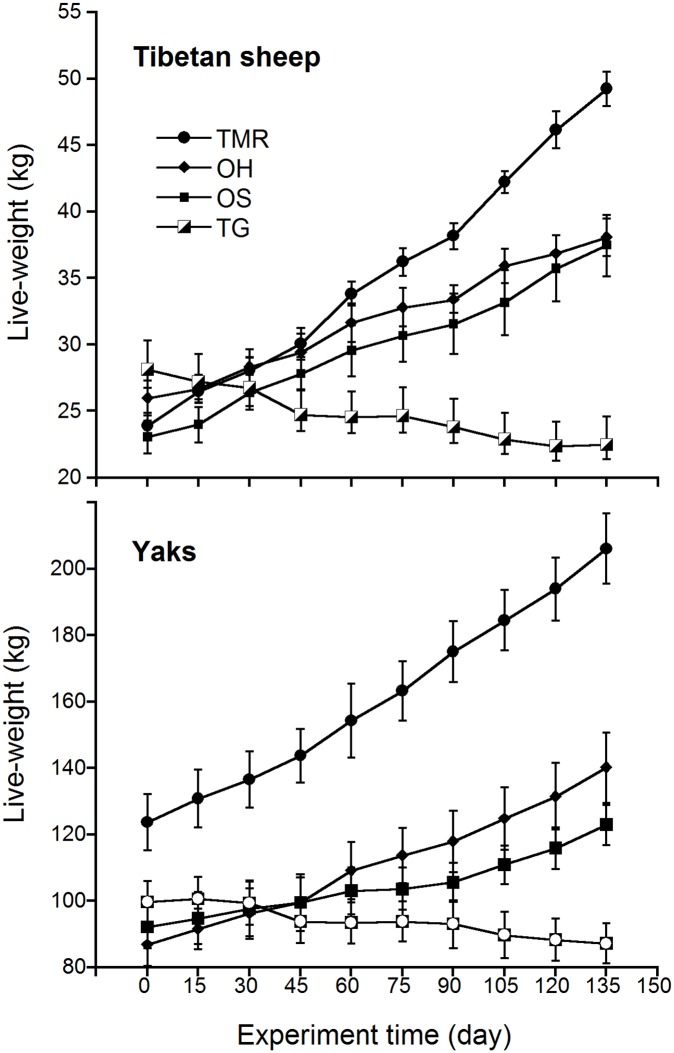
Pastoralists on the Tibetan alpine rangeland suffered great economic loss in cold season, due to serious live-weight loss of domestic livestock under traditional grazing management. This study aimed to evaluate the effect of dietary types (crude protein levels) on feed intakes, growth performance and economic returns of local Tibetan sheep and yaks during cold season. Twenty-four yearling Tibetan sheep (25.29±3.95 kg LW) and twenty two-year-old yaks (100.62±4.55 kg LW) with familiar body conditions were randomly assigned to four groups, fed oats hay (OH), oats silage (OS), total mixed ration (TMR) and traditionally grazed on the local cool-season pasture (TG), respectively, over a 135-day experiment. Daily dry matter intake was determined; all animals were weighed at the beginning and every 15 days of the 135-day experiment. Then, the total live-weight gain, average daily live-weight gain, gain rate, feed efficiency and net economic benefit were calculated. Results indicated that feed and nutrient intakes (DMI, DMI/kg LW, DMI/kg LW0.75 and CPI) of TMR, OH and OS were higher than TG (P < 0.05). Grazing animals suffered serious live-weight loss, while TMR, OS and OH significantly (P < 0.05) improved total live-weight gain and gain rate in both Tibetan sheep and yaks during the entire experiment. TMR worked better in animal performance and feed efficiency, obtained the highest breeding profit in both Tibetan sheep and yaks among four treatments (P < 0.05). When expressed on net economic benefit, TMR shared the highest net economic benefit in Tibetan sheep, OH shared the highest net economic benefit in yaks, but, no significant difference of net economic benefit in yaks fed TMR and OH diets was determined (P > 0.05). Results indicated that TMR was a reasonable diet in promoting feed intakes, animal performance, feed efficiency and economic returns in domestic livestock, which should be considered by local herdsmen to increase their breeding profit during cold season.
由于传统放牧管理方式下家畜在寒冷季节体重严重下降,青藏高原高寒草原的牧民遭受了巨大的经济损失。本研究旨在评估日粮类型(粗蛋白水平)对当地藏羊和牦牛在寒冷季节的采食量、生长性能和经济效益的影响。选取24只体况相近的一岁藏羊(体重25.29±3.95千克)和22头两岁牦牛(体重100.62±4.55千克),随机分为四组,分别在为期135天的试验中饲喂燕麦干草(OH)、燕麦青贮料(OS)、全混合日粮(TMR)以及在当地冷季牧场进行传统放牧(TG)。测定每日干物质摄入量;在试验开始时以及135天试验期内每隔15天对所有动物进行称重。然后,计算总增重、平均日增重、增重率、饲料效率和净经济效益。结果表明,TMR、OH和OS组的采食量和养分摄入量(干物质摄入量、每千克体重干物质摄入量、每千克代谢体重干物质摄入量和粗蛋白摄入量)均高于TG组(P<0.05)。放牧动物体重严重下降,而TMR、OS和OH组在整个试验期间显著(P<0.05)提高了藏羊和牦牛的总增重和增重率。TMR在动物生产性能和饲料效率方面表现更佳,在四种处理中藏羊和牦牛的养殖利润均最高(P<0.05)。从净经济效益来看,TMR组藏羊的净经济效益最高,OH组牦牛的净经济效益最高,但TMR组和OH组牦牛的净经济效益差异不显著(P>0.05)。结果表明,TMR是一种合理的日粮,可促进家畜的采食量、生产性能、饲料效率和经济效益,当地牧民在寒冷季节增加养殖利润时应予以考虑。