Grönthal Thomas, Eklund Marjut, Thomson Katariina, Piiparinen Heli, Sironen Tarja, Rantala Merja
Department of Equine and Small Animal Medicine, Faculty of Veterinary Medicine, PO Box 57, FI-00014 University of Helsinki, Helsinki, Finland.
Veterinary Teaching Hospital, Faculty of Veterinary Medicine, PO Box 57, FI-00014 University of Helsinki, Helsinki, Finland.
J Antimicrob Chemother. 2017 Apr 1;72(4):1021-1030. doi: 10.1093/jac/dkw559.
To investigate antimicrobial susceptibility in Staphylococcus pseudintermedius and the occurrence of methicillin-resistant S. pseudintermedius (MRSP), to explore the molecular structure of the MRSP population and to analyse risk factors for MRSP.
Susceptibility data for clinical S. pseudintermedius isolates in 2011-15 were analysed using WHONET. All MRSP isolates in 2010-14 ( n = 362) were typed using PFGE. Representative isolates ( n = 87) of clusters were analysed using MLST and staphylococcal cassette chromosome mec (SCC mec ) typing. Risk factors were analysed using logistic regression.
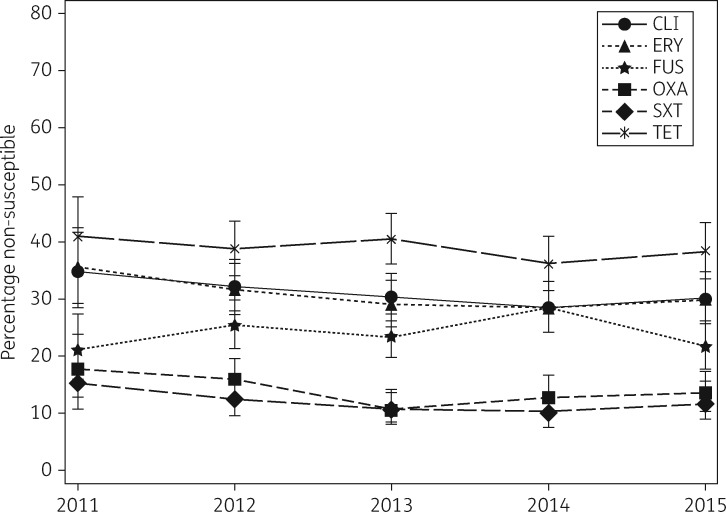
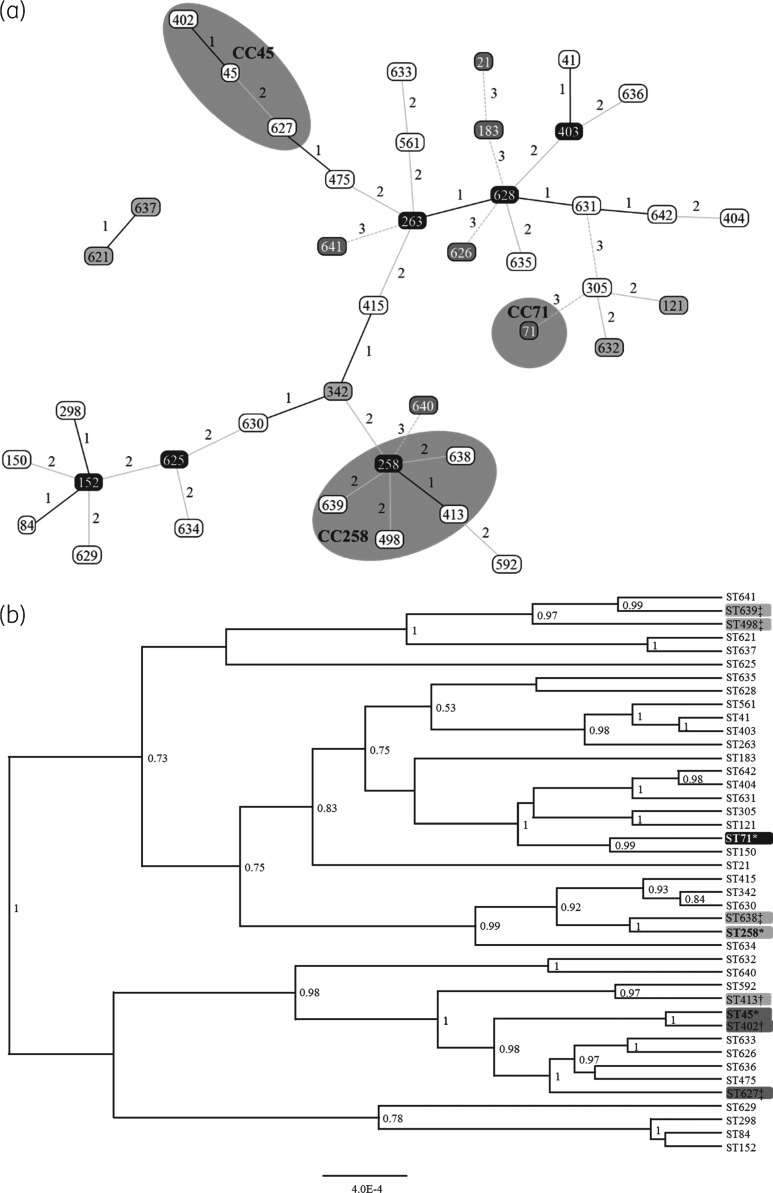
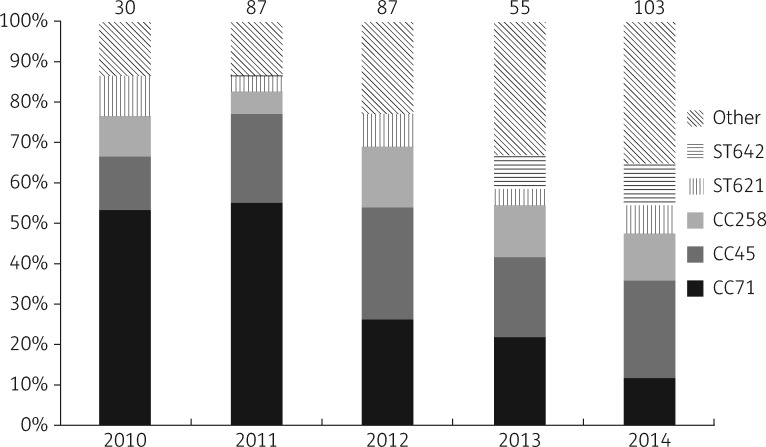
Of the clinical S. pseudintermedius ( n = 1958; 98% from dogs), 14% were MRSP. Resistance to other antimicrobials varied between 12% and 39%. No trends were observed over time. Among clinical specimens (from infection sites) and screening specimens (from potential carriers), respectively, 2.5% (267/10 813) and 9% (211/2434) revealed MRSP. MLST revealed 42 different STs, including 19 new ones. Clonal complexes 71, 45 and 258 were the most common, but the MRSP population diversified over the years. A clinical S. pseudintermedius isolate was more likely to be MRSP if the patient was on antimicrobials at the time of sampling or was male. The presence of MRSP in screening specimens was more likely if the patient was on multiple antimicrobials at the time of sampling. Specimens from private clinics (versus the Veterinary Teaching Hospital of the University of Helsinki) had a higher likelihood of MRSP in both analyses.
Resistance to antimicrobials among S. pseudintermedius in Finland is high, emphasizing the importance of infection control measures and susceptibility testing prior to therapy. The diverse MRSP population indicates non-clonal spread.
调查中间型葡萄球菌的抗菌药物敏感性及耐甲氧西林中间型葡萄球菌(MRSP)的发生情况,探索MRSP群体的分子结构并分析MRSP的危险因素。
使用WHONET分析2011 - 2015年临床中间型葡萄球菌分离株的药敏数据。对2010 - 2014年的所有MRSP分离株(n = 362)进行脉冲场凝胶电泳(PFGE)分型。对聚类中的代表性分离株(n = 87)进行多位点序列分型(MLST)和葡萄球菌盒式染色体mec(SCC mec)分型。使用逻辑回归分析危险因素。
在临床中间型葡萄球菌(n = 1958;98%来自犬)中,14%为MRSP。对其他抗菌药物的耐药率在12%至39%之间。未观察到随时间变化的趋势。在临床标本(来自感染部位)和筛查标本(来自潜在携带者)中,MRSP的检出率分别为2.5%(267/10813)和9%(211/2434)。MLST显示有42种不同的序列型(ST),包括19种新的。克隆复合体71、45和258最为常见,但多年来MRSP群体呈多样化。如果患者在采样时正在使用抗菌药物或为男性,则临床中间型葡萄球菌分离株更有可能为MRSP。如果患者在采样时正在使用多种抗菌药物,则筛查标本中出现MRSP的可能性更大。在两项分析中,来自私人诊所(相对于赫尔辛基大学兽医学院教学医院)的标本中MRSP的可能性更高。
芬兰中间型葡萄球菌对抗菌药物的耐药性较高,强调了感染控制措施和治疗前药敏试验的重要性。多样的MRSP群体表明其传播方式并非克隆性传播。