Department of Chemistry, Stony Brook University , New York 11794-3400, United States.
School of Chemistry, University of East Anglia , Norwich, NR4 7TJ, U.K.
J Phys Chem B. 2017 Feb 9;121(5):1010-1019. doi: 10.1021/acs.jpcb.7b00088. Epub 2017 Jan 25.
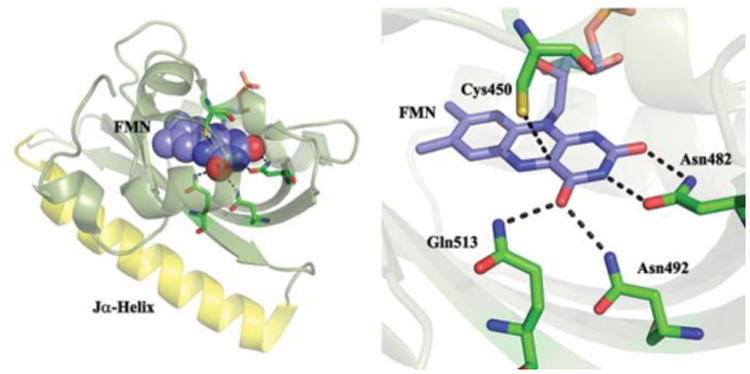
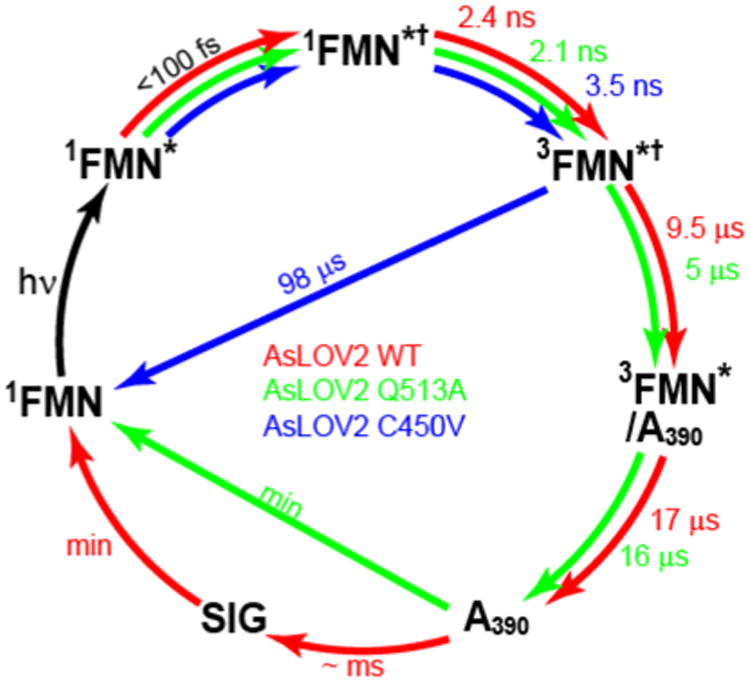
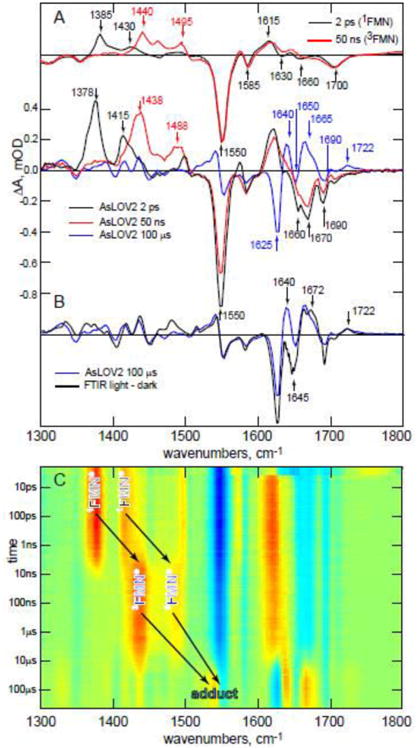
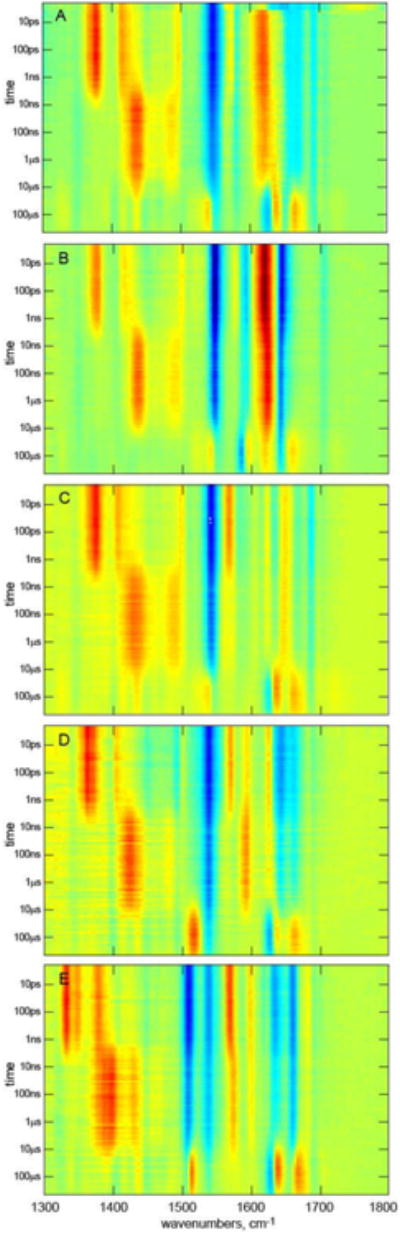
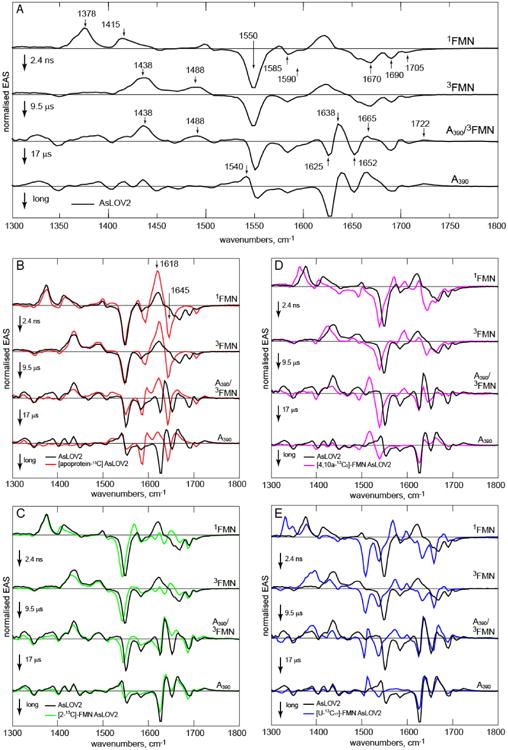
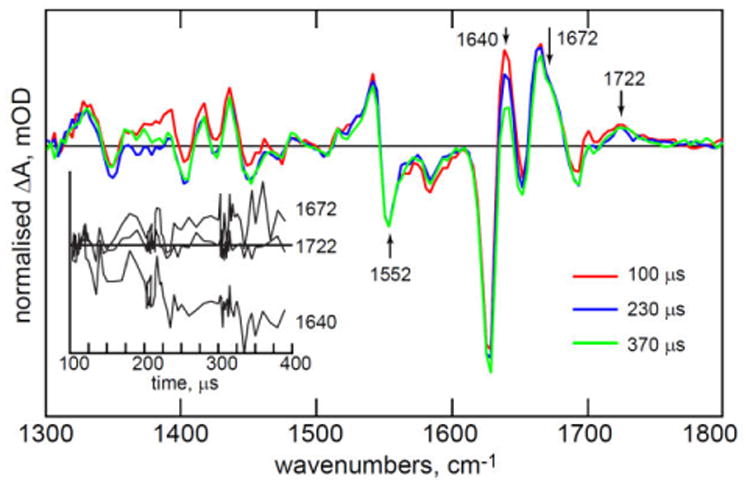
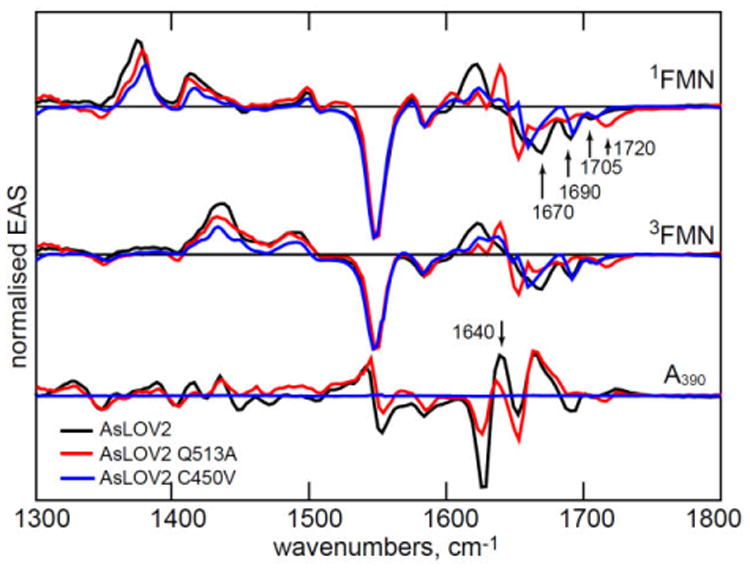
The rational engineering of photosensor proteins underpins the field of optogenetics, in which light is used for spatiotemporal control of cell signaling. Optogenetic elements function by converting electronic excitation of an embedded chromophore into structural changes on the microseconds to seconds time scale, which then modulate the activity of output domains responsible for biological signaling. Using time-resolved vibrational spectroscopy coupled with isotope labeling, we have mapped the structural evolution of the LOV2 domain of the flavin binding phototropin Avena sativa (AsLOV2) over 10 decades of time, reporting structural dynamics between 100 fs and 1 ms after optical excitation. The transient vibrational spectra contain contributions from both the flavin chromophore and the surrounding protein matrix. These contributions are resolved and assigned through the study of four different isotopically labeled samples. High signal-to-noise data permit the detailed analysis of kinetics associated with the light activated structural evolution. A pathway for the photocycle consistent with the data is proposed. The earliest events occur in the flavin binding pocket, where a subpicosecond perturbation of the protein matrix occurs. In this perturbed environment, the previously characterized reaction between triplet state isoalloxazine and an adjacent cysteine leads to formation of the adduct state; this step is shown to exhibit dispersive kinetics. This reaction promotes coupling of the optical excitation to successive time-dependent structural changes, initially in the β-sheet and then α-helix regions of the AsLOV2 domain, which ultimately gives rise to Jα-helix unfolding, yielding the signaling state. This model is tested through point mutagenesis, elucidating in particular the key mediating role played by Q513.
光遗传学领域的基础是光敏蛋白的合理工程设计,其中光被用于时空控制细胞信号。光遗传学元件的功能是将嵌入发色团的电子激发转化为微秒到秒时间尺度的结构变化,然后调节负责生物信号的输出结构域的活性。通过与同位素标记结合的时间分辨振动光谱学,我们在 10 个时间尺度上绘制了黄素结合光敏蛋白燕麦 Avena sativa(AsLOV2)的 LOV2 结构域的结构演变,报告了光激发后 100fs 到 1ms 之间的结构动力学。瞬态振动光谱包含发色团和周围蛋白质基质的贡献。通过研究四个不同的同位素标记样品来解析和分配这些贡献。高信噪比数据允许对与光激活结构演变相关的动力学进行详细分析。提出了与数据一致的光循环途径。最早的事件发生在黄素结合口袋中,其中蛋白质基质发生亚皮秒级的扰动。在这个受扰的环境中,先前表征的三重态异咯嗪与相邻半胱氨酸之间的反应导致加合物状态的形成;表明此步骤表现出弥散动力学。此反应促进了光激发与连续的时变结构变化的耦合,最初发生在 AsLOV2 结构域的β-折叠和α-螺旋区域,最终导致 Jα-螺旋展开,产生信号状态。通过定点突变进行测试,特别阐明了 Q513 所起的关键介导作用。