Webb Michael, Fahimi Saman, Singh Gitanjali M, Khatibzadeh Shahab, Micha Renata, Powles John, Mozaffarian Dariush
Stanford University, Stanford, CA, USA, and Institute for Fiscal Studies, London, UK.
Harvard TH Chan School of Public Health, Boston, MA, USA.
BMJ. 2017 Jan 10;356:i6699. doi: 10.1136/bmj.i6699.
To quantify the cost effectiveness of a government policy combining targeted industry agreements and public education to reduce sodium intake in 183 countries worldwide.
Global modeling study.
183 countries.
Full adult population in each country.
A "soft regulation" national policy that combines targeted industry agreements, government monitoring, and public education to reduce population sodium intake, modeled on the recent successful UK program. To account for heterogeneity in efficacy across countries, a range of scenarios were evaluated, including 10%, 30%, 0.5 g/day, and 1.5 g/day sodium reductions achieved over 10 years. We characterized global sodium intakes, blood pressure levels, effects of sodium on blood pressure and of blood pressure on cardiovascular disease, and cardiovascular disease rates in 2010, each by age and sex, in 183 countries. Country specific costs of a sodium reduction policy were estimated using the World Health Organization Noncommunicable Disease Costing Tool. Country specific impacts on mortality and disability adjusted life years (DALYs) were modeled using comparative risk assessment. We only evaluated program costs, without incorporating potential healthcare savings from prevented events, to provide conservative estimates of cost effectiveness MAIN OUTCOME MEASURE: Cost effectiveness ratio, evaluated as purchasing power parity adjusted international dollars (equivalent to the country specific purchasing power of US$) per DALY saved over 10 years.
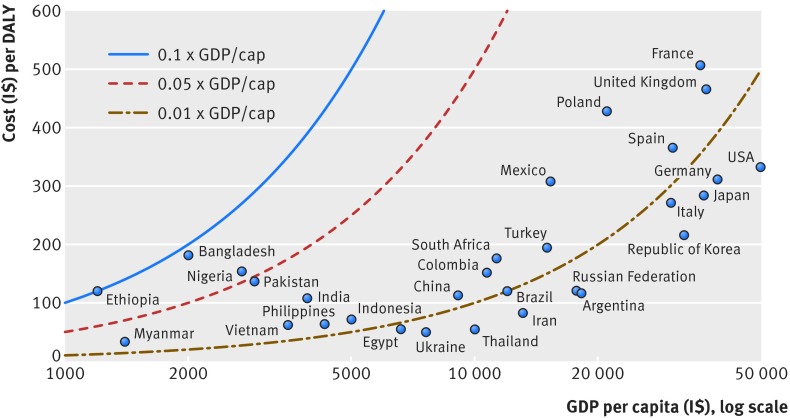
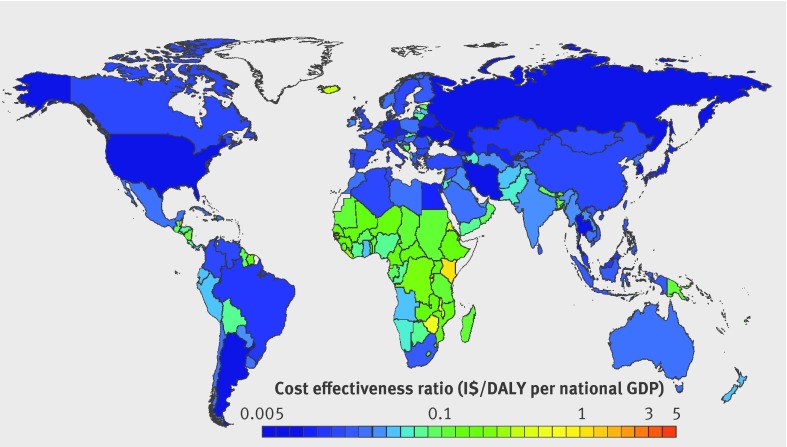
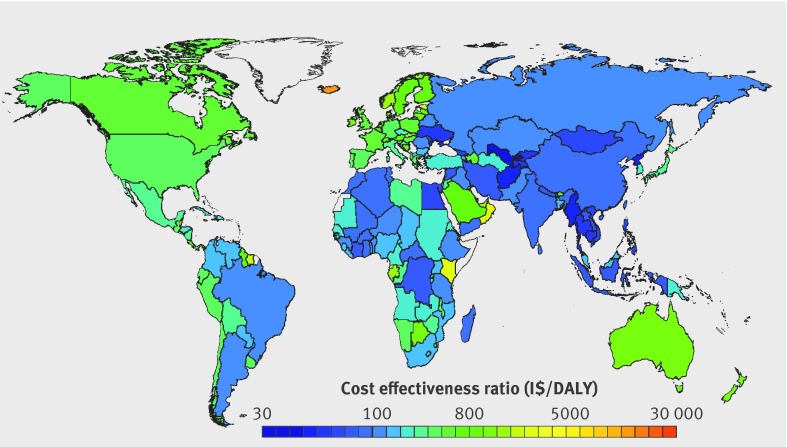
Worldwide, a 10% reduction in sodium consumption over 10 years within each country was projected to avert approximately 5.8 million DALYs/year related to cardiovascular diseases, at a population weighted mean cost of I$1.13 per capita over the 10 year intervention. The population weighted mean cost effectiveness ratio was approximately I$204/DALY. Across nine world regions, estimated cost effectiveness of sodium reduction was best in South Asia (I$116/DALY); across the world's 30 most populous countries, best in Uzbekistan (I$26.08/DALY) and Myanmar (I$33.30/DALY). Cost effectiveness was lowest in Australia/New Zealand (I$880/DALY, or 0.02×gross domestic product (GDP) per capita), although still substantially better than standard thresholds for cost effective (<3.0×GDP per capita) or highly cost effective (<1.0×GDP per capita) interventions. Most (96.0%) of the world's adult population lived in countries in which this intervention had a cost effectiveness ratio <0.1×GDP per capita, and 99.6% in countries with a cost effectiveness ratio <1.0×GDP per capita.
A government "soft regulation" strategy combining targeted industry agreements and public education to reduce dietary sodium is projected to be highly cost effective worldwide, even without accounting for potential healthcare savings.
量化一项政府政策的成本效益,该政策结合了有针对性的行业协议和公共教育,以降低全球183个国家的钠摄入量。
全球建模研究。
183个国家。
每个国家的成年人口。
一项“软监管”国家政策,结合有针对性的行业协议、政府监测和公共教育,以降低人群钠摄入量,该政策以英国近期的成功项目为蓝本。为考虑各国在疗效方面的异质性,评估了一系列情景,包括在10年内实现钠摄入量降低10%、30%、每天0.5克和每天1.5克。我们按年龄和性别对2010年183个国家的全球钠摄入量、血压水平、钠对血压的影响以及血压对心血管疾病的影响以及心血管疾病发病率进行了特征描述。使用世界卫生组织非传染性疾病成本核算工具估算了各国钠减排政策的具体成本。使用比较风险评估对各国对死亡率和伤残调整生命年(DALYs)的具体影响进行建模。我们仅评估了项目成本,未纳入预防事件带来的潜在医疗保健节省,以便对成本效益提供保守估计。主要结局指标:成本效益比,评估为10年内每节省一个DALY的购买力平价调整后的国际美元(相当于该国特定的美元购买力)。
在全球范围内,预计每个国家在10年内将钠消费量降低10%,每年可避免约580万与心血管疾病相关的伤残调整生命年,在10年干预期间人均成本加权平均为1.13国际美元。人群成本加权平均成本效益比约为204国际美元/DALY。在九个世界区域中,南亚的钠减排估计成本效益最佳(116国际美元/DALY);在世界上人口最多的30个国家中,乌兹别克斯坦(26.08国际美元/DALY)和缅甸(33.30国际美元/DALY)最佳。澳大利亚/新西兰的成本效益最低(880国际美元/DALY,或人均国内生产总值(GDP)的0.02倍),尽管仍远优于具有成本效益(<人均GDP的3.0倍)或高成本效益(<人均GDP的1.0倍)干预措施的标准阈值。世界上大多数(96.0%)成年人口生活在该干预措施成本效益比<人均GDP的0.1倍的国家,99.6%生活在成本效益比<人均GDP的1.0倍的国家。
预计一项结合有针对性的行业协议和公共教育以减少饮食中钠摄入的政府“软监管”战略在全球范围内具有很高的成本效益,即使不考虑潜在的医疗保健节省。