Ma Juan, Wang Rongyan, Li Xiuhua, Gao Bo, Chen Shulong
Institute of Plant Protection, Hebei Academy of Agricultural and Forestry Sciences/IPM Centre of Hebei Province/Key Laboratory of Integrated Pest Management on Crops in Northern Region of North China, Ministry of Agriculture, 437 Dongguan Street, Baoding 071000, China (
J Insect Sci. 2016 Jul 1;16(1). doi: 10.1093/jisesa/iew053. Print 2016.
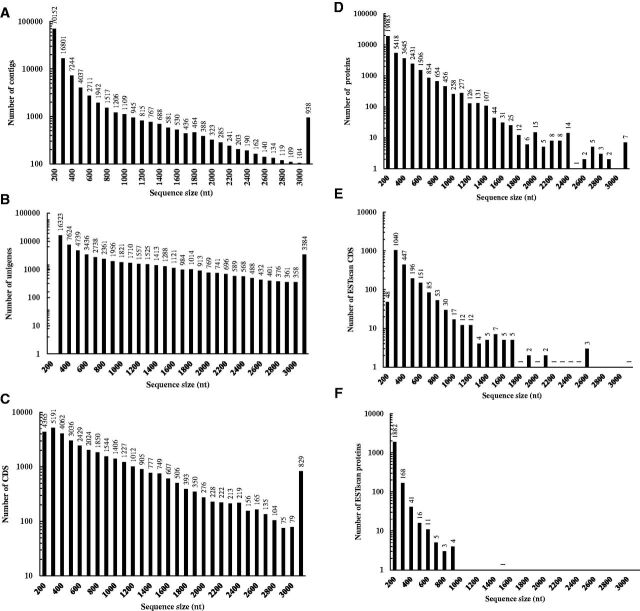
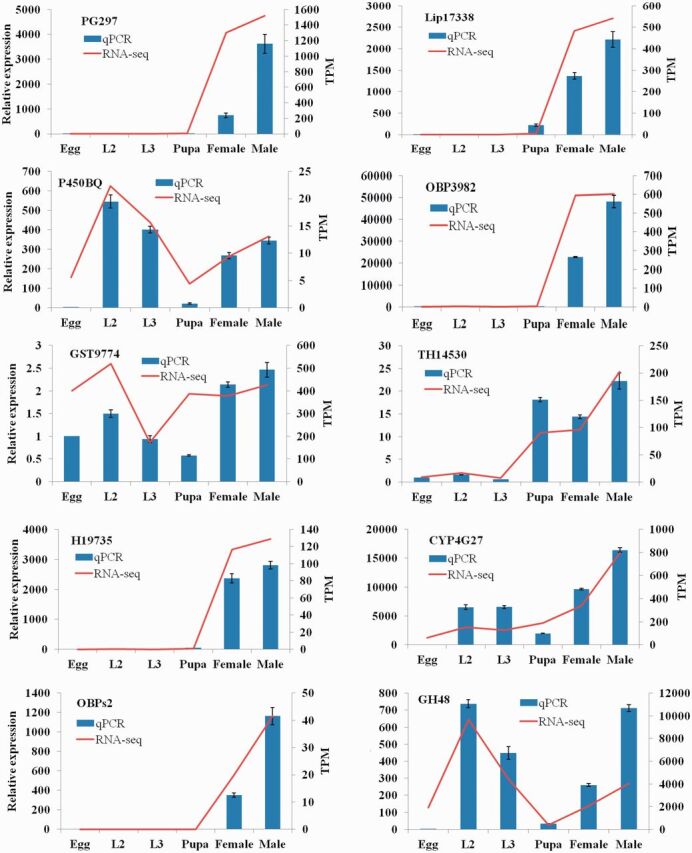
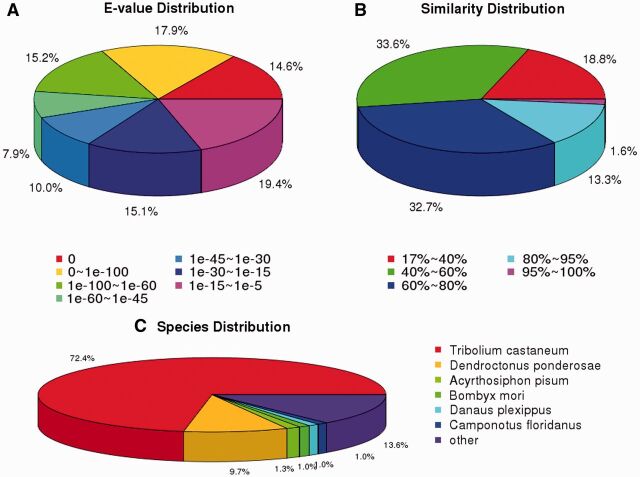
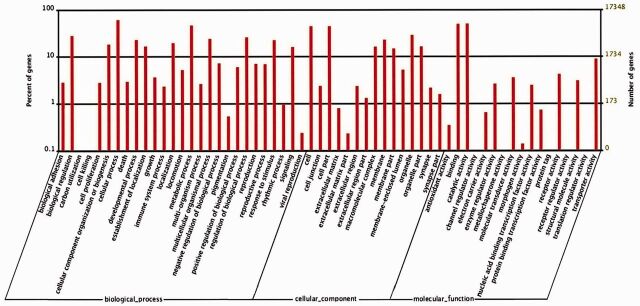
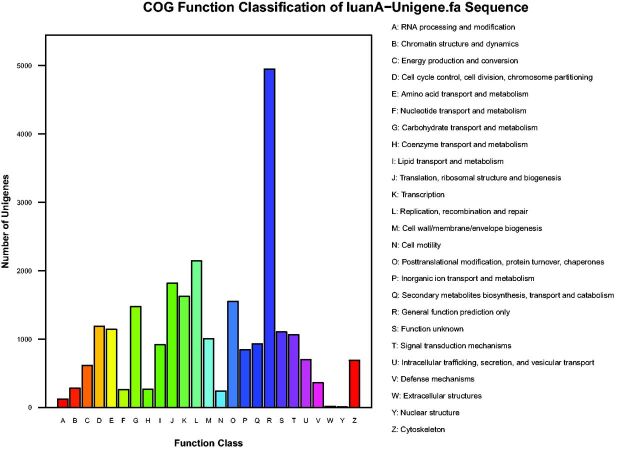
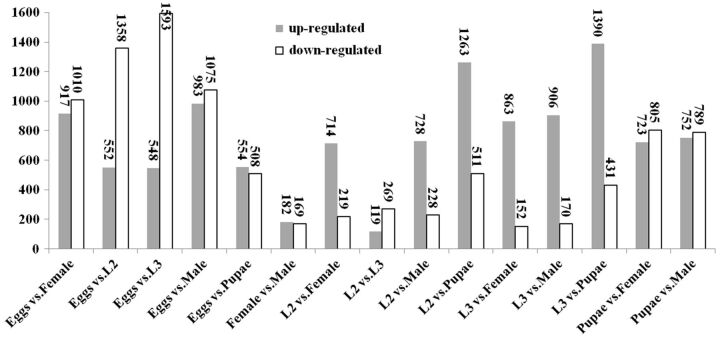
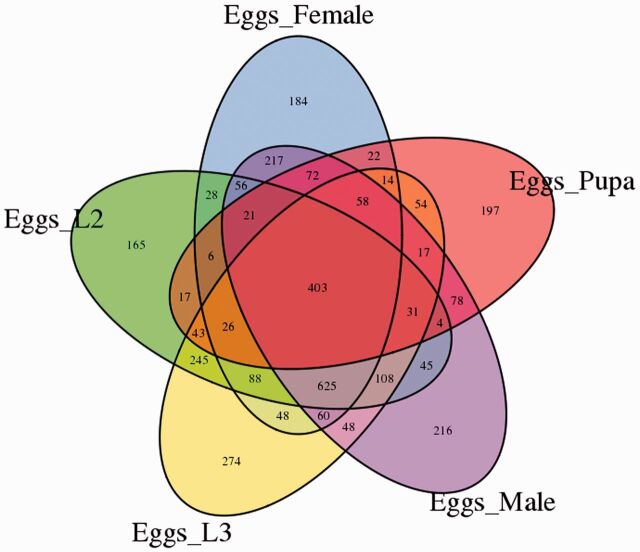
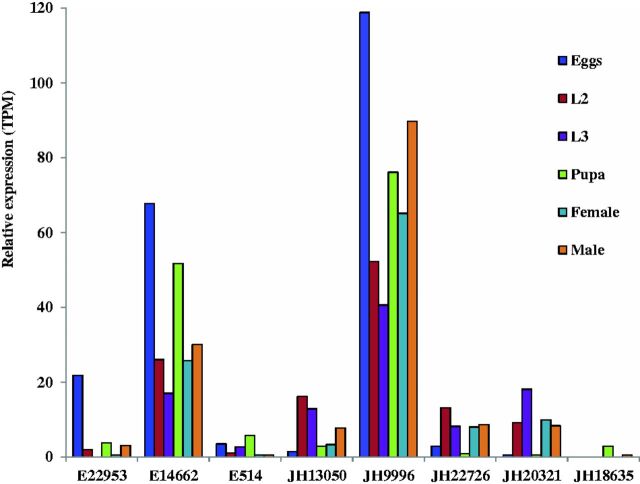
The sweet potato weevil, Cylas formicarius (F.) (Coleoptera: Brentidae), is an important pest of sweet potato worldwide. However, there is limited knowledge on the molecular mechanisms underlying growth and differentiation of C. formicarius The transcriptomes of the eggs, second instar larvae, third instar larvae (L3), pupae, females, and males of C. formicarius were sequenced using Illumina sequencing technology for obtaining global insights into developing transcriptome characteristics and elucidating the relative functional genes. A total of 54,255,544 high-quality reads were produced, trimmed, and de novo assembled into 115,281 contigs. 61,686 unigenes were obtained, with an average length of 1,009 nt. Among these unigenes, 17,348 were annotated into 59 Gene Ontology (GO) terms and 12,660 were assigned to 25 Cluster of Orthologous Groups classes, whereas 24,796 unigenes were mapped to 258 pathways. Differentially expressed unigenes between various developmental stages of C. formicarius were detected. Higher numbers of differentially expressed genes (DEGs) were recorded in the eggs versus L3 and eggs versus male samples (2,141 and 2,058 unigenes, respectively) than the others. Genes preferentially expressed in each stage were also identified. GO and pathway-based enrichment analysis were used to further investigate the functions of the DEGs. In addition, the expression profiles of ten DEGs were validated by quantitative real-time PCR. The transcriptome profiles presented in this study and these DEGs detected by comparative analysis of different developed stages of C. formicarius will facilitate the understanding of the molecular mechanism of various living process and will contribute to further genome-wide research.
甘薯蚁象甲,Cylas formicarius (F.)(鞘翅目:蛛甲科),是全球甘薯的一种重要害虫。然而,关于甘薯蚁象甲生长和分化的分子机制的了解有限。利用Illumina测序技术对甘薯蚁象甲的卵、二龄幼虫、三龄幼虫(L3)、蛹、雌虫和雄虫的转录组进行测序,以全面了解发育转录组特征并阐明相关功能基因。共产生了54,255,544条高质量 reads,经过修剪并从头组装成115,281个重叠群。获得了61,686个单基因,平均长度为1,009 nt。在这些单基因中,17,348个被注释到59个基因本体(GO)术语中,12,660个被分配到25个直系同源群类别中,而24,796个单基因被映射到258条通路中。检测到甘薯蚁象甲不同发育阶段之间差异表达的单基因。与其他样本相比,卵与L3以及卵与雄虫样本中记录的差异表达基因(DEGs)数量更多(分别为2,141个和2,058个单基因)。还鉴定了在每个阶段优先表达的基因。基于GO和通路的富集分析用于进一步研究DEGs的功能。此外,通过定量实时PCR验证了10个DEGs的表达谱。本研究中呈现的转录组图谱以及通过对甘薯蚁象甲不同发育阶段的比较分析检测到的这些DEGs将有助于理解各种生命过程的分子机制,并将有助于进一步的全基因组研究。