Graziano Talita Signoreti, Calil Caroline Morini, Sartoratto Adilson, Franco Gilson César Nobre, Groppo Francisco Carlos, Cogo-Müller Karina
- Universidade Estadual de Campinas, Faculdade de Odontologia de Piracicaba, Área de Microbiologia e Imunologia, Departamento de Diagnóstico Oral, Piracicaba, SP, Brasil.
- Centro de Diagnóstico de Halitose - Halicenter, São Paulo, SP, Brasil.
J Appl Oral Sci. 2016 Nov-Dec;24(6):582-589. doi: 10.1590/1678-775720160044.
Halitosis can be caused by microorganisms that produce volatile sulphur compounds (VSCs), which colonize the surface of the tongue and subgingival sites. Studies have reported that the use of natural products can reduce the bacterial load and, consequently, the development of halitosis. The aim of this study was to evaluate the antimicrobial activity of the essential oil of Melaleuca alternifolia on the growth and volatile sulphur compound (VSC) production of oral bacteria compared with chlorhexidine.
The effects of these substances were evaluated by the Minimum Inhibitory Concentration (MIC) and Minimum Bactericidal Concentration (MBC) in planktonic cultures of Porphyromonas gingivalis and Porphyromonas endodontalis. In addition, gas chromatography analyses were performed to measure the concentration of VSCs from bacterial cultures and to characterize M. alternifolia oil components.
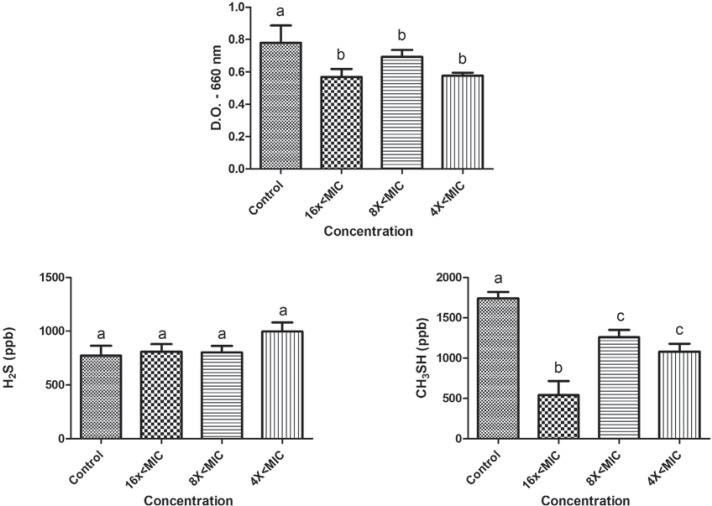
The MIC and MBC values were as follows: M. alternifolia - P. gingivalis (MIC and MBC=0.007%), P. endodontalis (MIC and MBC=0.007%=0.5%); chlorhexidine - P. gingivalis and P. endodontalis (MIC and MBC=1.5 mg/mL). M. alternifolia significantly reduced the growth and production of hydrogen sulfide (H2S) by P. gingivalis (p<0.05, ANOVA-Dunnet) and the H2S and methyl mercaptan (CH3SH) levels of P. endodontalis (p<0.05, ANOVA-Dunnet). Chlorhexidine reduced the growth of both microorganisms without altering the production of VSC in P. endodontalis. For P. gingivalis, the production of H2S and CH3SH decreased (p<0.05, ANOVA-Dunnet).
M. alternifolia can reduce bacterial growth and VSCs production and could be used as an alternative to chlorhexidine.
口臭可由产生挥发性硫化物(VSCs)的微生物引起,这些微生物定殖于舌表面和龈下部位。研究报道,使用天然产物可减少细菌载量,从而减少口臭的发生。本研究的目的是评估互叶白千层精油与氯己定相比,对口腔细菌生长和挥发性硫化物(VSC)产生的抗菌活性。
通过最低抑菌浓度(MIC)和最低杀菌浓度(MBC)评估这些物质对牙龈卟啉单胞菌和牙髓卟啉单胞菌浮游培养物的影响。此外,进行气相色谱分析以测量细菌培养物中VSCs的浓度并鉴定互叶白千层油的成分。
MIC和MBC值如下:互叶白千层-牙龈卟啉单胞菌(MIC和MBC = 0.007%),牙髓卟啉单胞菌(MIC和MBC = 0.007% = 0.5%);氯己定-牙龈卟啉单胞菌和牙髓卟啉单胞菌(MIC和MBC = 1.5 mg/mL)。互叶白千层显著降低了牙龈卟啉单胞菌的生长和硫化氢(H2S)产生(p<0.05, ANOVA-邓尼特检验)以及牙髓卟啉单胞菌的H2S和甲硫醇(CH3SH)水平(p<0.05, ANOVA-邓尼特检验)。氯己定降低了两种微生物的生长,但未改变牙髓卟啉单胞菌中VSC的产生。对于牙龈卟啉单胞菌,H2S和CH3SH的产生减少(p<0.05, ANOVA-邓尼特检验)。
互叶白千层可减少细菌生长和VSCs产生,可作为氯己定的替代品。