Mohammed Afrah E, Aabed Kawther, Benabdelkamel Hicham, Shami Ashwag, Alotaibi Modhi O, Alanazi Mona, Alfadda Assim A, Rahman Ishrat
Department of Biology, College of Science, Princess Nourah bint Abdulrahman University, P.O. Box 84428, Riyadh 11671, Saudi Arabia.
Proteomics Resource Unit, Obesity Research Center, College of Medicine, King Saud University, P.O. Box 2925 (98), Riyadh 11461, Saudi Arabia.
ACS Omega. 2023 Mar 28;8(14):12980-12991. doi: 10.1021/acsomega.3c00168. eCollection 2023 Apr 11.
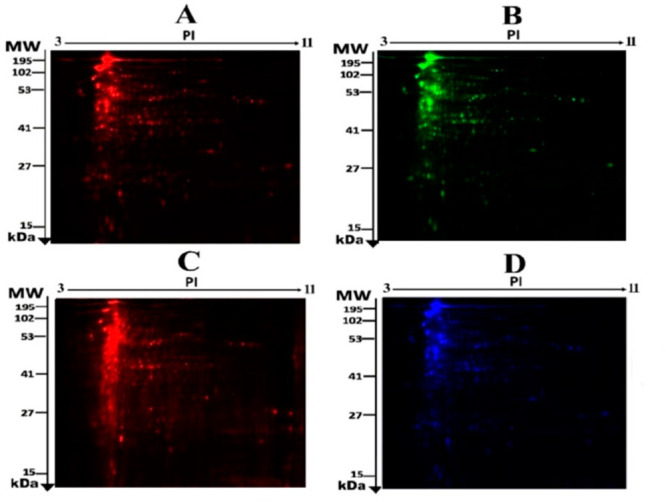
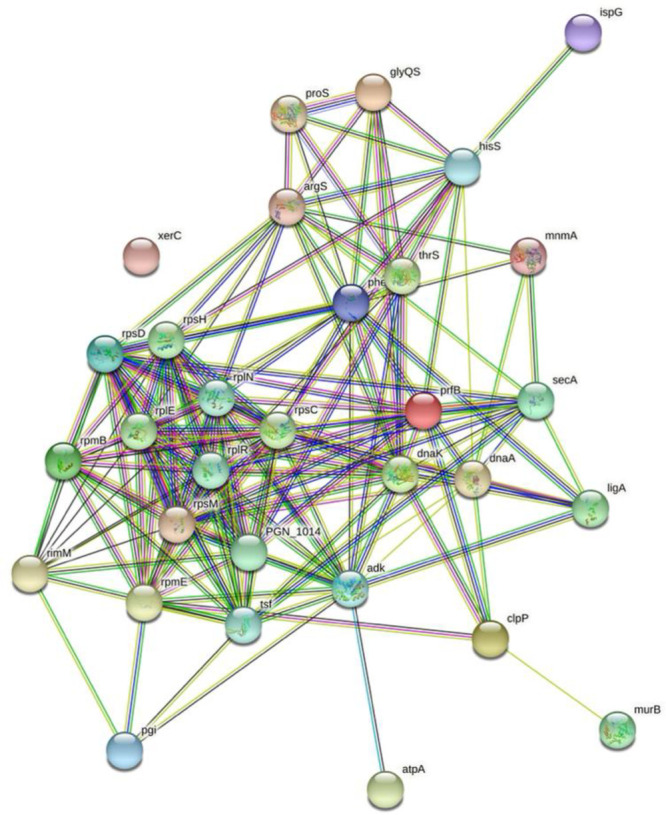
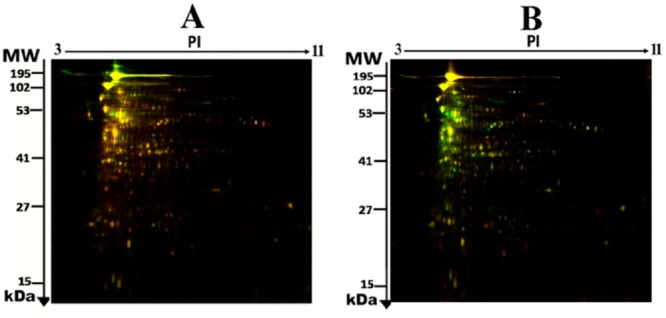
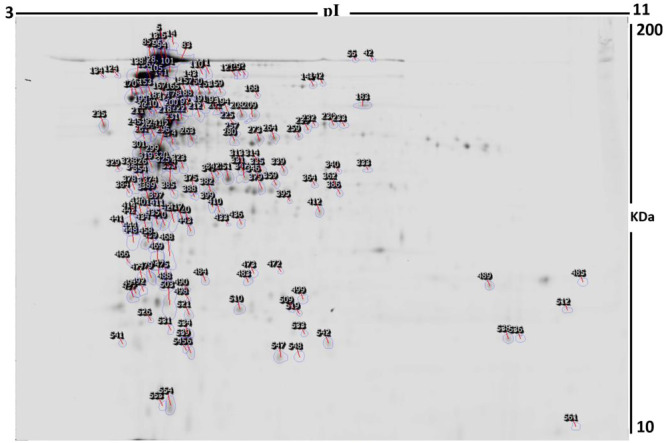
The increasing trend in the rise of antibiotic-resistant bacteria pushes research to discover new efficacious antibacterial agents from natural and synthetic sources. is a well-known bacterium commonly known for causing periodontal disease, and it is associated with the pathogenesis of life-changing systemic conditions such as Alzheimer's. Proteomic research can be utilized to test new antibacterial drugs and understand the adaptive resistive mechanisms of bacteria; hence, it is important in the drug discovery process. The current study focuses on identifying the antibacterial effects of (JR) and (MA) on and uses proteomics to identify modes of action while exploring its adaptive mechanisms. JR and MA extracts were tested for antibacterial efficacy using the agar well diffusion assay. A proteomic study was conducted identifying upregulated and downregulated proteins compared to control by 2D-DIGE analysis, and proteins were identified using MADLI-TOF/MS. The bacterial inhibition for JR was 20.14 ± 0.2, and that for MA was 19.72 ± 0.5 mm. Out of 88 differentially expressed proteins, there were 17 common differentially expressed proteins: 10 were upregulated and 7 were downregulated in both treatments. Among the upregulated proteins were Arginine-tRNA ligase, ATP-dependent Clp protease proteolytic, and flavodoxins. In contrast, down-regulated proteins were ATP synthase subunit alpha and quinone, among others, which are known antibacterial targets. STRING analysis indicated a strong network of interactions between differentially expressed proteins, mainly involved in protein translation, post-translational modification, energy production, metabolic pathways, and protein repair and degradation. Both extracts were equi-efficacious at inhibiting and displayed some overlapping proteomic profiles. However, the MR extract had a greater fold change in its profile than the JA extract. Downregulated proteins indicated similarity in the mode of action, and upregulated proteins appear to be related to adaptive mechanisms important in promoting repair, growth, survival, virulence, and resistance. Hence, both extracts may be useful in preventing -associated conditions. Furthermore, our results may be helpful to researchers in identifying new antibiotics which may offset these mechanisms of resistance.
抗生素耐药细菌不断增加的趋势推动了从天然和合成来源发现新的有效抗菌剂的研究。牙龈卟啉单胞菌是一种因引起牙周病而广为人知的细菌,它与诸如阿尔茨海默病等改变生活的全身性疾病的发病机制有关。蛋白质组学研究可用于测试新的抗菌药物并了解细菌的适应性耐药机制;因此,它在药物发现过程中很重要。当前的研究重点是确定日本厚朴(JR)和凹叶木兰(MA)对牙龈卟啉单胞菌的抗菌作用,并利用蛋白质组学确定作用模式,同时探索其适应性机制。使用琼脂孔扩散法测试JR和MA提取物的抗菌功效。通过二维差异凝胶电泳(2D-DIGE)分析进行蛋白质组学研究,确定与对照相比上调和下调的蛋白质,并使用基质辅助激光解吸电离飞行时间质谱(MADLI-TOF/MS)鉴定蛋白质。JR对细菌的抑制圈为20.14±0.2,MA为19.72±0.5毫米。在88种差异表达的蛋白质中,有17种共同的差异表达蛋白质:两种处理中10种上调,7种下调。上调的蛋白质中有精氨酸-tRNA连接酶、ATP依赖性Clp蛋白酶水解酶和黄素氧还蛋白。相比之下,下调的蛋白质有ATP合酶α亚基和醌等,它们是已知的抗菌靶点。STRING分析表明差异表达蛋白质之间存在强大的相互作用网络,主要涉及蛋白质翻译、翻译后修饰、能量产生、代谢途径以及蛋白质修复和降解。两种提取物在抑制牙龈卟啉单胞菌方面效果相当,并显示出一些重叠的蛋白质组学图谱。然而,MR提取物的图谱变化倍数比JA提取物更大。下调的蛋白质表明作用模式相似,而上调的蛋白质似乎与促进修复、生长、存活、毒力和耐药性的适应性机制有关。因此,两种提取物可能都有助于预防与牙龈卟啉单胞菌相关的病症。此外,我们的结果可能有助于研究人员鉴定新的抗生素,这些抗生素可能抵消这些耐药机制。