Gismervik Sigmund Ø, Drogset Jon O, Granviken Fredrik, Rø Magne, Leivseth Gunnar
Department Physical Medicine and Rehabilitation, St.Olavs University Hospital, P.B. 3250 Sluppen, NO-7006, Trondheim, Norway.
Department of Public Health and General Practice, Norwegian University of Science and Technology, P.B. 8905 MTFS, 7491, Trondheim, Norway.
BMC Musculoskelet Disord. 2017 Jan 25;18(1):41. doi: 10.1186/s12891-017-1400-0.
Physical examination tests of the shoulder (PETS) are clinical examination maneuvers designed to aid the assessment of shoulder complaints. Despite more than 180 PETS described in the literature, evidence of their validity and usefulness in diagnosing the shoulder is questioned.
This meta-analysis aims to use diagnostic odds ratio (DOR) to evaluate how much PETS shift overall probability and to rank the test performance of single PETS in order to aid the clinician's choice of which tests to use. This study adheres to the principles outlined in the Cochrane guidelines and the PRISMA statement. A fixed effect model was used to assess the overall diagnostic validity of PETS by pooling DOR for different PETS with similar biomechanical rationale when possible. Single PETS were assessed and ranked by DOR. Clinical performance was assessed by sensitivity, specificity, accuracy and likelihood ratio.
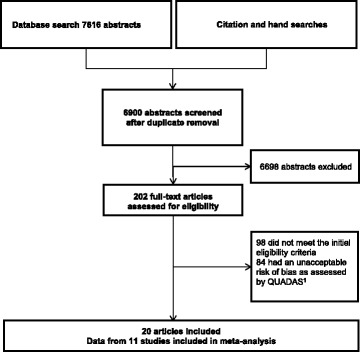
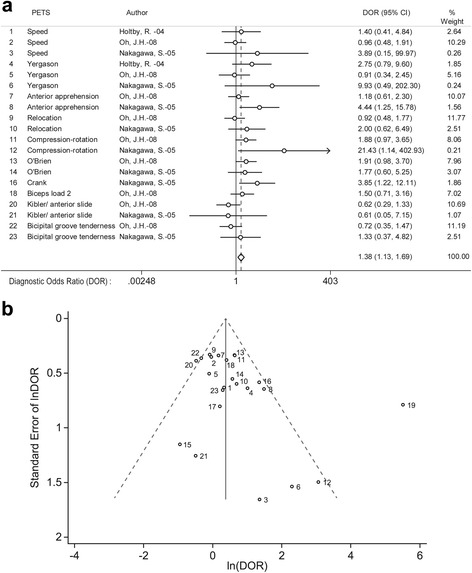
Six thousand nine-hundred abstracts and 202 full-text articles were assessed for eligibility; 20 articles were eligible and data from 11 articles could be included in the meta-analysis. All PETS for SLAP (superior labral anterior posterior) lesions pooled gave a DOR of 1.38 [1.13, 1.69]. The Supraspinatus test for any full thickness rotator cuff tear obtained the highest DOR of 9.24 (sensitivity was 0.74, specificity 0.77). Compression-Rotation test obtained the highest DOR (6.36) among single PETS for SLAP lesions (sensitivity 0.43, specificity 0.89) and Hawkins test obtained the highest DOR (2.86) for impingement syndrome (sensitivity 0.58, specificity 0.67). No single PETS showed superior clinical test performance.
The clinical performance of single PETS is limited. However, when the different PETS for SLAP lesions were pooled, we found a statistical significant change in post-test probability indicating an overall statistical validity. We suggest that clinicians choose their PETS among those with the highest pooled DOR and to assess validity to their own specific clinical settings, review the inclusion criteria of the included primary studies. We further propose that future studies on the validity of PETS use randomized research designs rather than the accuracy design relying less on well-established gold standard reference tests and efficient treatment options.
肩部体格检查测试(PETS)是旨在辅助评估肩部不适的临床检查手段。尽管文献中描述了180多种PETS,但它们在诊断肩部疾病方面的有效性和实用性受到质疑。
本荟萃分析旨在使用诊断比值比(DOR)来评估PETS如何改变总体概率,并对单个PETS的测试性能进行排名,以帮助临床医生选择使用哪些测试。本研究遵循Cochrane指南和PRISMA声明中概述的原则。当可能时,采用固定效应模型通过汇总具有相似生物力学原理的不同PETS的DOR来评估PETS的总体诊断有效性。单个PETS通过DOR进行评估和排名。临床性能通过敏感性、特异性、准确性和似然比进行评估。
评估了6900篇摘要和202篇全文文章的 eligibility;20篇文章符合要求,11篇文章的数据可纳入荟萃分析。所有汇总的针对SLAP(上盂唇前后)损伤的PETS的DOR为1.38 [1.13, 1.69]。针对任何全层肩袖撕裂的冈上肌测试获得了最高的DOR为9.24(敏感性为0.74,特异性为0.77)。在针对SLAP损伤的单个PETS中,压缩旋转测试获得了最高的DOR(6.36)(敏感性0.43,特异性0.89),而霍金斯测试在撞击综合征中获得了最高的DOR(2.86)(敏感性0.58,特异性0.67)。没有单个PETS表现出卓越的临床测试性能。
单个PETS的临床性能有限。然而,当汇总针对SLAP损伤的不同PETS时,我们发现测试后概率有统计学上的显著变化,表明总体具有统计学有效性。我们建议临床医生在具有最高汇总DOR的PETS中进行选择,并根据自己的特定临床环境评估有效性,审查纳入的原始研究的纳入标准。我们进一步建议,未来关于PETS有效性的研究采用随机研究设计,而不是依赖较少既定金标准参考测试和有效治疗选择的准确性设计。