Zhang Yuan, Wang Ting, Yang Ke, Xu Ji, Wu Jian-Ming, Liu Wen-Lan
Central Laboratory, Shenzhen Second People's Hospital, First Affiliated Hospital of Shenzhen University, Shenzhen, Guangdong Province, China; Shenzhen Key Laboratory of Neurosurgery, Shenzhen Second People's Hospital, First Affiliated Hospital of Shenzhen University, Shenzhen, Guangdong Province, China; Department of Pathophysiology, Baotou Medical College, Baotou, Inner Mongolia Autonomous Region, China.
Central Laboratory, Shenzhen Second People's Hospital, First Affiliated Hospital of Shenzhen University, Shenzhen, Guangdong Province, China; Shenzhen Key Laboratory of Neurosurgery, Shenzhen Second People's Hospital, First Affiliated Hospital of Shenzhen University, Shenzhen, Guangdong Province, China; Graduate School of Guangzhou Medical University, Guangzhou, Guangdong Province, China.
Neural Regen Res. 2016 Nov;11(11):1773-1778. doi: 10.4103/1673-5374.194747.
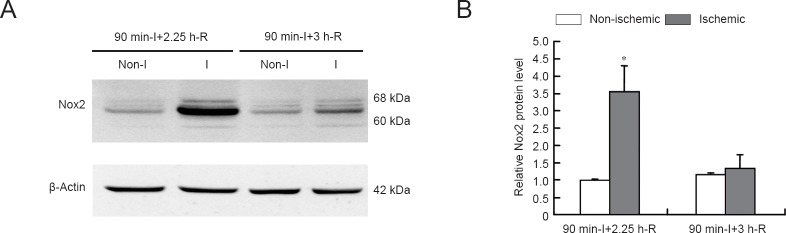
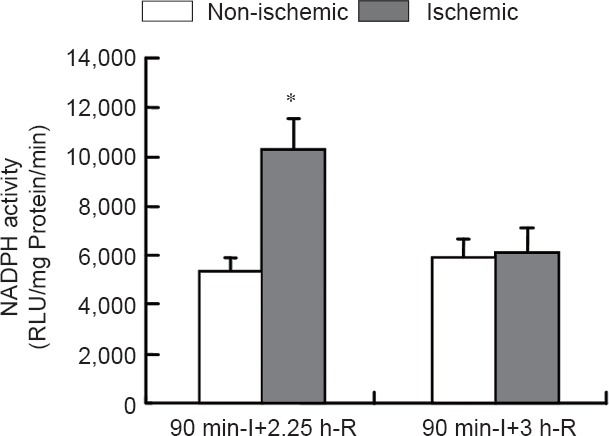
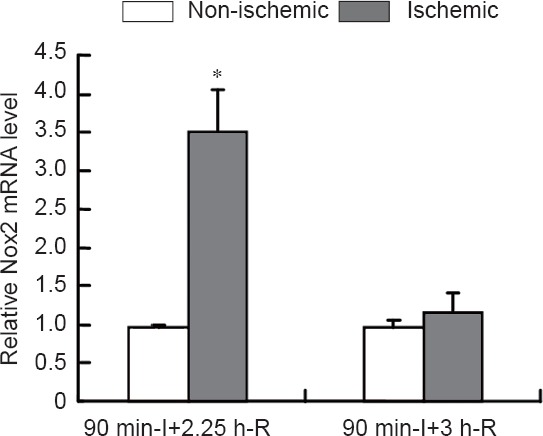
Excess production of reactive oxygen species (ROS) critically contributes to occurrence of reperfusion injury, the paradoxical response of ischemic brain tissue to restoration of cerebral blood flow. However, the enzymatic sources of ROS generation remain to be unclear. This study examined Nox2-containing NADPH oxidase (Nox2) expression and its activity in ischemic brain tissue following post-ischemic reperfusion to clarify the mechanism of enzymatic reaction of ROS. Male Sprague-Dawley rats were subjected to 90-minute middle cerebral artery occlusion, followed by 3 or 22.5 hours of reperfusion. Quantitative reverse transcriptase PCR and western blot assay were performed to measure mRNA and protein expression of Nox2. Lucigenin fluorescence assays were performed to assess Nox activity. Our data showed that Nox2 mRNA and protein expression levels were significantly increased (3.7-fold for mRNA and 3.6-fold for protein) in ischemic brain tissue at 22.5 hours but not at 3 hours following post-ischemic reperfusion. Similar results were obtained for the changes of NADPH oxidase activity in ischemic cerebral tissue at the two reperfusion time points. Our results suggest that Nox2 may not contribute to the early burst of reperfusion-related ROS generation, but is rather an important source of ROS generation during prolonged reperfusion.
活性氧(ROS)的过量产生是导致再灌注损伤发生的关键因素,而再灌注损伤是缺血脑组织对脑血流恢复的一种矛盾反应。然而,ROS产生的酶源仍不清楚。本研究检测了缺血再灌注后缺血脑组织中含Nox2的NADPH氧化酶(Nox2)的表达及其活性,以阐明ROS酶促反应的机制。雄性Sprague-Dawley大鼠接受90分钟的大脑中动脉闭塞,随后进行3或22.5小时的再灌注。采用定量逆转录PCR和蛋白质印迹法检测Nox2的mRNA和蛋白质表达。采用光泽精荧光分析法评估Nox活性。我们的数据显示,缺血再灌注22.5小时后缺血脑组织中Nox2的mRNA和蛋白质表达水平显著增加(mRNA增加3.7倍,蛋白质增加3.6倍),但再灌注3小时后未增加。在两个再灌注时间点,缺血脑组织中NADPH氧化酶活性的变化也得到了类似的结果。我们的结果表明,Nox2可能不是再灌注相关ROS早期爆发的原因,而是长时间再灌注期间ROS产生的重要来源。