Moormeier Derek E, Bayles Kenneth W
Center for Staphylococcal Research, Department of Pathology & Microbiology, University of Nebraska Medical Center, Omaha, NE, USA.
Mol Microbiol. 2017 May;104(3):365-376. doi: 10.1111/mmi.13634. Epub 2017 Mar 8.
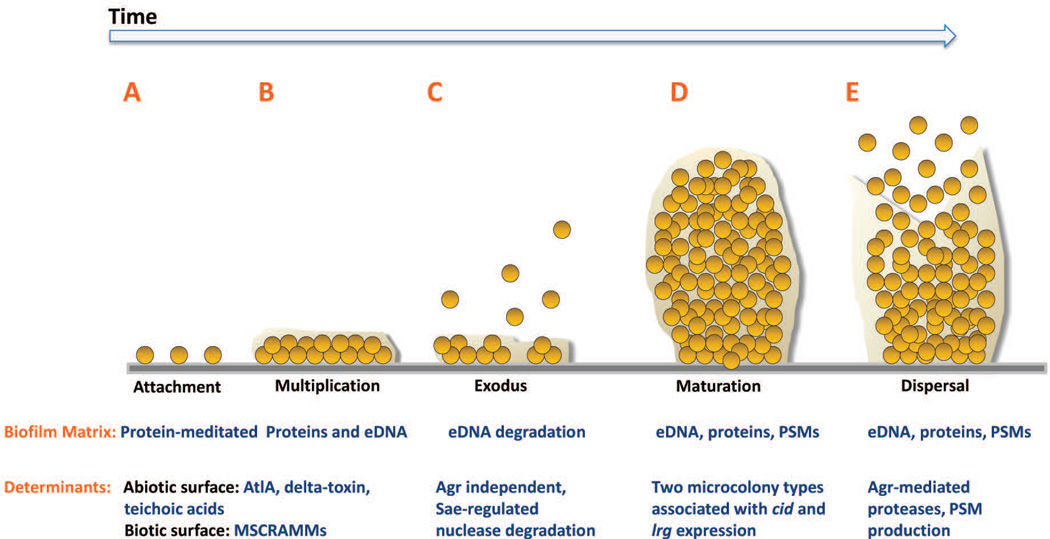
Chronic biofilm-associated infections caused by Staphylococcus aureus often lead to significant increases in morbidity and mortality, particularly when associated with indwelling medical devices. This has triggered a great deal of research attempting to understand the molecular mechanisms that control S. aureus biofilm formation and the basis for the recalcitrance of these multicellular structures to antibiotic therapy. The purpose of this review is to summarize our current understanding of S. aureus biofilm development, focusing on the description of a newly-defined, five-stage model of biofilm development and the mechanisms required for each stage. Importantly, this model includes an alternate view of the processes involved in microcolony formation in S. aureus and suggests that these structures originate as a result of stochastically regulated metabolic heterogeneity and proliferation within a maturing biofilm population, rather than a subtractive process involving the release of cell clusters from a thick, unstructured biofilm. Importantly, it is proposed that this new model of biofilm development involves the genetically programmed generation of metabolically distinct subpopulations of cells, resulting in an overall population that is better able to adapt to rapidly changing environmental conditions.
金黄色葡萄球菌引起的慢性生物膜相关感染常常导致发病率和死亡率显著增加,尤其是与植入式医疗设备相关的感染。这引发了大量研究,试图了解控制金黄色葡萄球菌生物膜形成的分子机制以及这些多细胞结构对抗生素治疗顽固性的基础。本综述的目的是总结我们目前对金黄色葡萄球菌生物膜发育的理解,重点描述新定义的生物膜发育五阶段模型以及每个阶段所需的机制。重要的是,该模型对金黄色葡萄球菌微菌落形成过程提出了另一种观点,并表明这些结构源于成熟生物膜群体中随机调节的代谢异质性和增殖,而不是涉及从厚的、无结构的生物膜中释放细胞簇的减法过程。重要的是,有人提出这种新的生物膜发育模型涉及细胞代谢不同亚群的基因编程生成,从而形成一个更能适应快速变化环境条件的总体群体。