Lai Lily, Flower Andrew, Prescott Philip, Wing Trevor, Moore Michael, Lewith George
University of Southampton Primary Care and Population Sciences Aldermoor Health Centre Aldermoor Close, Southampton, UK.
University of Southampton, Mathematical Sciences Highfield Southampton, Southampton, UK.
BMJ Open. 2017 Feb 3;7(2):e011709. doi: 10.1136/bmjopen-2016-011709.
To explore feasibility of a randomised study using standardised or individualised multiherb Chinese herbal medicine (CHM) for oligomenorrhoea and amenorrhoea in women with polycystic ovary syndrome (PCOS), to pilot study methods and to obtain clinical data to support sample size calculations.
Prospective, pragmatic, randomised feasibility and pilot study with participant and practitioner blinding.
2 private herbal practices in the UK.
40 women diagnosed with PCOS and oligomenorrhoea or amenorrhoea following Rotterdam criteria.
6 months of either standardised CHM or individualised CHM, 16 g daily taken orally as a tea.
Our primary objective was to determine whether oligomenorrhoea and amenorrhoea were appropriate as the primary outcome measures for the main study. Estimates of treatment effects were obtained for menstrual rate, body mass index (BMI), weight and hirsutism. Data were collected regarding safety, feasibility and acceptability.
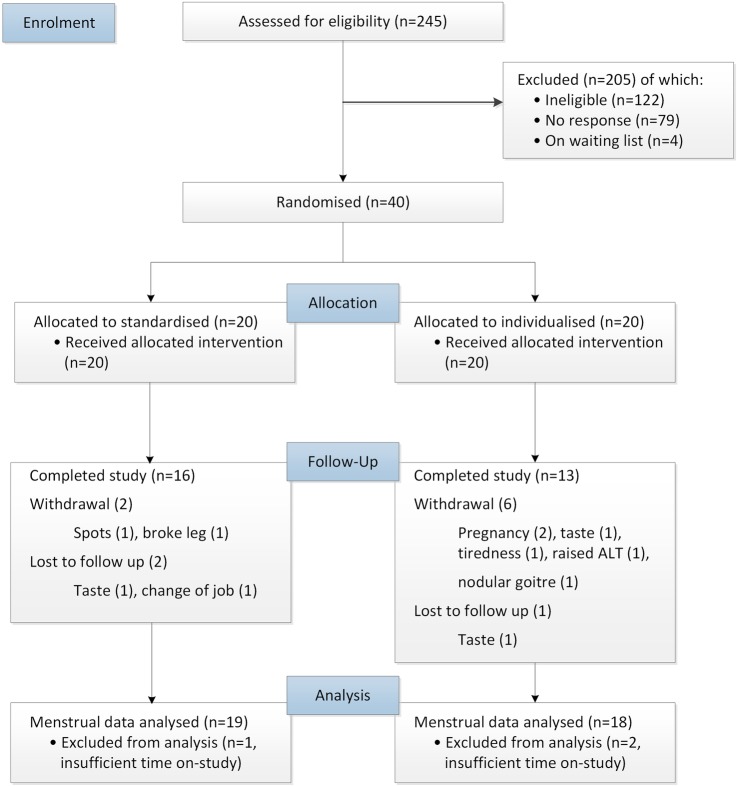
Of the 40 participants recruited, 29 (72.5%) completed the study. The most frequently cited symptoms of concern were hirsutism, weight and menstrual irregularity. Statistically significant improvements in menstrual rates were found at 6 months within group for both standardised CHM (mean difference (MD) 0.18±0.06, 95% CI 0.06 to 0.29; p=0.0027) and individualised CHM (MD 0.27±0.06, 95% CI 0.15 to 0.39; p<0.001), though not between group (p=0.26). No improvements were observed for BMI nor for weight in either group. Improvements in hirsutism scores found within group for both groups were not statistically significant between group (p=0.09). Liver and kidney function and adverse events data were largely normal. Participant feedback suggests changing to tablet administration could facilitate adherence.
A CHM randomised controlled trial for PCOS is feasible and preliminary data suggest that both individualised and standardised multiherb CHMs have similar safety profiles and clinical effects on promoting menstrual regularity. These data will inform the design of a study in primary care that will incorporate an appropriate control.
ISRCTN 31072075; Results.
探讨采用标准化或个体化多草药中药治疗多囊卵巢综合征(PCOS)女性月经过少和闭经的随机研究的可行性,进行方法的初步研究并获取临床数据以支持样本量计算。
前瞻性、实用性、随机可行性和初步研究,采用参与者和从业者双盲。
英国的2家私人中医诊所。
40名根据鹿特丹标准诊断为PCOS且月经过少或闭经的女性。
6个月的标准化中药或个体化中药治疗,每日16克,作为茶饮口服。
我们的主要目标是确定月经过少和闭经是否适合作为主要研究的主要观察指标。获取了月经率、体重指数(BMI)、体重和多毛症的治疗效果估计值。收集了有关安全性、可行性和可接受性的数据。
在招募的40名参与者中,29名(72.5%)完成了研究。最常提及的关注症状是多毛症、体重和月经不规律。标准化中药组(平均差值(MD)0.18±0.06,95%置信区间0.06至0.29;p = 0.0027)和个体化中药组(MD 0.27±0.06,95%置信区间0.15至0.39;p < 0.001)在6个月时组内月经率均有统计学显著改善,但组间无差异(p = 0.26)。两组的BMI和体重均未观察到改善。两组组内多毛症评分的改善在组间无统计学显著差异(p = 0.09)。肝肾功能和不良事件数据基本正常。参与者反馈表明改为片剂给药可能有助于提高依从性。
一项针对PCOS的中药随机对照试验是可行的,初步数据表明个体化和标准化多草药中药在促进月经规律方面具有相似的安全性和临床效果。这些数据将为初级保健中纳入适当对照的研究设计提供信息。
ISRCTN 31072075;结果