Warren Eric, Teskey Garrett, Venketaraman Vishwanath
Department of Basic Medical Sciences, College of Osteopathic Medicine of the Pacific, Western University of Health Sciences, 309 East Second Street, Pomona, CA 91766-1854, USA.
Graduate College of Biomedical Sciences, Western University of Health Sciences, Pomona, CA 91766-1854, USA.
J Clin Med. 2017 Feb 7;6(2):15. doi: 10.3390/jcm6020015.
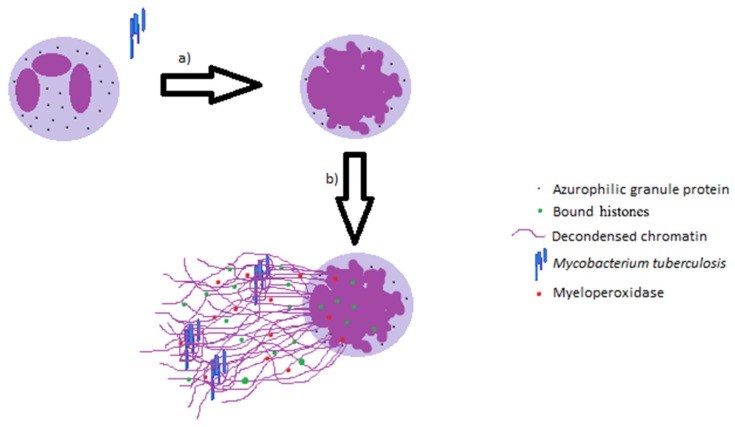
Neutrophils have a significant yet controversial role in the innate immune response to () infection, which is not yet fully understood. In addition to neutrophils' well-known effector mechanisms, they may also help control infection of through the formation of neutrophil extracellular traps (NETs), which are thought to further promote the killing of by resident alveolar macrophages. Cytokines such as IFN-γ have now been shown to serve an immunomodulatory role in neutrophil functioning in conjunction to its pro-inflammatory function. Additionally, the unique transcriptional changes of neutrophils may be used to differentiate between infection with and other bacterial and chronic rheumatological diseases such as Systemic Lupus Erythematosus. Adversely, during the innate immune response to , inappropriate phagocytosis of spent neutrophils can result in nonspecific damage to host cells due to necrotic lysis. Furthermore, some individuals have been shown to be more genetically susceptible to tuberculosis (TB) due to a "Trojan Horse" phenomenon whereby neutrophils block the ability of resident macrophages to kill . Despite these aforementioned negative consequences, through the scope of this review we will provide evidence to support the idea that neutrophils, while sometimes damaging, can also be an important component in warding off infection. This is exemplified in immunocompromised individuals, such as those with human immunodeficiency virus (HIV) infection or Type 2 diabetes mellitus. These individuals are at an increased risk of developing tuberculosis (TB) due to a diminished innate immune response associated with decreased levels of glutathione. Consequently, there has been a worldwide effort to limit and contain infection through the use of antibiotics and vaccinations. However, due to several significant limitations, the current bacille Calmette-Guerin vaccine (BCG, vaccine against TB) does not meet the criteria for universal utilization for all ages and populations across the globe. New research involving neutrophils has yielded a new vaccine called -Ag85C-MPT51-HspX (mc²-CMX) that has been shown to elicit a humoral and cellular response against in mice that is superior to the BCG vaccine.
中性粒细胞在对()感染的固有免疫反应中具有重要但存在争议的作用,目前对此尚未完全了解。除了中性粒细胞众所周知的效应机制外,它们还可能通过形成中性粒细胞胞外陷阱(NETs)来帮助控制()感染,据认为这会进一步促进驻留肺泡巨噬细胞对()的杀伤。现已表明,诸如干扰素-γ等细胞因子在发挥促炎功能的同时,还在中性粒细胞功能中起到免疫调节作用。此外,中性粒细胞独特的转录变化可用于区分()感染与其他细菌感染以及慢性风湿性疾病,如系统性红斑狼疮。不利的是,在对()的固有免疫反应过程中,对衰老中性粒细胞的不适当吞噬会因坏死溶解而导致对宿主细胞的非特异性损伤。此外,由于“特洛伊木马”现象,一些个体在遗传上对结核病(TB)更易感,即中性粒细胞会阻碍驻留巨噬细胞杀灭()的能力。尽管有上述负面后果,但在本综述范围内,我们将提供证据支持以下观点:中性粒细胞虽然有时具有破坏性,但在抵御()感染方面也可能是重要组成部分。这在免疫受损个体中得到体现,例如感染人类免疫缺陷病毒(HIV)或患有2型糖尿病的个体。这些个体由于与谷胱甘肽水平降低相关的固有免疫反应减弱,患结核病(TB)的风险增加。因此,全球一直在努力通过使用抗生素和疫苗来限制和控制()感染。然而,由于一些重大局限性,目前的卡介苗(BCG,抗结核疫苗)不符合全球所有年龄和人群普遍使用的标准。涉及中性粒细胞的新研究产生了一种名为-Ag85C-MPT51-HspX(mc²-CMX)的新疫苗,已证明该疫苗在小鼠中能引发针对()的体液和细胞反应,优于卡介苗。