Tamburino Rachele, Vitale Monica, Ruggiero Alessandra, Sassi Mauro, Sannino Lorenza, Arena Simona, Costa Antonello, Batelli Giorgia, Zambrano Nicola, Scaloni Andrea, Grillo Stefania, Scotti Nunzia
Institute of Biosciences and BioResources, National Research Council of Italy (CNR-IBBR), via Università 133, 80055, Portici, NA, Italy.
Institute for the Animal Production System in the Mediterranean Environment, National Research Council of Italy (CNR-ISPAAM), via Argine 1085, 80147, Napoli, Italy.
BMC Plant Biol. 2017 Feb 10;17(1):40. doi: 10.1186/s12870-017-0971-0.
Drought is a major constraint for plant growth and crop productivity that is receiving an increased attention due to global climate changes. Chloroplasts act as environmental sensors, however, only partial information is available on stress-induced mechanisms within plastids. Here, we investigated the chloroplast response to a severe drought treatment and a subsequent recovery cycle in tomato through physiological, metabolite and proteomic analyses.
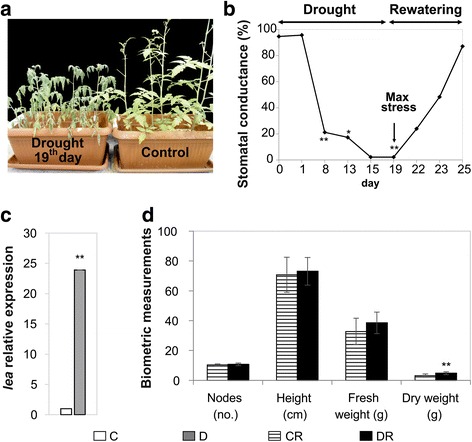
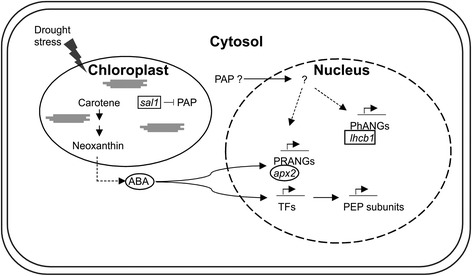
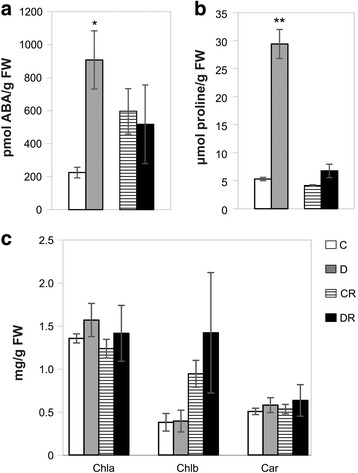
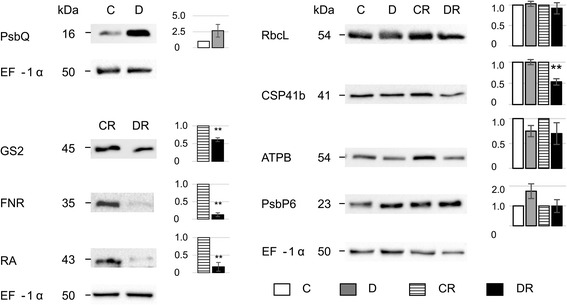
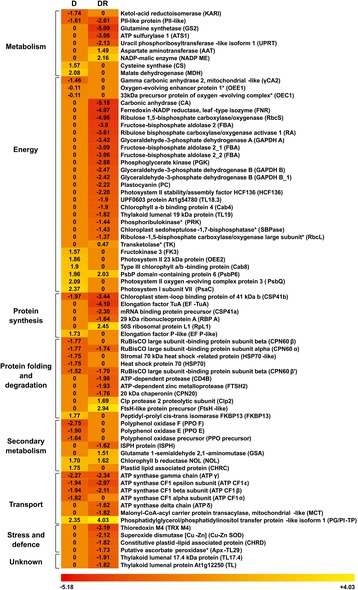
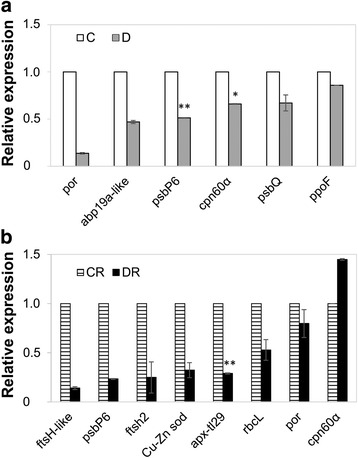
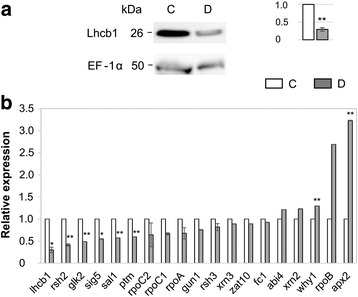
Under stress conditions, tomato plants showed stunted growth, and elevated levels of proline, abscisic acid (ABA) and late embryogenesis abundant gene transcript. Proteomics revealed that water deficit deeply affects chloroplast protein repertoire (31 differentially represented components), mainly involving energy-related functional species. Following the rewatering cycle, physiological parameters and metabolite levels indicated a recovery of tomato plant functions, while proteomics revealed a still ongoing adjustment of the chloroplast protein repertoire, which was even wider than during the drought phase (54 components differentially represented). Changes in gene expression of candidate genes and accumulation of ABA suggested the activation under stress of a specific chloroplast-to-nucleus (retrograde) signaling pathway and interconnection with the ABA-dependent network.
Our results give an original overview on the role of chloroplast as enviromental sensor by both coordinating the expression of nuclear-encoded plastid-localised proteins and mediating plant stress response. Although our data suggest the activation of a specific retrograde signaling pathway and interconnection with ABA signaling network in tomato, the involvement and fine regulation of such pathway need to be further investigated through the development and characterization of ad hoc designed plant mutants.
干旱是植物生长和作物生产力的主要限制因素,由于全球气候变化,其受到的关注日益增加。叶绿体充当环境传感器,然而,关于质体内应激诱导机制的信息仅部分可得。在此,我们通过生理、代谢物和蛋白质组学分析,研究了番茄叶绿体对严重干旱处理及随后恢复周期的响应。
在胁迫条件下,番茄植株生长受阻,脯氨酸、脱落酸(ABA)水平升高,晚期胚胎发生丰富基因转录本增加。蛋白质组学显示,水分亏缺深刻影响叶绿体蛋白质组(31个差异表达组分),主要涉及能量相关功能种类。复水周期后,生理参数和代谢物水平表明番茄植株功能得以恢复,而蛋白质组学显示叶绿体蛋白质组仍在持续调整,其范围甚至比干旱阶段更广(54个差异表达组分)。候选基因的基因表达变化和ABA积累表明,胁迫下特定的叶绿体到细胞核(逆向)信号通路被激活,并与ABA依赖网络相互连接。
我们的结果通过协调核编码质体定位蛋白的表达和介导植物应激反应,对叶绿体作为环境传感器的作用给出了一个全新的概述。尽管我们的数据表明番茄中特定逆向信号通路被激活并与ABA信号网络相互连接,但需要通过设计特定的植物突变体并对其进行发育和表征,进一步研究该通路的参与情况和精细调控。