Muzari Mutizwa Odwell, Devine Gregor, Davis Joseph, Crunkhorn Bruce, van den Hurk Andrew, Whelan Peter, Russell Richard, Walker James, Horne Peter, Ehlers Gerhard, Ritchie Scott
Medical Entomology, Tropical Public Health Services Cairns, Cairns and Hinterland Hospital & Health Services, Cairns, Queensland, Australia.
Mosquito Control Laboratory, QIMR Berghofer Medical Research Institute, Royal Brisbane Hospital, Herston, Queensland, Australia.
PLoS Negl Trop Dis. 2017 Feb 13;11(2):e0005286. doi: 10.1371/journal.pntd.0005286. eCollection 2017 Feb.
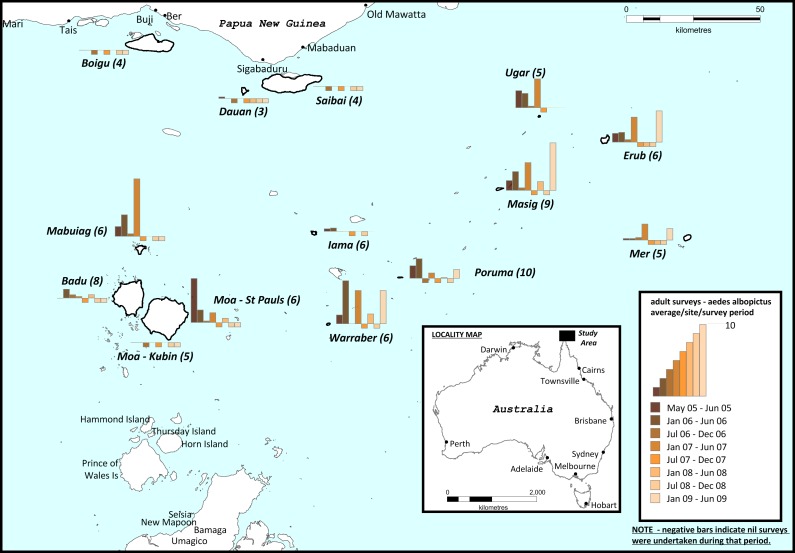
The Asian tiger mosquito, Aedes albopictus, is an important vector of dengue, chikungunya and Zika viruses and is a highly invasive and aggressive biter. Established populations of this species were first recognised in Australia in 2005 when they were discovered on islands in the Torres Strait, between mainland Australia and Papua New Guinea. A control program was implemented with the original goal of eliminating Ae. albopictus from the Torres Strait. We describe the evolution of management strategies that provide a template for Ae. albopictus control that can be adopted elsewhere.
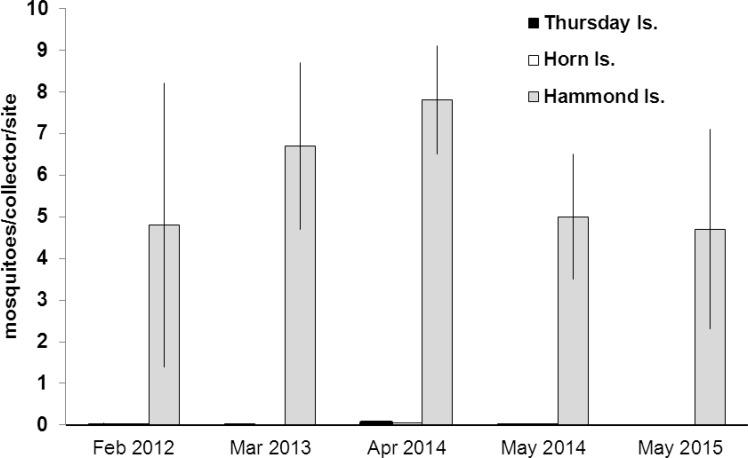
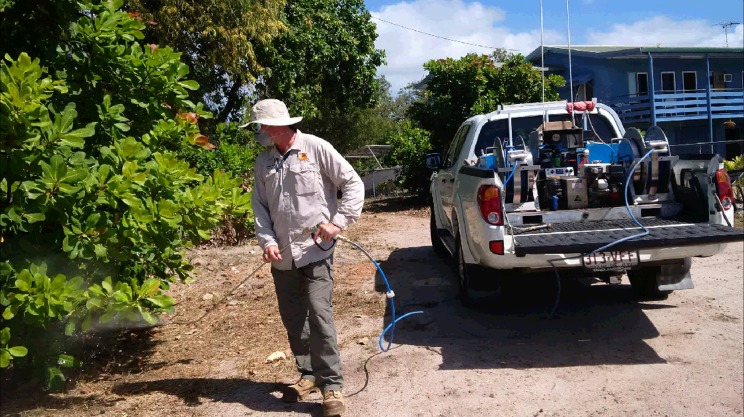
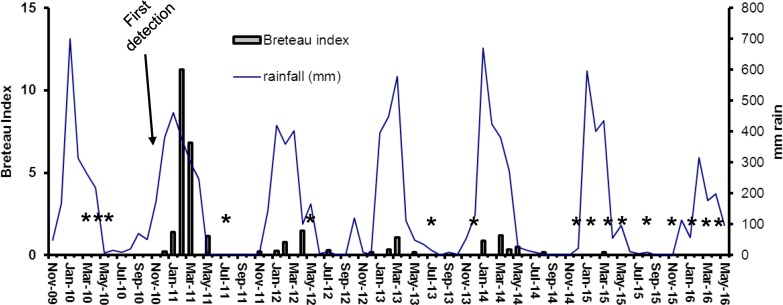
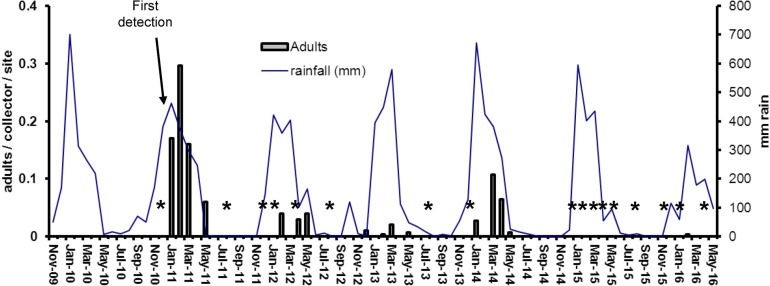
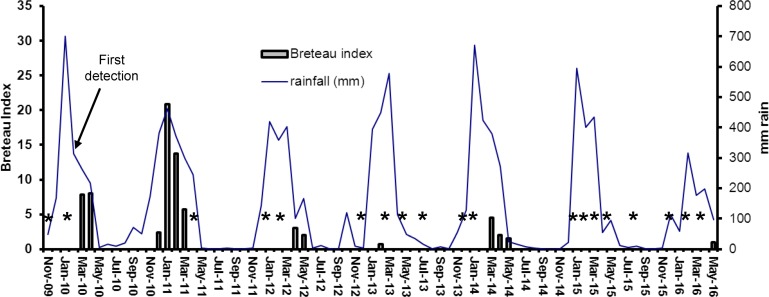
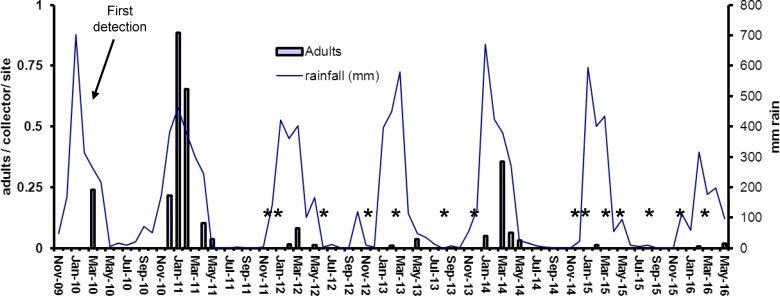
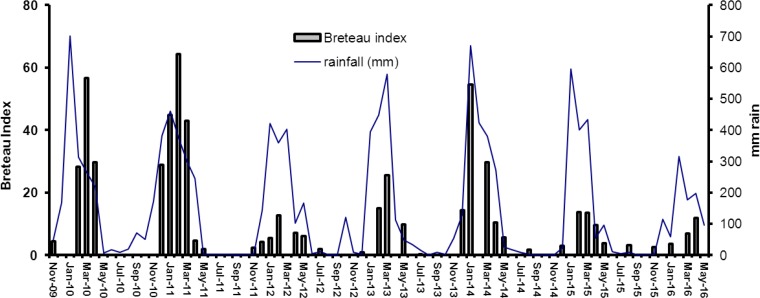
METHODOLOGY / PRINCIPAL FINDINGS: The control strategy implemented between 2005 and 2008 targeted larval habitats using source reduction, insect-growth regulator and pyrethroid insecticide to control larvae and adults in the containers. However, the infrequency of insecticide reapplication, the continual accumulation and replacement of containers, and imminent re-introduction of mosquitoes through people's movement from elsewhere compromised the program. Consequently, in 2009 the objective of the program changed from elimination to quarantine, with the goal of preventing Ae albopictus from infesting Thursday and Horn islands, which are the transport hubs connecting the Torres Strait to mainland Australia. However, larval control strategies did not prevent the species establishing on these islands in 2010. Thereafter, an additional strategy adopted by the quarantine program in early 2011 was harborage spraying, whereby the vegetated, well shaded resting sites of adult Ae. albopictus were treated with a residual pyrethroid insecticide. Inclusion of this additional measure led to a 97% decline in Ae. albopictus numbers within two years. In addition, the frequency of container treatment was increased to five weeks between treatments, compared to an average of 8 weeks that occurred in the earlier iterations of the program. By 2015 and 2016, Ae. albopictus populations on the two islands were undetectable in 70-90% of surveys conducted. Importantly, a comprehensive surveillance network in selected strategic areas has not identified established populations of this species on the Australian mainland.
CONCLUSIONS / SIGNIFICANCE: The program has successfully reduced Ae. albopictus populations on Thursday Island and Horn Island to levels where it is undetectable in up to 90% of surveys, and has largely removed the risk of mainland establishment via that route. The vector management strategies adopted in the later years of the program have been demonstrably successful and provide a practical management framework for dengue, chikungunya or Zika virus outbreaks vectored by Ae. albopictus. As of June 2016, Ae. albopictus had not established on the Australian mainland and this program has likely contributed significantly to this outcome.
白纹伊蚊是登革热、基孔肯雅热和寨卡病毒的重要传播媒介,是一种极具入侵性且攻击性很强的叮咬者。2005年,澳大利亚首次确认该物种已建立种群,当时在澳大利亚大陆和巴布亚新几内亚之间的托雷斯海峡岛屿上发现了它们。实施了一项控制计划,最初目标是从托雷斯海峡根除白纹伊蚊。我们描述了管理策略的演变,这些策略为可在其他地方采用的白纹伊蚊控制提供了一个模板。
方法/主要发现:2005年至2008年实施的控制策略以幼虫栖息地为目标,采用减少源头、昆虫生长调节剂和拟除虫菊酯杀虫剂来控制容器中的幼虫和成虫。然而,杀虫剂重新施用的频率低、容器的持续积累和更换,以及由于人员从其他地方流动而即将再次引入蚊子,损害了该计划。因此,2009年该计划的目标从根除变为检疫,目的是防止白纹伊蚊侵扰星期四岛和霍恩岛,这两个岛是连接托雷斯海峡与澳大利亚大陆的交通枢纽。然而,幼虫控制策略未能阻止该物种在2010年在这些岛屿上建立种群。此后,检疫计划在2011年初采用的一项额外策略是栖息处喷洒,即用残留的拟除虫菊酯杀虫剂处理成年白纹伊蚊植被茂密、遮荫良好的栖息场所。纳入这一额外措施导致两年内白纹伊蚊数量下降了97%。此外,容器处理的频率增加到每隔五周处理一次,而该计划早期阶段平均为八周处理一次。到2015年和2016年,在进行的70%至90%的调查中,未在这两个岛屿上检测到白纹伊蚊种群。重要的是,在选定战略区域的全面监测网络尚未在澳大利亚大陆发现该物种已建立种群。
结论/意义:该计划已成功将星期四岛和霍恩岛的白纹伊蚊种群数量减少到在高达90%的调查中无法检测到的水平,并在很大程度上消除了通过该途径在澳大利亚大陆建立种群的风险。该计划后期采用的病媒管理策略已被证明是成功的,并为白纹伊蚊传播的登革热、基孔肯雅热或寨卡病毒疫情提供了一个实际的管理框架。截至2016年6月,白纹伊蚊尚未在澳大利亚大陆建立种群,该计划可能对此结果做出了重大贡献。