Park Woo-Chul, Seo Inho, Kim Shin-Hye, Lee Yong-Jae, Ahn Song Vogue
Department of Family Medicine, Yonsei University College of Medicine, Seoul, Korea.
Department of Preventive Medicine, Institute of Genomic Cohort, Yonsei University Wonju College of Medicine, Wonju, Korea.
Korean J Fam Med. 2017 Jan;38(1):8-13. doi: 10.4082/kjfm.2017.38.1.8. Epub 2016 Jan 18.
Inflammation is an important underlying mechanism in the pathogenesis of atherosclerosis, and an elevated resting heart rate underlies the process of atherosclerotic plaque formation. We hypothesized an association between resting heart rate and subclinical inflammation.
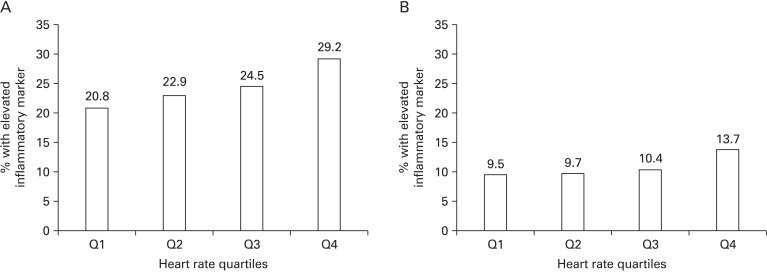
Resting heart rate was recorded at baseline in the KoGES-ARIRANG (Korean Genome and Epidemiology Study on Atherosclerosis Risk of Rural Areas in the Korean General Population) cohort study, and was then divided into quartiles. Subclinical inflammation was measured by white blood cell count and high-sensitivity C-reactive protein. We used progressively adjusted regression models with terms for muscle mass, body fat proportion, and adiponectin in the fully adjusted models. We examined inflammatory markers as both continuous and categorical variables, using the clinical cut point of the highest quartile of white blood cell count (≥7,900/mm) and ≥3 mg/dL for high-sensitivity C-reactive protein.
Participants had a mean age of 56.3±8.1 years and a mean resting heart rate of 71.4±10.7 beats/min; 39.1% were men. In a fully adjusted model, an increased resting heart rate was significantly associated with a higher white blood cell count and higher levels of high-sensitivity C-reactive protein in both continuous (P for trend <0.001) and categorical (P for trend <0.001) models.
An increased resting heart rate is associated with a higher level of subclinical inflammation among healthy Korean people.
炎症是动脉粥样硬化发病机制中的一个重要潜在机制,静息心率升高是动脉粥样硬化斑块形成过程的基础。我们推测静息心率与亚临床炎症之间存在关联。
在韩国基因组与流行病学研究——韩国普通人群农村地区动脉粥样硬化风险研究(KoGES-ARIRANG)队列研究中,记录基线时的静息心率,然后将其分为四分位数。通过白细胞计数和高敏C反应蛋白来测量亚临床炎症。在完全调整模型中,我们使用逐步调整的回归模型,纳入肌肉量、体脂比例和脂联素等项。我们将炎症标志物作为连续变量和分类变量进行检验,白细胞计数最高四分位数(≥7,900/mm)和高敏C反应蛋白≥3 mg/dL作为临床切点。
参与者的平均年龄为56.3±8.1岁,平均静息心率为71.4±10.7次/分钟;39.1%为男性。在完全调整模型中,静息心率升高与白细胞计数升高以及高敏C反应蛋白水平升高在连续变量模型(趋势P<0.001)和分类变量模型(趋势P<0.001)中均显著相关。
在健康的韩国人群中,静息心率升高与较高水平的亚临床炎症相关。