Fredsø N, Toft N, Sabers A, Berendt M
Department of Veterinary Clinical and Animal Sciences, University of Copenhagen, Dyrlaegevej 16, 1870, Frederiksberg C, Denmark.
National Veterinary Institute, Section for Epidemiology, Technical University of Denmark, Frederiksberg C, Denmark.
BMC Vet Res. 2017 Feb 16;13(1):54. doi: 10.1186/s12917-017-0966-y.
Seizures are common in dogs and can be caused by non-epileptic conditions or epilepsy. The clinical course of newly diagnosed epilepsy is sparsely documented. The objective of this study was to prospectively investigate causes for seizures (epileptic and non-epileptic) in a cohort of dogs with new-onset untreated seizures, and for those dogs with newly diagnosed epilepsy to investigate epilepsy type, seizure type and the course of disease over time, including the risk of seizure recurrence. Untreated client-owned dogs experiencing new-onset seizures were prospectively enrolled in a longitudinal observational study including clinical investigations and long-term monitoring at the Copenhagen University Hospital for Companion Animals. A baseline clinical assessment was followed by investigator/owner contact every eight weeks from inclusion to death or end of study. Inclusion of dogs was conducted from November 2010 to September 2012, and the study terminated in June 2014.
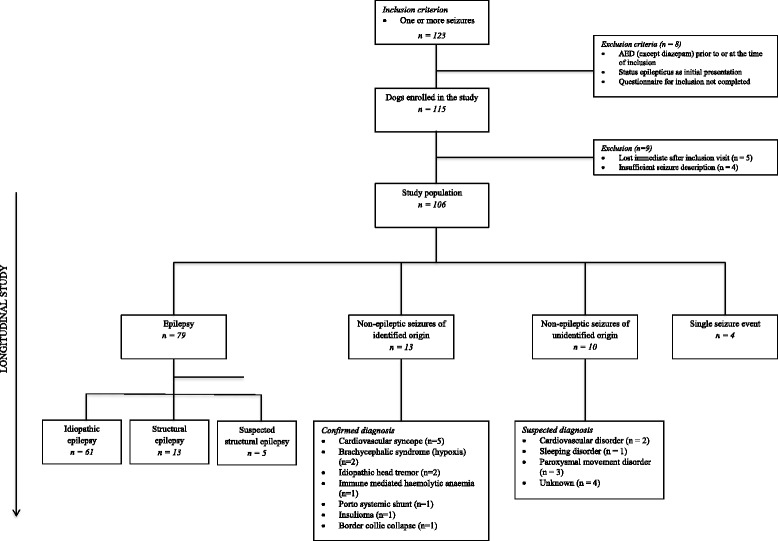
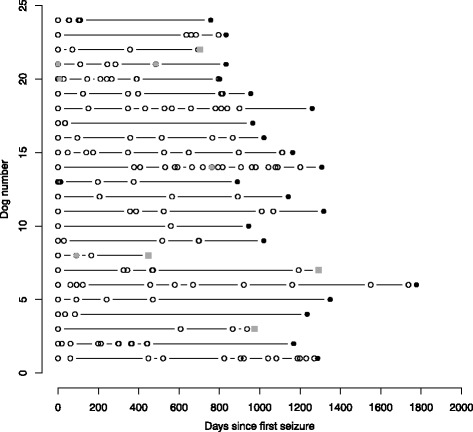
One hundred and six dogs were included in the study. Seventy-nine dogs (74.5%) were diagnosed with epilepsy: 61 dogs (77.2%) with idiopathic epilepsy, 13 dogs (16.5%) with structural epilepsy and five dogs (6.3%) with suspected structural epilepsy. A non-epileptic cause for seizures was identified in 13 dogs and suspected in 10 dogs. Four dogs in which no cause for seizures was identified experienced only one seizure during the study. In dogs with idiopathic epilepsy 60% had their second epileptic seizure within three months of seizure onset. Twenty-six dogs with idiopathic epilepsy (43%) completed the study without receiving antiepileptic treatment. The natural course of idiopathic epilepsy (uninfluenced by drugs) was illustrated by highly individual and fluctuating seizure patterns, including long periods of remission. Cluster seizures motivated early treatment. In a few dogs with a high seizure frequency owners declined treatment against the investigators advice.
Epilepsy is the most likely diagnosis in dogs presenting with new-onset seizures. The course of idiopathic epilepsy is highly individual and might not necessarily require long-term treatment. This must be considered when advising owners about what to expect with regard to treatment and prognosis.
癫痫发作在犬类中很常见,可能由非癫痫性疾病或癫痫引起。新诊断癫痫的临床病程记录稀少。本研究的目的是前瞻性调查一组新发未治疗癫痫发作犬的癫痫发作(癫痫性和非癫痫性)原因,对于那些新诊断为癫痫的犬,调查癫痫类型、发作类型以及疾病随时间的病程,包括癫痫发作复发的风险。未治疗的宠物犬新发癫痫发作被前瞻性纳入一项纵向观察性研究,包括在哥本哈根大学动物医院进行临床检查和长期监测。从纳入研究到死亡或研究结束,每八周进行一次基线临床评估,随后研究者/主人进行联系。犬的纳入时间为2010年11月至2012年9月,研究于2014年6月结束。
106只犬被纳入研究。79只犬(74.5%)被诊断为癫痫:61只犬(77.2%)为特发性癫痫,13只犬(16.5%)为结构性癫痫,5只犬(6.3%)为疑似结构性癫痫。13只犬确定了癫痫发作的非癫痫性原因,10只犬疑似有非癫痫性原因。4只未确定癫痫发作原因的犬在研究期间仅发作一次。特发性癫痫犬中60%在癫痫发作开始后三个月内出现第二次癫痫发作。26只特发性癫痫犬(43%)未接受抗癫痫治疗就完成了研究。特发性癫痫(不受药物影响)的自然病程表现为高度个体化且波动的癫痫发作模式,包括长时间缓解期。成簇发作促使早期治疗。少数癫痫发作频率高的犬,其主人不顾研究者建议拒绝治疗。
癫痫是新发癫痫发作犬最可能的诊断。特发性癫痫的病程高度个体化,不一定需要长期治疗。在向主人告知治疗和预后情况时必须考虑到这一点。