Joshi-Barve Swati, Kirpich Irina, Cave Matthew C, Marsano Luis S, McClain Craig J
Division of Gastroenterology, Hepatology and Nutrition, School of Medicine, University of Louisville, Louisville, Kentucky; Department of Medicine, School of Medicine, University of Louisville, Louisville, Kentucky; Department of Pharmacology and Toxicology, School of Medicine, University of Louisville, Louisville, Kentucky.
Division of Gastroenterology, Hepatology and Nutrition, School of Medicine, University of Louisville, Louisville, Kentucky; Department of Medicine, School of Medicine, University of Louisville, Louisville, Kentucky; Department of Pharmacology and Toxicology, School of Medicine, University of Louisville, Louisville, Kentucky; Robley Rex Veterans Affairs Medical Center, Louisville, Kentucky.
Cell Mol Gastroenterol Hepatol. 2015 Jun 3;1(4):356-367. doi: 10.1016/j.jcmgh.2015.05.006. eCollection 2015 Jul.
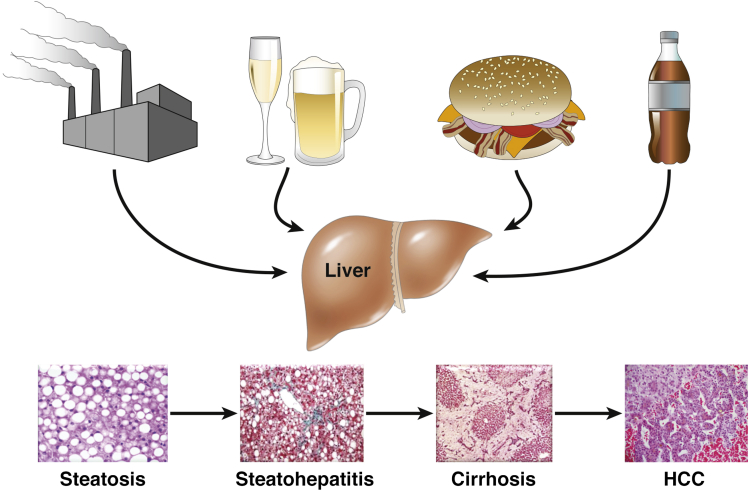
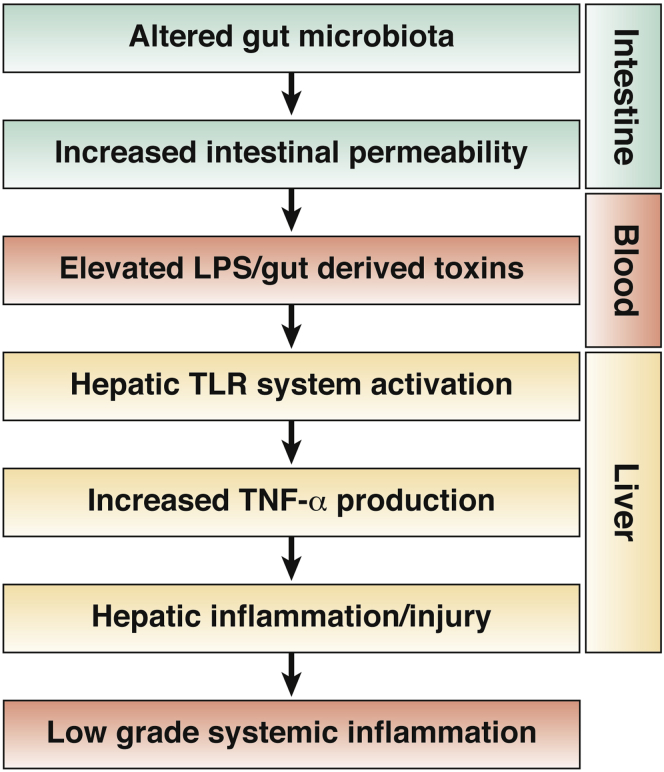
Hepatic steatosis and steatohepatitis are common histologic findings that can be caused by multiple etiologies. The three most frequent causes for steatosis/steatohepatitis are alcohol (alcoholic steatohepatitis, ASH), obesity/metabolic syndrome (nonalcoholic steatohepatitis, NASH), and environmental toxicants (toxicant-associated steatohepatitis, TASH). Hepatic steatosis is an early occurrence in all three forms of liver disease, and they often share common pathways to disease progression/severity. Disease progression is a result of both direct effects on the liver as well as indirect alterations in other organs/tissues such as intestine, adipose tissue, and the immune system. Although the three liver diseases (ASH, NASH, and TASH) share many common pathogenic mechanisms, they also exhibit distinct differences. Both shared and divergent mechanisms can be potential therapeutic targets. This review provides an overview of selected important mechanistic similarities and differences in ASH, NASH, and TASH.
肝脂肪变性和脂肪性肝炎是常见的组织学表现,可由多种病因引起。脂肪变性/脂肪性肝炎最常见的三个病因是酒精(酒精性脂肪性肝炎,ASH)、肥胖/代谢综合征(非酒精性脂肪性肝炎,NASH)和环境毒物(毒物相关性脂肪性肝炎,TASH)。肝脂肪变性在所有这三种肝病形式中都是早期出现的情况,并且它们通常具有疾病进展/严重程度的共同途径。疾病进展是对肝脏的直接影响以及其他器官/组织(如肠道、脂肪组织和免疫系统)的间接改变共同作用的结果。虽然这三种肝病(ASH、NASH和TASH)有许多共同的致病机制,但它们也表现出明显的差异。共同机制和不同机制都可能成为潜在的治疗靶点。本综述概述了ASH、NASH和TASH中选定的重要机制异同。