Adamek Mikolaj, Oschilewski Anna, Wohlsein Peter, Jung-Schroers Verena, Teitge Felix, Dawson Andy, Gela David, Piackova Veronika, Kocour Martin, Adamek Jerzy, Bergmann Sven M, Steinhagen Dieter
Fish Disease Research Unit, Institute for Parasitology, University of Veterinary Medicine, Bünteweg 17, 30559, Hannover, Germany.
Department of Pathology, University of Veterinary Medicine, Bünteweg 17, 30559, Hannover, Germany.
Vet Res. 2017 Feb 21;48(1):12. doi: 10.1186/s13567-017-0416-7.
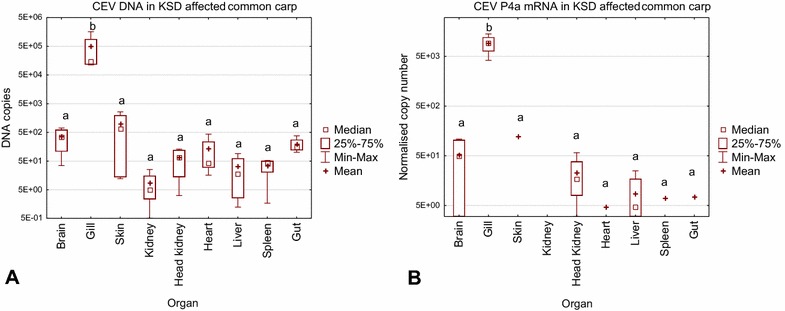
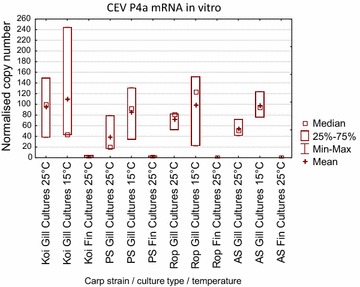
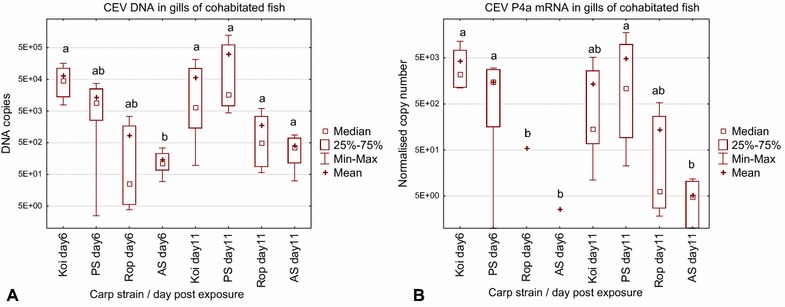
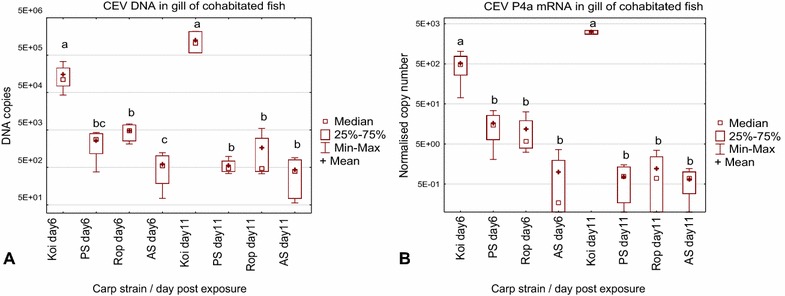
Outbreaks of koi sleepy disease (KSD) caused by carp edema virus (CEV) may seriously affect populations of farmed common carp, one of the most important fish species for global food production. The present study shows further evidence for the involvement of CEV in outbreaks of KSD among carp and koi populations: in a series of infection experiments, CEV from two different genogroups could be transmitted to several strains of naïve common carp via cohabitation with fish infected with CEV. In recipient fish, clinical signs of KSD were induced. The virus load and viral gene expression results confirm gills as the target organ for CEV replication. Gill explants also allowed for a limited virus replication in vitro. The in vivo infection experiments revealed differences in the virulence of the two CEV genogroups which were associated with infections in koi or in common carp, with higher virulence towards the same fish variety as the donor fish. When the susceptibility of different carp strains to a CEV infection and the development of KSD were experimentally investigated, Amur wild carp showed to be relatively more resistant to the infection and did not develop clinical signs for KSD. However, the resistance could not be related to a higher magnitude of type I IFN responses of affected tissues. Despite not having a mechanistic explanation for the resistance of Amur wild carp to KSD, we recommend using this carp strain in breeding programs to limit potential losses caused by CEV in aquaculture.
由鲤鱼水肿病毒(CEV)引起的锦鲤昏睡病(KSD)疫情可能会严重影响养殖鲤鱼的数量,鲤鱼是全球粮食生产中最重要的鱼类品种之一。本研究进一步证明了CEV与鲤鱼和锦鲤种群中KSD疫情的关联:在一系列感染实验中,来自两个不同基因组的CEV可通过与感染CEV的鱼同居而传播给几株未感染过的普通鲤鱼。在受体鱼中,诱发了KSD的临床症状。病毒载量和病毒基因表达结果证实鳃是CEV复制的靶器官。鳃外植体在体外也允许有限的病毒复制。体内感染实验揭示了两个CEV基因组在毒力上的差异,这与锦鲤或普通鲤鱼中的感染有关,对与供体鱼相同的鱼类品种具有更高的毒力。当通过实验研究不同鲤鱼品系对CEV感染的易感性和KSD的发展情况时,黑龙江野鲤显示出对感染相对更具抗性,并且未出现KSD的临床症状。然而,这种抗性与受影响组织中I型干扰素反应的更高强度无关。尽管对于黑龙江野鲤对KSD的抗性没有机理解释,但我们建议在育种计划中使用这种鲤鱼品系,以限制水产养殖中由CEV造成的潜在损失。