Jiang Xian, Huang Jiang, Song Daqiang, Deng Ru, Wei Jicheng, Zhang Zhuo
Department of Anesthesia, The Affiliated Hospital of Southwest Medical University Luzhou, China.
Department of Pharmacy, The Affiliated Traditional Chinese Medicine Hospital of Southwest Medical University Luzhou, China.
Front Aging Neurosci. 2017 Feb 7;9:18. doi: 10.3389/fnagi.2017.00018. eCollection 2017.
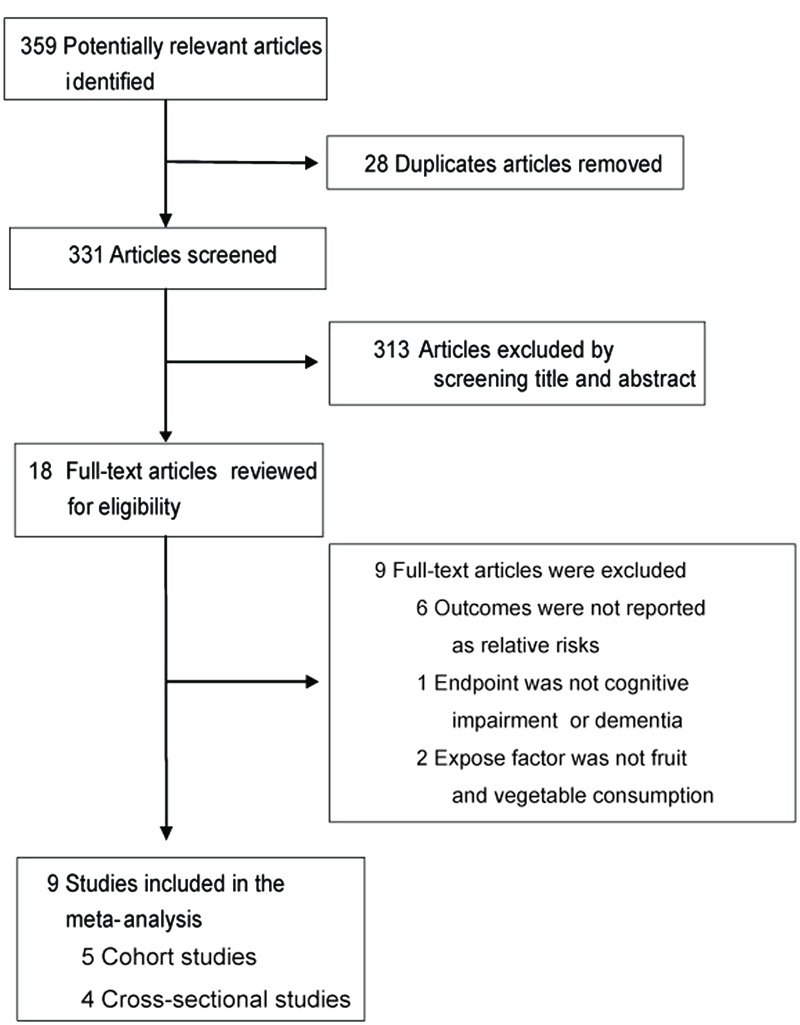
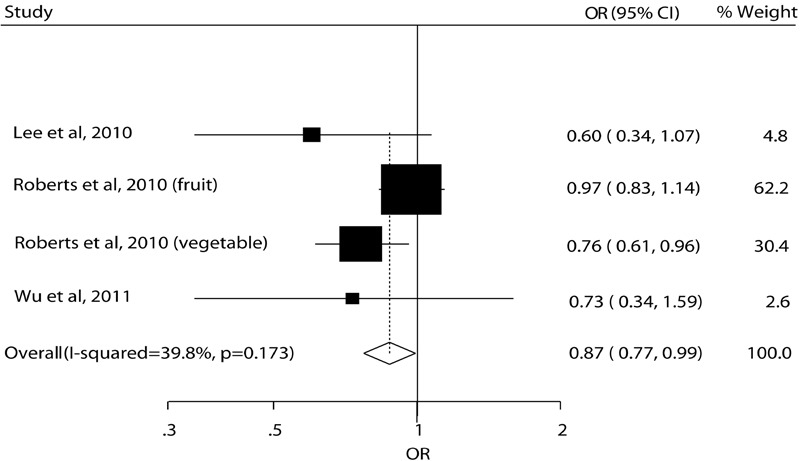
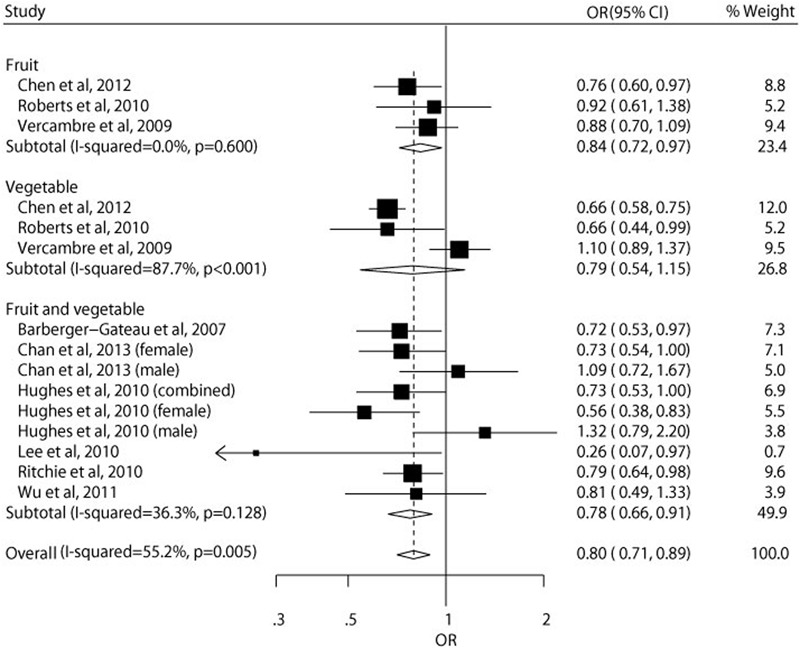
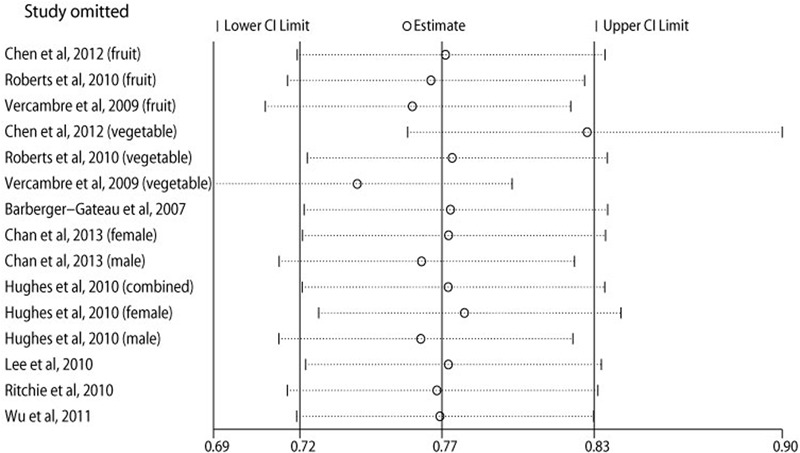
Increased consumption of fruit and vegetables has been shown to be associated with a reduced risk of cognitive impairment and dementia in many epidemiological studies. The purpose of this study was to assess the strength of this association in a meta-analysis. We identified relevant studies by searching Medline, Embase, and Cochrane Library electronic databases (from 1970 to January 2016). Study were included if they reported relative risks and corresponding 95% confidence intervals (CIs) of cognitive impairment and dementia with respect to frequency of fruit and vegetable intake. Nine studies (five cohort studies and four cross-sectional studies) met the inclusion criteria and were included in the meta-analysis. There were a total of 31,104 participants and 4,583 incident cases of cognitive impairment and dementia. The meta-analysis showed that an increased consumption of fruit and vegetables was associated with a significant reduction in the risk of cognitive impairment and dementia (OR = 0.80, 95% CI 0.71-0.89). Subgroup analysis indicated this inverse association was only found among participants with mean age over 65 years and combined sexes. Dose-response meta-analysis showed that an increment of 100 g per day of fruit and vegetable consumption was related to an approximately 13% (OR = 0.87, 95% CI 0.77-0.99) reduction in cognitive impairment and dementia risk. There was no potential publication bias in the meta-analysis and the dose-response meta-analysis. The increased consumption of fruit and vegetables is associated with a reduced risk of cognitive impairment and dementia.
在许多流行病学研究中,已表明增加水果和蔬菜的摄入量与降低认知障碍和痴呆症的风险有关。本研究的目的是通过荟萃分析评估这种关联的强度。我们通过检索Medline、Embase和Cochrane图书馆电子数据库(从1970年至2016年1月)来识别相关研究。如果研究报告了认知障碍和痴呆症相对于水果和蔬菜摄入频率的相对风险及相应的95%置信区间(CI),则纳入研究。九项研究(五项队列研究和四项横断面研究)符合纳入标准并被纳入荟萃分析。共有31,104名参与者以及4,583例认知障碍和痴呆症的发病病例。荟萃分析表明,增加水果和蔬菜的摄入量与显著降低认知障碍和痴呆症的风险相关(OR = 0.80,95% CI 0.71 - 0.89)。亚组分析表明,这种反向关联仅在平均年龄超过65岁的男女混合参与者中发现。剂量反应荟萃分析表明,每天水果和蔬菜摄入量增加100克与认知障碍和痴呆症风险降低约13%(OR = 0.87,95% CI 0.77 - 0.99)相关。荟萃分析和剂量反应荟萃分析中均无潜在的发表偏倚。增加水果和蔬菜的摄入量与降低认知障碍和痴呆症的风险相关。