Lobel Adam, Engels Rutger C M E, Stone Lisanne L, Burk William J, Granic Isabela
Swiss Center for Affective Sciences, University of Geneva, Chemin des Mines 9, Geneva, 1202, Switzerland.
Trimbos Institute, Da Costakade 45, Utrecht, 3521VS, Netherlands.
J Youth Adolesc. 2017 Apr;46(4):884-897. doi: 10.1007/s10964-017-0646-z. Epub 2017 Feb 21.
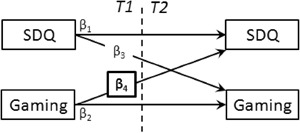
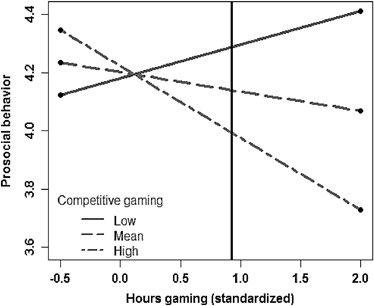
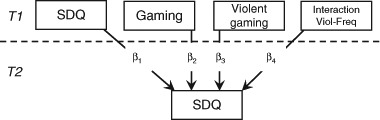
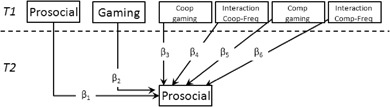
The effects of video games on children's psychosocial development remain the focus of debate. At two timepoints, 1 year apart, 194 children (7.27-11.43 years old; male = 98) reported their gaming frequency, and their tendencies to play violent video games, and to game (a) cooperatively and (b) competitively; likewise, parents reported their children's psychosocial health. Gaming at time one was associated with increases in emotion problems. Violent gaming was not associated with psychosocial changes. Cooperative gaming was not associated with changes in prosocial behavior. Finally, competitive gaming was associated with decreases in prosocial behavior, but only among children who played video games with high frequency. Thus, gaming frequency was related to increases in internalizing but not externalizing, attention, or peer problems, violent gaming was not associated with increases in externalizing problems, and for children playing approximately 8 h or more per week, frequent competitive gaming may be a risk factor for decreasing prosocial behavior. We argue that replication is needed and that future research should better distinguish between different forms of gaming for more nuanced and generalizable insight.
电子游戏对儿童心理社会发展的影响仍是争论的焦点。在相隔1年的两个时间点,194名儿童(7.27 - 11.43岁;男性98名)报告了他们的游戏频率、玩暴力电子游戏的倾向以及(a)合作游戏和(b)竞争游戏的倾向;同样,家长报告了孩子的心理社会健康状况。第一次测量时的游戏与情绪问题增加有关。暴力游戏与心理社会变化无关。合作游戏与亲社会行为的变化无关。最后,竞争游戏与亲社会行为减少有关,但仅在高频玩电子游戏的儿童中如此。因此,游戏频率与内化问题增加有关,但与外化问题、注意力问题或同伴问题增加无关,暴力游戏与外化问题增加无关,对于每周玩大约8小时或更多时间的儿童,频繁的竞争游戏可能是亲社会行为减少的一个风险因素。我们认为需要进行重复研究,并且未来的研究应该更好地区分不同形式的游戏,以获得更细致入微且具有普遍性的见解。