Bohon Cara
Department of Psychiatry and Behavioral Sciences, Stanford University School of Medicine, Stanford, California, United States of America.
PLoS One. 2017 Feb 24;12(2):e0172604. doi: 10.1371/journal.pone.0172604. eCollection 2017.
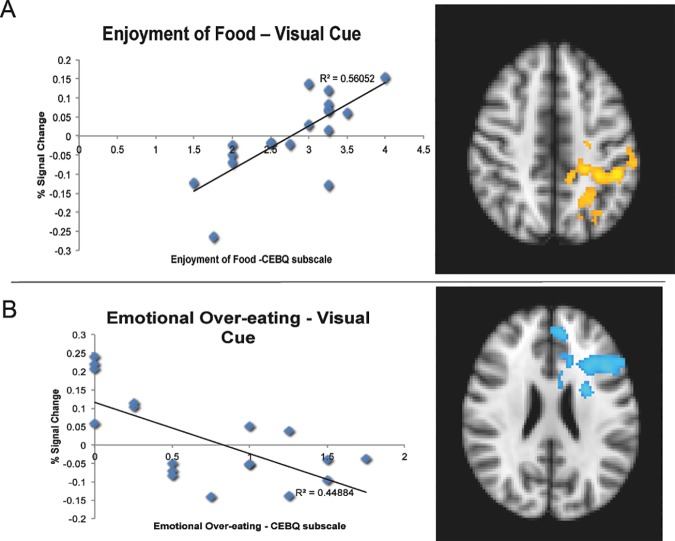
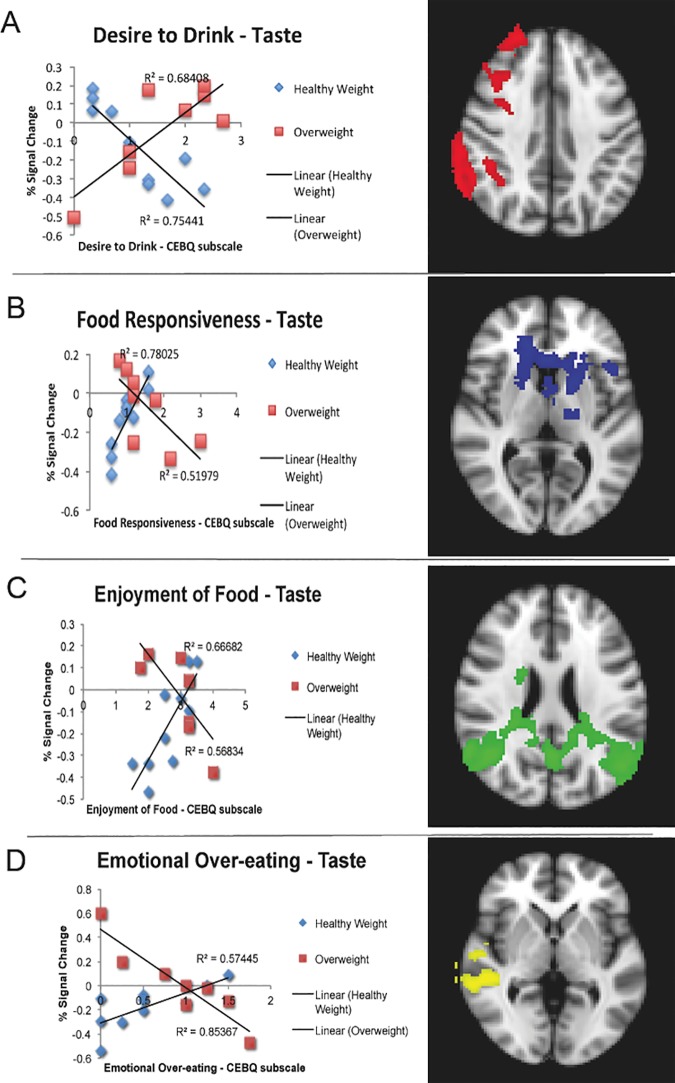
Understanding the neural response to food and food cues during early stages of weight gain in childhood may help us determine the drive processes involved in unhealthy eating behavior and risk for obesity. Healthy weight and overweight children ages 6-8 (N = 18; 10 with BMI between 5th and 85th %ile and 8 with BMI >85th %ile) underwent fMRI scans while anticipating and receiving tastes of chocolate milkshake. Parents completed a Children's Eating Behaviour Questionnaire. Results reveal greater response to milkshake taste receipt in overweight children in the right insula, operculum, precentral gyrus, and angular gyrus, and bilateral precuneus and posterior cingulate. No group differences were found for brain response to a visual food cue. Exploratory analyses revealed interactions between self-report measures of eating behavior and weight status on brain response to taste. This pilot study provides preliminary evidence of feasibility of studying young children's taste processing and suggests a possible developmental shift in brain response to taste.
了解儿童体重增加早期阶段对食物及食物线索的神经反应,可能有助于我们确定与不健康饮食行为及肥胖风险相关的驱动过程。6至8岁的健康体重和超重儿童(N = 18;10名BMI处于第5至85百分位之间,8名BMI>85百分位)在预期并品尝巧克力奶昔时接受了功能磁共振成像扫描。家长完成了一份儿童饮食行为问卷。结果显示,超重儿童的右侧脑岛、岛盖、中央前回、角回以及双侧楔前叶和后扣带回对奶昔味道的反应更强。在对视觉食物线索的脑反应方面未发现组间差异。探索性分析揭示了饮食行为的自我报告测量与体重状况在对味道的脑反应上的相互作用。这项初步研究为研究幼儿味觉加工的可行性提供了初步证据,并表明大脑对味道的反应可能存在发育转变。